
The Lord Is My Shepherd (Psalm 23)

Psalm 23, by Cliff Gleason

The Lord is my shepherd;
    I have all that I need.
He lets me rest in green meadows;
    he leads me beside peaceful streams.
    He renews my strength.
He guides me along right paths,
    bringing honor to his name.
Even when I walk
    through the darkest valley,
I will not be afraid,
    for you are close beside me.
Your rod and your staff
    protect and comfort me.
You prepare a feast for me
    in the presence of my enemies.
You honor me by anointing my head with oil.
    My cup overflows with blessings.
Surely your goodness and unfailing love will pursue me
    all the days of my life,
and I will live in the house of the Lord
    forever. (New Living Translation)

This is one of the best known places in the Bible – even for people who are not religious. And that is for good reason. The psalm is timeless in it’s relating to us in our human condition. It taps into our human need for a compassionate presence, secure protection, and abundant provision. I believe that, most of all, Psalm 23 effectively goes to our inner selves and reminds us of our greatest need: God.

My underlying conviction concerning this wonderful psalm is that the reason we adore it so much is because we humans have an innate primal desire for God. Whether we are consciously religious or not, our deepest longing is for connection with the Divine.

Much of humanity, it seems to me, have repressed this desire. Many people bury this longing underneath multiple layers of other interests and competing desires. Others experience the primal desire for God as a yearning for wholeness, completion, or fulfillment.

Yet, regardless of how particular individuals or groups may frame it, humanity’s basic need is to love and be loved – to move ever closer to the source of love. This inner craving is the essence of the human spirit, and it is captured well in a biblical psalm which pictures a person who settled into the God who is Love.

“Our hearts are forever restless until we rest in God.”

St. Augustine

With Psalm 23, our human longing is spelled out in a mere 50 or so words – we can imagine not only being transported, but also being actually transformed into an enjoyable divine/human relationship, set within an idyllic landscape of settled peace, safety, and strength.

Serenity for our anxious racing thoughts becomes a real hope, for there is a shepherd who protects the human flock and ensures that they have everything they need.

It is understandable that the relationship between God and humans is likened to that of a shepherd and sheep. In reality, sheep need a shepherd. They require someone to look out for them and provide for them. Sheep, in my opinion, are not stupid and clueless; they are skittish animals who only function well if they are non-anxious and at peace.

The presence of a caring shepherd makes all the difference. And, more than that, the shepherd does a myriad of needed things for the sheep that they are not able to do themselves, such as protecting them from wolves, finding adequate pasture to feed upon, and relieving them of the intestinal gas from eating all that grass which would literally kill them without the shepherd’s intervention.

Whereas human shepherds may or may not be faithful in their duties and extend genuine care to the flock, God is always present and loving. Moving to the rich pasture of the New Testament, Jesus is described as the Good Shepherd who will care for and preserve the sheep in every way needed. (John 10:1-21)

Psalm 23, by Cliff Gleason

Indeed, with Jesus as the consummate shepherd, people want for nothing and have everything they need. No wolf can snatch them out of his hand, and the mundane tasks of washing their feet is lovingly done for them. With Jesus, the deep yearning of the inner person becomes satisfied; the soul is restored.

Even the implements of a rod and a staff are used for good, and not for ill. An unfaithful shepherd will likely beat the sheep and berate them, only concerned for fleecing them to sell their wool on the market. But Jesus uses the rod to guide and direct in the way we ought to go, for our benefit and well-being. And the staff – the shepherd’s crook – is benevolently used to rein in the strays who don’t realize how in danger they’re in.

Truly, discipline and encouragement are not mutually exclusive concepts; they instead go together as two forms of loving leadership and care. Only those who take the time and effort to correct another are the ones who really care enough to do so.

In the shepherd’s presence, we can exist with a sense of security, even though there is danger all around us. Our longing for peace, and to be secure within oneself, is not a pipe dream, but a real possibility. To be provided for by God in the face of hard circumstances strengthens faith, awakens hope, and fosters love. It becomes an overflowing feast of the soul.

And this goodness is not fleeting. It can be a continuous present reality. Since God is good, all the time, and there is never a time when God is not good, we are continually and actively pursued and shepherded by goodness and not by harm, all the days of our lives.

The threat of death – and even death itself – cannot thwart the avenues of righteousness from being available to us. We can walk the true path toward inner peace and fulfillment, of genuine connection with God and others, without moral or spiritual harm.

There are good and right paths of life. Those avenues are guarded by a gracious God; they will never be destroyed or damaged. If the psalm is correct, and if my core convictions are right, then there is no longer any reasonable or justified basis for fear.

A good care-taking Shepherd is protecting the flock, and providing the sheep with everything they need. We can live a morally strong, ethically sound, and eminently happy life, without being constantly afraid.

Blessed and Good Shepherd of all, by laying down your life for the flock, you reveal your love for all. Lead us from the place of death to the place of abundant life, so that guided by your care for us, we may rightly offer our lives in love for you and our neighbors. Amen.

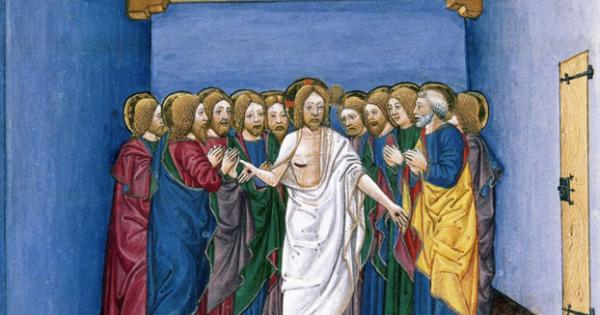
To Believe, or Not (Mark 16:9-18)

The risen Jesus appears to his disciples, by Unknown Italian artist, 1476

[Note: The earliest manuscripts and some other ancient witnesses do not have verses 9–20.]

When Jesus rose early on the first day of the week, he appeared first to Mary Magdalene, out of whom he had driven seven demons. She went and told those who had been with him and who were mourning and weeping. When they heard that Jesus was alive and that she had seen him, they did not believe it.

Afterward Jesus appeared in a different form to two of them while they were walking in the country. These returned and reported it to the rest; but they did not believe them either.

Later Jesus appeared to the Eleven as they were eating; he rebuked them for their lack of faith and their stubborn refusal to believe those who had seen him after he had risen.

He said to them, “Go into all the world and preach the gospel to all creation. Whoever believes and is baptized will be saved, but whoever does not believe will be condemned. And these signs will accompany those who believe: In my name they will drive out demons; they will speak in new tongues; they will pick up snakes with their hands; and when they drink deadly poison, it will not hurt them at all; they will place their hands on sick people, and they will get well.” (New International Version)

The Great Commission, by He Qi

So, how do you view the Bible? Some view it as a direct communication from God to human authors, as if the Lord actually wrote it all, akin to how Moses received the Ten Commandments. Others see the Bible as a thoroughly human invention of literature about God. And then there are those who are somewhere in-between the two views.

Textual criticism is a branch of study that examines a literary work, and aims to establish the original text. This is important and needed, especially since we have all sorts of ancient pieces of literature. We rely upon learned scholars who are fluent in the original languages, and in the examination of texts, so that we can have reliable translations of those texts.

Therefore, textual criticism of the Bible means thinking critically about manuscripts and variations in the biblical texts found in those manuscripts, in order to identify the original reading of the Bible. Keep in mind that, prior to the invention of the printing press, copies of everything had to be hand written. Scribes were trained scholars who meticulously copied manuscripts; and human error was always a part of the process.

The New Testament was copied by thousands of people in thousands of places in dozens of languages. Though that reality can make textual criticism rather complicated, this diversity is also a blessing; it speaks to the high probability that we have a very close and reliable authentic original Bible – namely because so many people were involved in copying scriptural texts.

Today’s lectionary reading is an entire chunk at the end of Mark’s Gospel that is very difficult to ascertain whether it was original to his writing, or not. If you are of the ilk that the Bible is a God-authored book, you will likely want to resolve this tension. And if you’re not, you just might be rolling your eyes at this point, as if this is all silly stuff that doesn’t matter.

I’m suggesting it is neither as silly nor as serious as some want to make it. It just is. And sometimes we must accept what is, without always having to explain it in objective Enlightenment terms; or relegate it to the realm of the ethereal and mystical.

Instead, we can deal with the text we have in front of us without any wringing of the hands, or ignoring it altogether. And what we have, it seems to me, is this: a text of Scripture that is consistent with the rest of Mark’s Gospel in showing us the nature of both belief and unbelief.

An ancient papyrus fragment of Mark’s Gospel

To believe, or not to believe? That is the question.

Throughout the Gospel of Mark, we are confronted with the choice of believing or disbelieving the acts of Jesus in his earthly ministry. And that issue of faith comes to a head with Christ’s resurrection.

The women exhibited belief. They made the pilgrimage to Christ’s tomb and discovered it empty. It is upon the testimony of women – even though a woman’s testimony was not considered reliable in that day – that believers know Christ is risen from death.

The men, however, are nowhere to be found. One reason for unbelief by people who ought to know better is that they go looking for all the wrong sort of evidence. While on this earth, Jesus refused to be like any sort of worldly ruler; he sought to use his authority by being a servant; and he tapped into the power of humility and love.

If we go limiting our epistemology (the study of how we receive knowledge) then we will likely not discover the truth about much of anything. The male disciples refused to believe the testimony of the female Mary Magdalene. The risen Christ finally showed himself and rebuked the stubborn men.

To see Jesus will take something else, something more, than our standard use of three dimensions and five senses and critical thinking skills. As important and needed as they are, it isn’t enough to truly see the risen Lord. We need to bring in some other epistemic impulses: the conscience and the gut; the spirit and the heart; intuition and experience; and the testimony of witnesses whom we would rather dismiss, than listen to.

Jesus ascends to heaven, but not everyone sees it – for obvious reasons. There are some who may search for evidence their entire lives, never to find it, because they want confirmation by means of their own mentally contrived and culturally conditioned constructs.

The Gospel is neither ant-intellectual nor only understood by the scholarly and learned; the good news of Jesus Christ is both simple and complex, easy to understand and hard to comprehend, compelling and revolting. And there is one thing for sure: the person and work of Jesus will always challenge us, change us, and move us.

The story is still being written, not just with pens and keyboards, with textual criticism and documentary evidence, but with mercy and love upon the tablet of the heart.

Lord, I want to believe. Help me in my unbelief! May I see and hear the risen Savior, through the enablement of the Spirit. Amen.

Hallelujah! (Psalm 150)

Psalm 150, by Christie Michael

Hallelujah!

Praise God in his holy place.
Praise him in his mighty heavens.
Praise him for his mighty acts.
Praise him for his immense greatness.
Praise him with sounds from horns.
Praise him with harps and lyres.
Praise him with tambourines and dancing.
Praise him with stringed instruments and flutes.
Praise him with loud cymbals.
Praise him with crashing cymbals.

Let everything that breathes praise the Lord!

Hallelujah! (God’s Word Translation)

The word “hallelujah” is an English transliteration of the Hebrew word, הַלְלוּ יָהּ, which when translated means, “praise Yahweh,” or “praise the Lord.” According to today’s psalm, there is a whole lot of hallelujah that is encouraged for us to do.

There is a time for quiet reflection and contemplation, and there is a time for jubilant shouts of praise. The biblical psalms mirror the full range of human emotion. Having moved through the ups and downs of doubt, curiosity, anger, lament, and trust, it is appropriate that the psalter ends with lots of joyful noise.

I grew up in a generation where children were expected to be quiet in church. Not surprisingly, as a child, I found the church worship service on Sunday to be the most boring hour of my week. After a Saturday of morning cartoons, sugary cereal, All-Star Wrestling, and playing outside in the dirt with my brother, Sunday morning was typically a big letdown.

All I have to say about that, and about cranky old women shushing kids in church, is that the adults somehow forgot to read Psalm 150. Maybe if us big people were better about encouraging our little people to dance in the aisles, blow a kazoo as loud as they can, and freely give a shout to the Lord, then perhaps there would be a lot fewer defections from church worship services.

But don’t think that I’m advocating for everyone to go all out noise, all the time. Just as it is neither necessary nor appropriate to always shout everything you say, and skip everywhere you go, so the worship of God needs to encompass the broad scope of the human condition. Silence, meditation, and stillness have their important place. In a desire to make church fun, some Christians have created imbalanced experiences of only victory in Jesus.

By Marc Chagall, 1977

One of the reasons I follow the Christian Year with its liturgical movements is that it holds and maintains the balance of worship and the theological tension of both crucifixion and resurrection. We need healthy rhythms of sorrow and joy, stillness and movement, quietness and shouting.

The Church is currently in the Christian season of Eastertide. It is a focused time of celebration – which is why we have biblical sections in this time of year like Psalm 150. This is the appropriate time to lift loud praise to God for the risen Christ and celebrate salvation and new life in Jesus.

I’m not really a numbers kind of guy, yet it’s easy to notice the word “praise” occurs 10 times in a psalm of just 6 verses. And 7 musical instruments are mentioned. Methinks we’re supposed to not miss something here.

Praise is to happen in heaven and earth, in all creation, out in the world as well as inside the walls of the church building. It is to be done with voice, dance, drums, horns, woodwinds, and stringed instruments. Because God has done wonderful and marvelous acts throughout the earth, people are to respond with profuse gratitude expressed with lots of emotion.

Just so you know, that means sourpuss Christians who wrongheadedly believe human feelings ought to be stuffed and suppressed, need some remedial theological education about who God is and exactly what he expects from people. Somebody, please dispense the laxative of Psalm 150 to loosen their spiritual constipation!

God gave us our breath, and we are to use it for praise. If we see the entire book of Psalms as a life, then it is fitting the final psalm ends with sanguine praise. Indeed, when a person is at end of life, do they have reason to praise? A life of walking with God through thick and thin will inevitably end with recounting the ways in which the Lord has shown up and delivered. They want musical praise filling their last days and minutes.

That is exactly what Duke Ellington did in the twilight of his life. On January 19, 1968, Ellington performed a concert of sacred music at St. John the Divine cathedral in New York City. Among the original songs he performed and later recorded was his musical interpretation of Psalm 150. He called it “Praise God and Dance.”

Duke Ellington said that this praise music, and the two other albums of sacred music he recorded, were “the most important thing I have ever done.” When Ellington performed “Praise God and Dance” at the ancient Church of Santa Maria del Mar in Barcelona, Spain, the congregation spontaneously burst into the aisles with dancing and singing.

The whole person is to be involved in praise – mind, body, emotions, and spirit – because Yahweh is the God of the whole earth, and not just of the spiritual dimension.

Make a joyful noise to the Lord, all the earth; break forth into joyous song and sing praises. Sing praises to the Lord with the lyre, with the lyre and the sound of melody. With trumpets and the sound of the horn make a joyful noise before the King, the Lord. (Psalm 98:4-6, NRSV)

I will bless you every day. I will praise your name forever and always. The Lord is great and so worthy of praise! God’s greatness can’t be grasped. (Psalm 145:2-3, CEB)

Praise the Lord! My whole being, praise the Lord. I will praise the Lord all my life; I will sing praises to my God as long as I live. (Psalm 146:1-2, NCV)

Shout praises to the Lord! Our God is kind, and it is right and good to sing praises to him. (Psalm 147:1, CEV)

Hallelujah! Amen.

Restoration (Jeremiah 30:1-11a)

This is the word that came to Jeremiah from the Lord: “This is what the Lord, the God of Israel, says: ‘Write in a book all the words I have spoken to you. The days are coming,’ declares the Lord, ‘when I will bring my people Israel and Judah back from captivity and restore them to the land I gave their ancestors to possess,’ says the Lord.”

These are the words the Lord spoke concerning Israel and Judah: 

“This is what the Lord says:

“‘Cries of fear are heard—
    terror, not peace.
Ask and see:
    Can a man bear children?
Then why do I see every strong man
    with his hands on his stomach like a woman in labor,
    every face turned deathly pale?
How awful that day will be!
    No other will be like it.
It will be a time of trouble for Jacob,
    but he will be saved out of it.

“‘In that day,’ declares the Lord Almighty,
    ‘I will break the yoke off their necks
and will tear off their bonds;
    no longer will foreigners enslave them.
Instead, they will serve the Lord their God
    and David their king,
    whom I will raise up for them.

“‘So do not be afraid, Jacob my servant;
    do not be dismayed, Israel,’
declares the Lord.
‘I will surely save you out of a distant place,
    your descendants from the land of their exile.
Jacob will again have peace and security,
    and no one will make him afraid.
I am with you and will save you,’
    declares the Lord.” (New International Version)

The cry of Jeremiah the prophet, by Slovakian artist, 1937

To be restored is a beautiful thing, namely because it presupposes that someone or a group of people were dilapidated and in need of healing. Restoration implies that something was lost, but now is found.

If you have lost things like finances, a home, a car, precious memorial items, a job; or relationships such as a marriage, a friendship, estrangement from family members; or your health to disease or disaster; or even lost your mind or your soul – you can completely understand the longing for restoration and wholeness.

The Jews lost their homeland, their property, their temple, and their dignity to the invading Babylonians. Babylon took everything from Judea. The people became exiled in a strange land. Only some poor folk were left behind in a land that was ravaged.

This was the place that was once referred to as a land of milk and honey, a good home of abundance and blessing. But in the prophet Jeremiah’s day, it was becoming a thing of the past. Would the people ever recover what they had lost? Is restoration even a possibility? Could they learn to hope again?

Into a time of distress and despair, God spoke, and said that yes, it is possible; yes, restoration can and will happen. The people will not be in captivity forever.

Things can get so bad that you become physically sick, emotionally spent, mentally fearful, and spiritually disheartened – as if your life has been ripped from you without mercy and with malice. Yet, what is true of us today is not necessarily going to be true of us tomorrow.

Oppression is a terrible thing. To be constantly harassed by others or by chronic pain or by adverse situations is draining; it sucks the life out of us. Into these sorts of circumstances, God says to us, “I am with you, and I will save you.”

Perhaps tomorrow comes and nothing changes. The pain is still there. The mean-spirited people haven’t gone anywhere. The lost things are not found. And yet, there is something primal and universal which has always been here and shall never go away, no matter the circumstances: God is with us, and God loves us.

If we have the spiritual eyes to see, we will notice that God is alongside us, weeping with us. God knows a thing or two about the sort of suffering and pain that is unimaginable.

“Why does not God do something sooner, if God is so loving and powerful?” you may ask. If you are a parent, you have likely had a child ask you why you are doing something to them that feels awful. You know that emotion of feeling hurt alongside them. You also know that there is sometimes no way you can adequately explain to them what’s going on.

You commit yourself to being there, being present, and assuring the child that you aren’t going anywhere. So, when it comes to us, why is it so hard to understand that God is not a divine Santa or a cosmic Genie granting our every wish? If we want kids to understand, then perhaps we ought to first understand our own relationship as God’s children.

There will be times of trial and tribulation, even divine judgment. Yet there shall also be deliverance from evil, and salvation from sin, death, and hell. The yoke of oppression won’t last because there is the promise of restoration.

No matter how nasty, misguided, or sinful the political leadership and governmental system, none of those rulers or politicians have the last word – God does, not them. Grace has the final say, utilizing a restorative mercy which cannot be undone.

The days are coming when there will be a new future, based in the resolve of God to accomplish it. Fortunes shall be restored. Rehabilitation and renewal are ahead for the faithful. Healing will happen, whether it be in this life, or the next.

Things may seem impossibly hopeless now, but God can and will overrule the present evil machinations of oppressive rulers. Terror may be on every side, yet the Lord will break the bonds of oppression; God will burst the unjust practices. Indeed, God will save.

Therefore, we need not fear, for God is with us; and divine intervention is nearly here.

O God of heavenly powers, by your holy might, be present to us in your goodness and grace; banish all injustice and unrighteousness and restore your people in the strength of faith. Amen.