Trust and Obey (Deuteronomy 32:44-47)

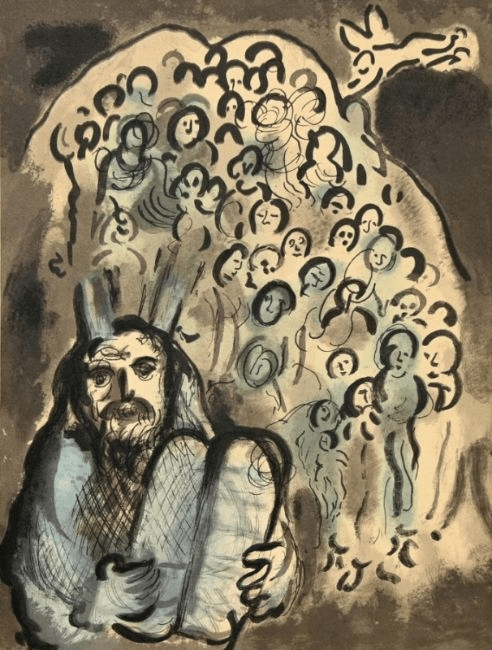
Moses and His People, by Marc Chagall, 1973

Moses and Joshua son of Nun recited this song, so that the people of Israel could hear it.

When Moses had finished giving God’s teachings to the people, he said, “Be sure to obey all these commands that I have given you today. Repeat them to your children, so that they may faithfully obey all of God’s teachings. These teachings are not empty words; they are your very life. Obey them and you will live long in that land across the Jordan that you are about to occupy.” (Good News Translation)

It seems that most people don’t like being told to do anything. There’s a lot of reasons for that. For me, it’s a trust issue. I have a very hard time obeying an authority that I don’t have much faith in.

That’s why I’m just fine submitting myself to God and obeying God’s commands and instructions – because I am firmly convinced that God knows what God is doing; and what’s more, that God has my best interests at mind and at heart.

The ancient Israelites were exhorted by Moses to obey all of God’s teachings because it would be the best way for them to live as a new nation in a new land. The Lord truly wanted what was best for the people, and so, God made sure to give them solid instructions on how to live and thrive together as a nation.

Deuteronomy is the fifth and final book of the Hebrew Torah, and of the Bible’s Pentateuch. The core of the book is a restatement of God’s Law received at Mount Sinai 40 years earlier for the generation about to enter the Promised Land.

The book of Deuteronomy emphasizes God’s love, justice, and transcendence; and stresses the covenant relationship between God and Israel. It looks forward to Israel’s life in the land being established. Foundational to their society, was maintaining God’s social and religious laws.

And those laws were in no way meant to be onerous or oppressive, but were a divine gift to the people. By obeying the Law, the divine/human relationship was secured and the people brought close to God. Foremost to the society was a humanitarianism and concern for the welfare of the poor and disadvantaged.

What’s more, Deuteronomy has a strong intellectual orientation. It urges all Israelites to study God’s laws. There is the expectation that everyone is to be smart and learn how to live wisely.

The participation of Joshua with Moses in teaching he laws was appropriate and important because Joshua was the one who would take over the leadership of Israel and bring them into the Promised Land. The leaders of the people were thoroughly committed to God’s Law – and it was through their wholehearted devotion that they could encourage others to follow them and do the same.

They were to take all of God’s words to heart. The mind, will, and emotions of individuals and families were to be captivated by the standard of God’s divine gift of the law to them. Only in this way would obedience truly become a reality. In other words, it takes complete faith and trust in order to obey.

The way to receive all the blessings of being in the land is through knowing God’s instructions and following them with wholehearted obedience. That means future generations need to be educated about the Law’s stipulations and about the necessity of obeying them with confidence.

Moses made it clear to the people that the divine laws are what life is to be oriented around. God and God’s Law cannot be separated because God’s Law is an expression of God’s very character. For the ancient Israelites, there was no other way.

Many generations later, King David received and learned these laws, understanding the relationship between the Lord and the Law:

The law of the Lord is perfect;
    it gives new strength.
The commands of the Lord are trustworthy,
    giving wisdom to those who lack it.
The laws of the Lord are right,
    and those who obey them are happy.
The commands of the Lord are just
    and give understanding to the mind. (Psalm 19:7-8, GNT)

When it comes to passing on the faith and spiritually forming others, we must have a holistic concern for both what and whom is being taught, as well as how to teach and why we do it. 

For Moses, he was open about expressing the great redemptive acts of God that brought deliverance and vindication to the people. He was convinced that there is no God but the Lord. And he wanted all Israel to know this and to never forget.

All of us, in every generation of believers, are to remember, recite, and rehearse the mighty acts of God, who secured salvation for us. We are responsible to learn, know, and keep the commands of the Lord in our hearts so that we can live into the freedom we possess as believers.

And the Lord has made it known that learning, knowing, remembering, and doing is no trifle thing; rather, this is our very life.

This is one reason why I have devoted myself to the reading, learning, teaching, and living of the Bible. It’s important stuff! And I can testify that living according to the understanding I have of God and Scripture is satisfying, as well as far superior to any other way I have ever tried to live before.

God’s Word must be personally received – no one else can do the work that I myself must do. God’s Word must be faithfully shared and communicated with our children. And God’s Word must be carefully obeyed and observed with head, heart, and hands. This is the responsibility of every believer.

Moses knew that the people could not possibly enjoy life if they deliberately chose to ignore the words given to them in love. I’m glad that, by grace, I know that, too.

Blessed Lord, who caused all Holy Scriptures to be written for our learning: Grant us so to hear them, read, mark, learn, and inwardly digest them, that we may embrace and ever hold fast the blessed hope of everlasting life, which you have given us in our Savior Jesus Christ. Amen.


The Servant of the Lord (Isaiah 42:5-9)

This is what God the Lord says—
the Creator of the heavens, who stretches them out,
    who spreads out the earth with all that springs from it,
    who gives breath to its people,
    and life to those who walk on it:
“I, the Lord, have called you in righteousness;
    I will take hold of your hand.
I will keep you and will make you
    to be a covenant for the people
    and a light for the Gentiles,
to open eyes that are blind,
    to free captives from prison
    and to release from the dungeon those who sit in darkness.

“I am the Lord; that is my name!
    I will not yield my glory to another
    or my praise to idols.
See, the former things have taken place,
    and new things I declare;
before they spring into being
    I announce them to you.” (New International Version)

For those who serve the God of Scripture, there is work to be done.

According to Scripture, people are created in the image and likeness of God (Genesis 1:26-27). As the only creatures on earth with the divine stamp of God’s image, humanity’s purpose is to reflect and work toward that which characterizes God:

  • Be holy because God is holy. That is, set apart your life for good and right purposes, and not for ill. Devote yourself to being above board in everything, and work for the common good of all persons.
  • Love one another as God has loved you. Since the Lord demonstrated a sacrificial and unconditional love toward you, so do the same for others. Love God. Love your neighbor.
  • Do justice because God is just. God is concerned that everyone on planet earth has what they need – both physically and spiritually – to live and thrive in this world. Ensure that people’s needs are met, without any prejudice or favoritism.

The servant of God has a mandate to be a covenant and light for people. Since God makes and keeps promises to people; and since the Lord is light without any darkness, so God’s servant is to embrace and embody a steadfast commitment to continually doing good.

We are meant to be a blessing to people on this earth – and not a curse. (Galatians 3:8)

I don’t have much stomach for fellow believers who think they are responsible to let people know how sinful they really are. Such supposed messengers end up puking the “good news” on others, often leaving people in such a bad state that they want nothing to do with religion.

Any sort of forceful verbiage, or manipulative gaslighting of others, does not in any way reflect the God whom I serve; I view such underhanded methods as inconsistent with Scripture. Besides, the Lord certainly doesn’t need any of us, as if God is dependent on people’s gospel witness.

Instead, the Lord graciously cuts us in on the benevolent and gracious divine action that is being accomplished in the world. That God allows me to be a mouthpiece is a privilege and a responsibility. So, I will steward that trust well by using words that build up and encourage, without verbally accosting another in the name of serving God.

In the ancient world, the poor often found themselves in prison through the inability to pay off a debt. Part of the servant’s work is to cancel debt, thus providing freedom and a further means to work and support family. For the Christian, this is an elementary part of our prayers:

And forgive us our debts, as we also have forgiven our debtors. (Matthew 6:12, NIV)

Those words of Jesus are meant to uphold the ethical teachings of the Law:

At the end of every seven years you must cancel debts… There need be no poor people among you, for in the land the Lord your God is giving you to possess as your inheritance, he will richly bless you, if only you fully obey the Lord your God and are careful to follow all these commands I am giving you today. For the Lord your God will bless you as he has promised, and you will lend to many nations but will borrow from none. You will rule over many nations but none will rule over you.

If anyone is poor among your fellow Israelites in any of the towns of the land the Lord your God is giving you, do not be hardhearted or tightfisted toward them. Rather, be openhanded and freely lend them whatever they need. (Deuteronomy 15:1, 4-8, NIV)

Holiness, love, and justice are done by paying attention to the neediest of persons around us. The Lord’s servant can bring light because God is against the darkness. And the reason debts are cancelled (both real economic and spiritual forgiveness) is so that the monetary poor, and the poor in spirit, are liberated.

God is attentive to the vulnerable and needy; it is the Lord’s will that no one lives under the oppression of debilitating debt.

The work of the humble servant brings dignity, honor, and respect to human beings, thus honoring God and showing to the world what sort of God the Lord is – a gracious and merciful God who has a zeal for justice and for right relations in society. The Servant of the Lord, the ultimate Servant, is described in this way by the prophet:

Of the greatness of his government and peace there will be no end. He will reign on David’s throne and over his kingdom, establishing and upholding it with justice and righteousness from that time on and forever. The zeal of the Lord Almighty will accomplish this. (Isaiah 9:7, NIV)

Our Father in heaven,
hallowed be your name.
Your kingdom come,
your will be done,
    on earth as it is in heaven.
Give us this day our daily bread,
and forgive us our debts,
    as we also have forgiven our debtors.
And lead us not into temptation,
    but deliver us from evil. Amen.

God Has No Favorites (Acts 10:1-34)

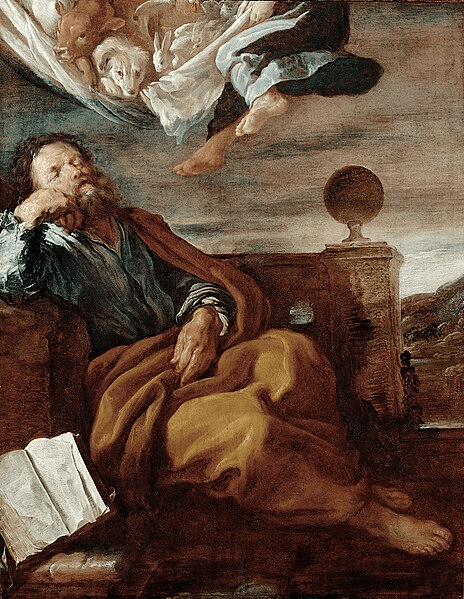
Peter’s Vision, by Domenico Fetti, c.1619

At Caesarea there was a man named Cornelius, a centurion in what was known as the Italian Regiment. He and all his family were devout and God-fearing; he gave generously to those in need and prayed to God regularly. One day at about three in the afternoon he had a vision. He distinctly saw an angel of God, who came to him and said, “Cornelius!”

Cornelius stared at him in fear. “What is it, Lord?” he asked.

The angel answered, “Your prayers and gifts to the poor have come up as a memorial offering before God. Now send men to Joppa to bring back a man named Simon who is called Peter. He is staying with Simon the tanner, whose house is by the sea.”

When the angel who spoke to him had gone, Cornelius called two of his servants and a devout soldier who was one of his attendants. He told them everything that had happened and sent them to Joppa.

About noon the following day as they were on their journey and approaching the city, Peter went up on the roof to pray. He became hungry and wanted something to eat, and while the meal was being prepared, he fell into a trance. He saw heaven opened and something like a large sheet being let down to earth by its four corners. It contained all kinds of four-footed animals, as well as reptiles and birds. Then a voice told him, “Get up, Peter. Kill and eat.”

“Surely not, Lord!” Peter replied. “I have never eaten anything impure or unclean.”

The voice spoke to him a second time, “Do not call anything impure that God has made clean.”

This happened three times, and immediately the sheet was taken back to heaven.

While Peter was wondering about the meaning of the vision, the men sent by Cornelius found out where Simon’s house was and stopped at the gate. They called out, asking if Simon, who was known as Peter, was staying there.

While Peter was still thinking about the vision, the Spirit said to him, “Simon, three men are looking for you. So get up and go downstairs. Do not hesitate to go with them, for I have sent them.”

Peter went down and said to the men, “I’m the one you’re looking for. Why have you come?”

The men replied, “We have come from Cornelius the centurion. He is a righteous and God-fearing man, who is respected by all the Jewish people. A holy angel told him to ask you to come to his house so that he could hear what you have to say.” Then Peter invited the men into the house to be his guests.

The next day Peter started out with them, and some of the believers from Joppa went along. The following day he arrived in Caesarea. Cornelius was expecting them and had called together his relatives and close friends. As Peter entered the house, Cornelius met him and fell at his feet in reverence. But Peter made him get up. “Stand up,” he said, “I am only a man myself.”

While talking with him, Peter went inside and found a large gathering of people. He said to them: “You are well aware that it is against our law for a Jew to associate with or visit a Gentile. But God has shown me that I should not call anyone impure or unclean. So when I was sent for, I came without raising any objection. May I ask why you sent for me?”

Cornelius answered: “Three days ago I was in my house praying at this hour, at three in the afternoon. Suddenly a man in shining clothes stood before me and said, ‘Cornelius, God has heard your prayer and remembered your gifts to the poor. Send to Joppa for Simon who is called Peter. He is a guest in the home of Simon the tanner, who lives by the sea.’ So I sent for you immediately, and it was good of you to come. Now we are all here in the presence of God to listen to everything the Lord has commanded you to tell us.”

Then Peter began to speak: “I now realize how true it is that God does not show favoritism…”

Peter’s Vision, by Doug Jaques

In this binary world of either/or, there are either good guys or bad guys, protagonists or antagonists, nice folk or jerks, Christians or non-Christians, etc.

Because this story is tied to its own cultural context, its punchline may not have the intended effect. Perhaps the story needs to be heard in a contemporary setting…

There was a man named “Dem.” He lived in New York, and was head of a labor union there. Dem did right by the people he represented. He always found ways to help those in need; led his family to worship God; and prayed faithfully every day.

One day, at about 3:00pm, during his time of prayer, he had a vision. An angelic messenger of God, as real as his next-door neighbor, came in and said, “Dem.”

Dem stared hard, wondering if he was seeing things. Then he said, “What do you want?” The angelic messenger said, “Your prayers and good works at your workplace and in your neighborhood have gotten God’s attention. So, here’s what you are to do: Send some people to Washington to get the one everyone calls ‘Pastor Pub.’ He’s staying with Perry the Politician whose house is down by the ocean.”

As soon as the angelic messenger was gone, Dem called two employees and one devout worker from the union. He went over with them in great detail everything he just experienced, and sent them off to Washington.

The next day, as the three travelers were approaching the city, Pastor Pub went out on the patio to pray. It was about noon. He got hungry and started thinking about lunch. While his food was being prepared, Pastor Pub fell into a trance.

He saw the skies open up. Something that looked like a huge blanket lowered by ropes at its four corners settled on the ground. Every kind of person – ethnicity, race, and gender – was on it. Then a voice came: “Go, Pastor Pub – baptize, marry, and bury.”

Pastor Pub exclaimed, “Oh, no, Lord. I’ve never so much as gotten close to non-Christians, let alone baptize, marry, or bury just anyone! It’s not holy!”

The voice came a second time: “If God says it’s okay, it’s okay.”

This happened three times, and then the blanket was pulled back up into the skies.

Peter’s Vision, by Edward Knippers

As Pastor Pub sat there puzzled, trying to figure out what it all meant, the people sent by Dem showed up at Perry’s front door. When the butler answered the door bell, they asked if there was a person known as Pastor Pub there.

Pastor Pub, on the back patio, didn’t hear them. So, the Spirit whispered to him, “Three people are at the door looking for you. Get up and go with them. Don’t ask any questions. I sent them to get you.”

Pastor Pub went to the front door and said, “I think I’m the guy you’re looking for. What in the world is going on?”

They said, “Dem is a God-fearing person, well-known for his just and right ways. Ask any politician in this city! He was commanded by an angelic messenger to get you and bring you to his house, so he could hear what you have to say.” Pastor Pub invited them in and was hospitable.

The next morning he got up and went with them. Some of his friends from Washington went along. Arriving in New York, Dem was expecting them; his close friends and relatives, and some workers, were waiting with him.

The minute Pastor Pub came through the door, Dem was up on his feet greeting him – and then down on his knees thanking him profusely. But Pastor Pub pulled him up saying, “There’s no need for that. I’m just a person no different than you.”

Talking things over, they went into the house, where Dem introduced Pastor Pub to everyone. Pastor Pub addressed them, “I’m sure that this is a highly irregular meeting. After all, Republicans, straight people, and anti-abortionists don’t do this sort of thing – visit and relax with Democrats, LGBTQ+ folk, and abortionists.

But God has shown me that no political party, gender, or issue is better than any other. So, the minute I was sent for, I came, no questions asked. But now I’d like to know why you sent for me.”

Dem said, “A few days ago at about this time, midafternoon, I was home praying. Suddenly there was a man right in front of me, flooding the room with light. He said, ‘Dem, your daily prayers and benevolent work have brought you to God’s attention. I want you to send to Washington to get the one they call Pastor Pub. He’s staying with Perry the Politician down by the ocean.’ So, I did it – I sent for you. And you have been good enough to come. Now we are all here in God’s presence, ready to listen to whatever the Lord put in your heart to tell us.”

At that point, the good news came exploding out of Pastor Pub: “It’s God’s own truth, and nothing could be plainer than this: God has no favorites!”

My friends, it is high time we set aside our sinful prejudice toward others. Far too many of us believe and claim that our positions on issues and ideas about how things ought to go are gospel truth – not to mention our ungodly discrimination against another race, ethnicity, and gender.

If it is judgment you want, then that judgment must begin with your own house, and specifically with you yourself…

I Am Coming to You (John 14:18-31)

Upper Room, by Gail Meyer

“I will not leave you orphaned; I am coming to you. In a little while the world will no longer see me, but you will see me; because I live, you also will live. On that day you will know that I am in my Father, and you in me, and I in you. They who have my commandments and keep them are those who love me, and those who love me will be loved by my Father, and I will love them and reveal myself to them.” 

Judas (not Iscariot) said to him, “Lord, how is it that you will reveal yourself to us and not to the world?” Jesus answered him, “Those who love me will keep my word, and my Father will love them, and we will come to them and make our home with them. Whoever does not love me does not keep my words, and the word that you hear is not mine but is from the Father who sent me.

“I have said these things to you while I am still with you. But the Advocate, the Holy Spirit, whom the Father will send in my name, will teach you everything and remind you of all that I have said to you. Peace I leave with you; my peace I give to you. I do not give to you as the world gives. Do not let your hearts be troubled, and do not let them be afraid. You heard me say to you, ‘I am going away, and I am coming to you.’

“If you loved me, you would rejoice that I am going to the Father, because the Father is greater than I. And now I have told you this before it occurs, so that when it does occur you may believe. I will no longer talk much with you, for the ruler of this world is coming. He has no power over me, but I do as the Father has commanded me, so that the world may know that I love the Father. Rise, let us be on our way.” (New Revised Standard Version)

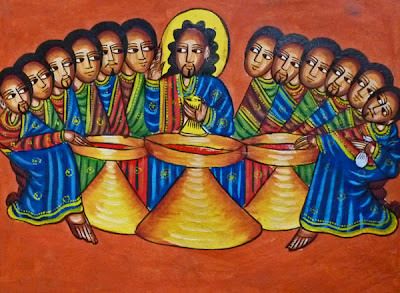
Ethiopian Orthodox Church depiction of the Last Supper in the Upper Room

“He’s leaving!? What!? Huh!?” Although Jesus had tried to prepare the disciples for his impending cross and resurrection, they didn’t quite catch on. It was in the Upper Room, in their final meal together, that Jesus made it plain he was leaving and going back to the Father. (John 14:1-17)

There was both confusion and distress amongst the men. Anticipatory grief had suddenly smacked them like a golf club upside the head. Dizzied and dazed with thoughts that their Lord would no longer be with them, Jesus sought to assure them that this would be temporary.

Christ is coming, again. In fact, three comings are to be realized:

  • Rising from death and appearing to the disciples
  • Sending the Spirit as the continuing presence of Christ on earth
  • Returning at the end of the age to judge the living and the dead

Jesus was caring for his followers, including us, by providing future hope.

That is just what happened with the first two comings. Christians everywhere celebrate the rising of Christ from death, his ascension into heaven, and the giving of the Holy Spirit at Pentecost. The Christian tradition holds that the Spirit – the Paraclete, Advocate, Comforter, and Counselor – is now presently with us.

Although the world no longer sees Jesus, believers see him with eyes of faith, hope, and love. Christians intuitively perceive another spiritual dimension in which Christ is beside them in the person of God’s Spirit. Some things can’t be intellectually explained. They just are.

Meanwhile, while Christians everywhere await the return of Christ to this earth, they are busy loving their Lord through obedience to his commands. And his command is to love one another as he demonstrated his love for them. Love and obedience go hand in hand. To know the love of God in Christ is to willingly give oneself to obey the merciful Lord.

We are not left alone to fumble around on this earth, trying to love in our own strength or ability. The Spirit is present, helping us to do loving work. There is real spiritual assistance in applying Christ’s teaching to the practical aspects of life in the here-and-now. Such constructive down-to-earth support gives Christians a sense of peace and integrity of living.

Worldly peace, which typically uses war to try and end war, has merely the absence of conflict as its goal. However, the peace of Christ is intensely personal and has the goal of unity, harmony, and love. It is his very own peace. Through Christ’s suffering and death, he absorbed in himself the malice and hatred of others and introduced a true and settled peace.

The profound absence of love, the rebellion of humanity against concern for the common good of all, and the shame of selfishness that damns the world, is overthrown by the obedience and self-sacrifice of Jesus. The world will learn this – either by discovering the love of Christ now or, at the end of the age, with the return of Christ.

Jesus came in the past through the incarnation and resurrection. Jesus is presently here in the person of the Holy Spirit. Jesus will come again in the future to judge the living and the dead.

These comings are for us and for our deliverance from all that is unjust and broken in this world. We are not alone. There is ever-present help. This is the basis of the Christian’s confidence.

Come, Holy Spirit, and fill the hearts of your faithful with divine love. Come as the wind that blows, come as the fire that refines, come as the dew that refreshes. Convict, convert and consecrate us until we are wholly yours, through Jesus Christ, our Lord. Amen.