Return to the Lord (1 Samuel 7:3-15)

Samuel prays to the Lord on behalf of the people, by Bible Art

So Samuel said to all the Israelites, “If you are returning to the Lord with all your hearts, then rid yourselves of the foreign gods and the Ashtoreths and commit yourselves to the Lord and serve him only, and he will deliver you out of the hand of the Philistines.” So the Israelites put away their Baals and Ashtoreths, and served the Lord only.

Then Samuel said, “Assemble all Israel at Mizpah, and I will intercede with the Lord for you.” When they had assembled at Mizpah, they drew water and poured it out before the Lord. On that day they fasted and there they confessed, “We have sinned against the Lord.” Now Samuel was serving as leader of Israel at Mizpah.

When the Philistines heard that Israel had assembled at Mizpah, the rulers of the Philistines came up to attack them. When the Israelites heard of it, they were afraid, because of the Philistines. They said to Samuel, “Do not stop crying out to the Lord our God for us, that he may rescue us from the hand of the Philistines.” Then Samuel took a suckling lamb and sacrificed it as a whole burnt offering to the Lord. He cried out to the Lord on Israel’s behalf, and the Lord answered him.

While Samuel was sacrificing the burnt offering, the Philistines drew near to engage Israel in battle. But that day the Lord thundered with loud thunder against the Philistines and threw them into such a panic that they were routed before the Israelites. The men of Israel rushed out of Mizpah and pursued the Philistines, slaughtering them along the way to a point below Beth Kar.

Then Samuel took a stone and set it up between Mizpah and Shen. He named it Ebenezer, saying, “Thus far the Lord has helped us.”

So the Philistines were subdued and they stopped invading Israel’s territory. Throughout Samuel’s lifetime, the hand of the Lord was against the Philistines. The towns from Ekron to Gath that the Philistines had captured from Israel were restored to Israel, and Israel delivered the neighboring territory from the hands of the Philistines. And there was peace between Israel and the Amorites.

Samuel continued as Israel’s leader all the days of his life. (New International Version)

Faithfulness to God matters. One cannot worship the Lord by day, then have a moonlighting job with other gods.

The priest and prophet Samuel helped lead Israel to repentance, and thus, a restoration of right relationship with their God. His leadership made all the difference. Samuel was not like the previous priests of Eli and his sons; nor was he like anyone else who didn’t really know what they were doing.

Samuel performed the appropriate sacrifices correctly; interceded with God on behalf of the people; enabled them to achieve victory; and continually and carefully watched over everything. Samuel was a needed stabilizing force in Israel. He identified sin in the nation and dealt with it wisely. Samuel led them to do right.

I confess my iniquity; I am troubled by my sin.

Psalm 38:18, NIV

Godly sorrow brings repentance that leads to salvation and leaves no regret, but worldly sorrow brings death. (2 Corinthians 7:10, NIV)

Come near to God and he will come near to you. Wash your hands, you sinners, and purify your hearts, you double-minded. Grieve, mourn and wail. Change your laughter to mourning and your joy to gloom. Humble yourselves before the Lord, and he will lift you up. (James 4:8-10, NIV)

Today’s Old Testament lesson brings up important questions of acknowledging disobedience, ignorance, and guilt; and how we are to respond to it.

Whenever we say or do something that we ought not to, it’s like squeezing a big tube of toothpaste out; there’s no way you can get it back in.

I actually did that once when I was a little kid. I saw new tube of toothpaste in the bathroom and wondered what it would be like to squeeze out a big amount. So, I did. It was fun. I did it again, then again and again, until it was all gone.

Knowing that perhaps this toothpaste thing might be a problem, I made an artwork out of it. After I was done, I turned off the light, shut the door, and in my little four-year-old brain, hoped nobody would see it. But oh my, they did!

As we get older, and into adulthood, we discover that we have a capacity to do a lot worse than toothpaste escapades. When we sin, there’s no way to put everything back the way it was before. Everything has changed because of our actions (or inactions). And we cannot make it look better, or put a positive spin on it.

There needs to be repentance – a confession of sin, a coming to God, and letting grace and forgiveness have its way. This is the path to restoration in returning to God, in bringing relational connections together again.

Repentance means that we tell God what we did; and that we’re sad about it. Instead of running away, we run to God and admit our guilt. This, by no means, is easy; but it’s the only way to take care of the problem and to feel better about it. And the Lord won’t make us feel worse, but will help us, no matter what.

Everybody is sad when they are caught doing something bad. But there is a good kind of sad, and a bad kind of sad. The bad kind of sad thinks to self, “I’m so stupid; I can’t do anything right,” and punishes myself for the wrong. On the other hand, the good kind of sad helps us realize that we never want to do that thing ever again; and we look to Jesus to forgive us and be our example of what to do right.

Good leaders, like Samuel, assist us in this process with grace, sensitivity, humility, respect, and a forthright spirit.

Most merciful God, we confess that we have sinned against you in thought, word, and deed, by what we have done, and by what we have left undone. We have not loved you with our whole heart; we have not loved our neighbors as ourselves. We are truly sorry and we humbly repent. For the sake of your Son Jesus Christ, have mercy on us and forgive us; that we may delight in your will, and walk in your ways, to the glory of your Name. Amen.

Misunderstanding Jesus (Mark 3:20-35)

By Jorge Cocco Santángelo

Then he went home, and the crowd came together again, so that they could not even eat. When his family heard it, they went out to restrain him, for people were saying, “He has gone out of his mind.” And the scribes who came down from Jerusalem said, “He has Beelzebul, and by the ruler of the demons he casts out demons.” 

And he called them to him and spoke to them in parables, “How can Satan cast out Satan? If a kingdom is divided against itself, that kingdom cannot stand. And if a house is divided against itself, that house will not be able to stand. And if Satan has risen up against himself and is divided, he cannot stand, but his end has come. But no one can enter a strong man’s house and plunder his property without first tying up the strong man; then indeed the house can be plundered.

“Truly I tell you, people will be forgiven for their sins and whatever blasphemies they utter, but whoever blasphemes against the Holy Spirit can never have forgiveness but is guilty of an eternal sin”—for they had said, “He has an unclean spirit.”

Then his mother and his brothers came, and standing outside they sent to him and called him. A crowd was sitting around him, and they said to him, “Your mother and your brothers are outside asking for you.” And he replied, “Who are my mother and my brothers?” And looking at those who sat around him, he said, “Here are my mother and my brothers! Whoever does the will of God is my brother and sister and mother.” (New Revised Standard Version)

Who exactly is Jesus? That’s a question which has been bantered around by people for the past two millennia. I suppose that is to be expected, since people contemporary to Christ misunderstood him, including his own family.

There were a couple of related charges against Jesus by the religious authorities of his day: he has a demon; and by the prince of demons he casts out demons. There was also a charge against Jesus from members of his family: he is out of his mind. All the accusations and misinterpretations were in response to the crowds Jesus was attracting.

Sometimes one’s own relatives will think one is crazy, just for doing God’s will. Yet, the good news is that the misunderstood and the misinterpreted folks can find a family within Christian community. Jesus stated that his family are not those who are related by blood, but those who share his purpose of doing the will of God.

Jesus teaching, by James Tissot (1836-1902)

When it came to the religious leaders accusations, they were essentially saying that Jesus was using dark magic and not God’s power. They thought of Jesus as having gained control of certain spirits to do his bidding, as if he were casting spells on people and making them do what he wanted.

Yet, it is illogical, as Christ pointed out, that Satan would cast out his own demons, thus undermining his own sinister work. It’s much more logical to discern Christ’s work as the power of God and the work of the Holy Spirit. To miss this completely, and accuse otherwise, is to commit an unpardonable sin.

The controversy and charges in this story are about who is truly in and who is really out. Because, in reality, the insiders are out and the outsiders are in. And it isn’t so clear cut as everyone seems to think.

Jesus was drawing in the crowd of people, while family members were becoming outsiders. Those on the inside are given insight and understanding about God’s kingdom, whereas those on the outside are scratching their heads, not knowing what Jesus is doing or talking about.

Since the family was mystified by their own relative, they misinterpreted Jesus as being off his rocker. And since the religious leaders were clueless to the parables and actions of Jesus, they misunderstood the source of his power as demonic.

To mistake the work and power of the Holy Spirit as satanic is to be guilty of an unforgivable sin, simply because the ones mistaking, misunderstanding, and misinterpreting never see a need for repentance and forgiveness. They believe they’re okay, and that Jesus is not.

You cannot be forgiven if you always think you’re right.

The bottom line for both the family and the religious leaders is that Jesus didn’t meet their expectations and act as they all think he should; so they make completely misguided conclusions about him.

But, in truth, all they’re actually doing is projecting their own stuff onto Jesus. The family is out of their mind for not recognizing who is actually in front of their face. And the religious authorities blasphemed God by saying hard things about the Lord of life, of whom they were observing.

If that’s how others are going to treat Jesus, then they’re going to be on the outside of God’s kingdom. It’s their own fault, because of their own chosen lack of awareness, and their refusal to take a good hard look at who Jesus is.

For myself, I want to investigate Jesus so closely that I’m like the crowd pressing in to see him and touch the hem of his garment – believing that my desperate desire can be fully met in him. And I want the continued assurance that I am claimed by Christ as his brother.

I am grateful that I no longer have to be an outsider looking in; but instead have become a keeper of kingdom truth because I am drawn into the mystery of God’s love in Jesus Christ through the enablement of the Holy Spirit. To which I say with flavor, “amen” and “amen.”

It’s a Bad Idea to Try and Handle God (1 Samuel 6:1-18)

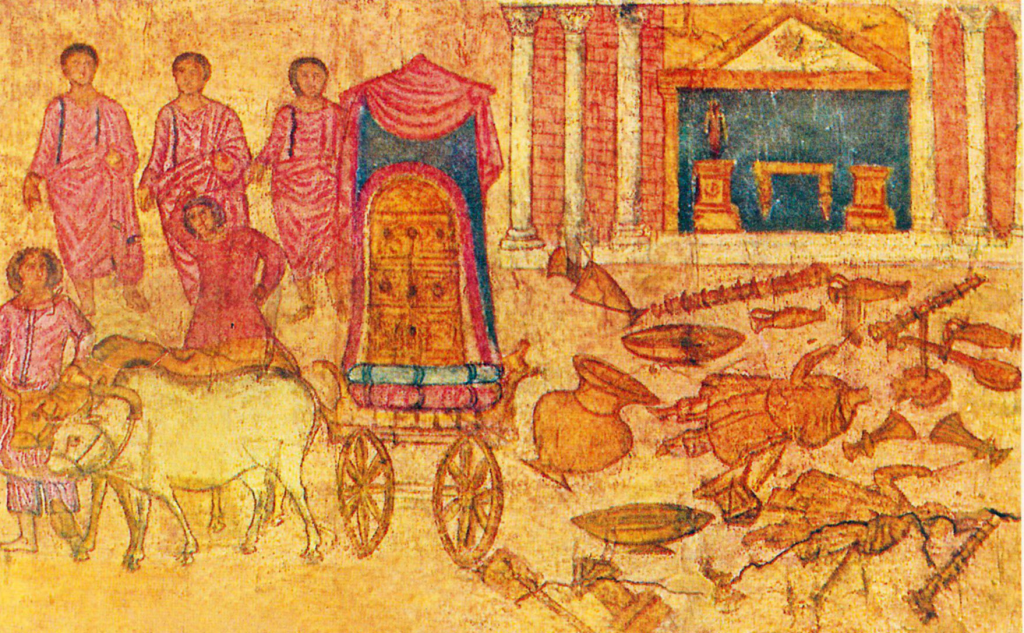
A fresco of the Philistine captivity of the Ark of God, from the ancient Dura-Europos Synagogue, excavated in 1932

The Ark of the Lord remained in Philistine territory seven months in all. Then the Philistines called in their priests and diviners and asked them, “What should we do about the Ark of the Lord? Tell us how to return it to its own country.”

“Send the Ark of the God of Israel back with a gift,” they were told. “Send a guilt offering so the plague will stop. Then, if you are healed, you will know it was his hand that caused the plague.”

“What sort of guilt offering should we send?” they asked.

And they were told, “Since the plague has struck both you and your five rulers, make five gold tumors and five gold rats, just like those that have ravaged your land. Make these things to show honor to the God of Israel. Perhaps then he will stop afflicting you, your gods, and your land. Don’t be stubborn and rebellious as Pharaoh and the Egyptians were. By the time God was finished with them, they were eager to let Israel go.

“Now build a new cart, and find two cows that have just given birth to calves. Make sure the cows have never been yoked to a cart. Hitch the cows to the cart, but shut their calves away from them in a pen. Put the Ark of the Lord on the cart, and beside it place a chest containing the gold rats and gold tumors you are sending as a guilt offering. Then let the cows go wherever they want. If they cross the border of our land and go to Beth-shemesh, we will know it was the Lord who brought this great disaster upon us. If they don’t, we will know it was not his hand that caused the plague. It came simply by chance.”

So these instructions were carried out. Two cows were hitched to the cart, and their newborn calves were shut up in a pen. Then the Ark of the Lord and the chest containing the gold rats and gold tumors were placed on the cart. And sure enough, without veering off in other directions, the cows went straight along the road toward Beth-shemesh, lowing as they went. The Philistine rulers followed them as far as the border of Beth-shemesh.

The people of Beth-shemesh were harvesting wheat in the valley, and when they saw the Ark, they were overjoyed! The cart came into the field of a man named Joshua and stopped beside a large rock. So the people broke up the wood of the cart for a fire and killed the cows and sacrificed them to the Lord as a burnt offering. 

Several men of the tribe of Levi lifted the Ark of the Lord and the chest containing the gold rats and gold tumors from the cart and placed them on the large rock. Many sacrifices and burnt offerings were offered to the Lord that day by the people of Beth-shemesh. The five Philistine rulers watched all this and then returned to Ekron that same day.

The five gold tumors sent by the Philistines as a guilt offering to the Lord were gifts from the rulers of Ashdod, Gaza, Ashkelon, Gath, and Ekron. The five gold rats represented the five Philistine towns and their surrounding villages, which were controlled by the five rulers. The large rock at Beth-shemesh, where they set the Ark of the Lord, still stands in the field of Joshua as a witness to what happened there. (New Living Translation)

The Ark Sent Away from the Philistines, by James Tissot, 1902

Out of all the stories in the Bible, this is one of them. The Philistines and the Israelites were fighting military battles. The Israelites did not do so well. Therefore, they decided to bring up the Ark of the Covenant of God (the symbol of God’s presence) to the front lines in order to win the battle.

The plan backfired. Israel lost, and the Ark of God (think Raiders of the Lost Ark, and not Noah’s ark) was taken by the Philistines. However, the five cities of Philistia likely regretted ever doing this. Wherever the Ark was, the people were plagued with nasty tumors, so that they suffered grievously. And that’s when the Philistines decided to hatch their own plan for ridding themselves of the Ark, while preserving their cities.

For three chapters (1 Samuel 4-6) we get various humans who made plans for the Ark of the Covenant. Since the Ark is a symbol of God’s presence, engaging in these plans is akin to deciding how things are going to go with God.

Humanity doesn’t get to flip-flop who is in control, God as sovereign over humanity to humanity manipulating God for their own purposes. Trying to leverage the Lord into what we want is a bit like believing we can make the sun spin around the earth. In other words, it’s not going to happen, no matter how much effort and ingenuity you put into it.

It’s a bad idea to try and handle God, instead of letting God handle us.

At least the Philistines quickly figured out it was a fool’s errand in possessing God’s Ark. And they had enough sense to consult somebody before they acted in getting the Ark away. Eventually, we’re all going to either humble ourselves, or just get humiliated; it’s our choice.

Yes, it seems like a weird plan – making gold objects in the shape of tumors – and yet the Lord often cares much more about the humility behind a plan than the actual plan itself. Despite being worshipers of pagan gods, God was picking up what the Philistines were putting down, and graciously received the Ark back into Israel.

Turn anywhere in Holy Scripture, begin reading, and you will quickly find that God will not tolerate any person or group of people trying to use, leverage, or manipulate heaven for it’s own purposes. The Lord has made it clear what is important; it’s up to us to live into it.

Holy and almighty God, help us to walk humbly with You and one another. Let your holy Spirit guide us on the right path to truth and reconciliation with humility. Help us to hear each other, for we do not want to walk by pride or self-sufficiency. Amen.

Temporary vs. Permanent (2 Corinthians 5:1-5)

For we know that if the earthly tent we live in is destroyed, we have a building from God, an eternal house in heaven, not built by human hands. Meanwhile we groan, longing to be clothed instead with our heavenly dwelling, because when we are clothed, we will not be found naked. For while we are in this tent, we groan and are burdened, because we do not wish to be unclothed but to be clothed instead with our heavenly dwelling, so that what is mortal may be swallowed up by life. Now the one who has fashioned us for this very purpose is God, who has given us the Spirit as a deposit, guaranteeing what is to come. (New International Version)

Back in the day, when my kids were small, we did our fair share of camping. We had a large two room tent that we called “The Tabernacle.” But even that large tent could not compare to finally getting back home to our house.

We are all on something of a perpetual spiritual camping trip. It may or may not feel like one, but every person is living in a tent. 

One of the challenges of the biblical writers is that they worked to communicate hope and spiritual realities in concrete language. They often made use of metaphors to help us understand. So, when the Apostle Paul likens our current lives to being in a tent, he means that what we are experiencing now with our bodies is temporary. 

Compared to the permanent resurrected body that will be coming in the future, our existence now in this present life, in this body, is not very glorious.

We consider someone homeless if they live in a tent on a permanent basis. In many ways, the Christian is homeless; we are not completely at home in this present body, nor in this present world. So, it seems rather curious to me that many believers in Jesus can be ruthlessly attached to the trappings and stuff of this contemporary campground.

If we were to make a list of all the things we do and all the things we have that are extra-biblical, that is, not specifically mentioned in the Bible, it would not take long to discover that much of what we do on a day to day basis – not to mention religiously and through church ministry – is rather quite temporary. Yet, too many persons cling to their stuff and their ways as if all of it will endure forever.

In those times when we experience bereavement; in the situations that demonstrate that we are mortal; and, in the circumstances that occur in which we glimpse how fleeting this present life can be, we begin to understand that what we need to be living for is the permanence of relationships expressed through the ever-present Spirit of God. 

It is good for us to long for a better day when we will no longer groan in the tent of this body so that we will connect with the unseen God who goes before us, with us, after us.

Camping can be both fun and challenging. But if we had to make an actual tent our real home, I can easily imagine how much groaning would happen every day. We would certainly long for a more established residence. Paul gets at this exasperation, which a temporal finite existence can be, when writing to the Roman Christians:

We know that the whole creation has been groaning as in the pains of childbirth right up to the present time. Not only so, but we ourselves, who have the first-fruits of the Spirit, groan inwardly as we wait eagerly for our adoption to sonship, the redemption of our bodies. (Romans 8:22-23, NIV)

Because we have the Spirit, we have help. The Spirit is our advocate. Sometimes, because of our situation, our prayers to God only come out as groans; words can seem far away from us. Yet, that is enough. The Spirit speaks groaning, and knows how to interpret it.

The Spirit helps us in our weakness. We do not know what we ought to pray for, but the Spirit himself intercedes for us through wordless groans. And he who searches our hearts knows the mind of the Spirit, because the Spirit intercedes for God’s people in accordance with the will of God. (Romans 8:26-27, NIV)

God has our back. We may not know what exactly we are going through, and why we are going through it, much less how to even pray about it. But the one thing we do know is that God works for the good of those who love him, who have been called according to his purpose. (Romans 8:28)

With the Spirit alongside us, there is the continual assurance and reassurance that we belong to God. Our present existence may be temporary, but the presence and love of God are permanent and will never change.

For I am convinced that neither death nor life, neither angels nor demons, neither the present nor the future, nor any powers, neither height nor depth, nor anything else in all creation, will be able to separate us from the love of God that is in Christ Jesus our Lord. (Romans 8:38-39, NIV)

Our present circumstances will eventually pass; they are temporary. But the love of God has staying power; it is permanent and forever. Our bodies are always changing; someday we will die. Yet, because of Christ’s resurrection, believers shall be raised with a body fit for eternity. Our tent will be fashioned into a house.

Eternal God, who always has been and always will be, help me to so connect with your Holy Spirit that I can discern the difference between what is temporary and what is permanent. Guide me with your holy hand so that I can place my present efforts into the things that will make a difference for eternity, through Jesus Christ my Lord. Amen.