Welcome, friends! On this Transfiguration Sunday for Christians everywhere around the world, let us celebrate the good changes which come from our Lord Jesus Christ, who is our ultimate Deliverer and Revivalist to new hope and new life. Click the videos below to worship Christ and listen to Jesus…
Mark 9:2-9, Pastor Tim Ehrhardt
“Transfiguration” by Hillsong Worship. From the album “Open Heaven / River Wild”. Written by Scott Ligertwood, Aodhan King, Brooke Ligertwood, and Taya Smith. Worship leader is Taya Smith.
Not all is as it seems. There is glory hidden in everything, waiting to be revealed to the eyes of those who believe, beyond what seems inevitable, who do not want to live in the status quo but in the promises of God.
Hold onto this vision as we turn towards Lent and walk the more difficult path. There is yet a greater glory still to be revealed. Go in peace. Go in hope. Go in love, to serve the Lord Jesus, who is love incarnate. Amen.
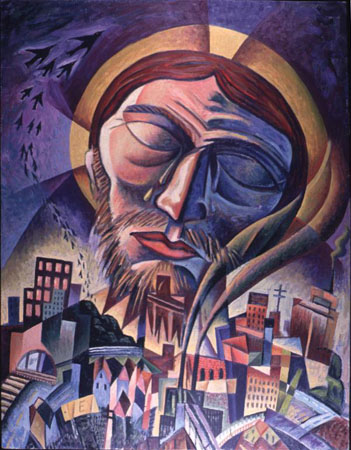
Transfiguration of Jesus by Macedonian artist Armando Alemdar
After six days Jesus took Peter, James, and John with him and led them up a high mountain, where they were all alone. There he was transfigured before them. His clothes became dazzling white, whiter than anyone in the world could bleach them. And there appeared before them Elijah and Moses, who were talking with Jesus.
Peter said to Jesus, “Rabbi, it is good for us to be here. Let us put up three shelters—one for you, one for Moses and one for Elijah.” (He did not know what to say, they were so frightened.)
Then a cloud appeared and covered them, and a voice came from the cloud: “This is my Son, whom I love. Listen to him!”
Suddenly, when they looked around, they no longer saw anyone with them except Jesus.
As they were coming down the mountain, Jesus gave them orders not to tell anyone what they had seen until the Son of Man had risen from the dead. (Mark 9:2-9, NIV)
It is quite possible that in reading this account of Christ’s transfiguration (or metamorphosis) that this all seems very strange, even confusing. Maybe you just have no categories of thought to explain such an encounter.
In a Peanuts cartoon Charlie Brown, Lucy, and Linus were lying on their backs looking at the sky. Lucy says, “If you use your imagination you can see lots of things in the cloud formations. What do you think you see, Linus?” Linus replies, “Well, those clouds up there look to me like the map of the British Honduras on the Caribbean… That cloud up there looks a little like the profile of Thomas Eakins, the famous painter and sculptor… And that group of clouds over there gives me the impression of the stoning of Stephen… I can see the Apostle Paul standing there to one side…” Lucy responds, “Uh huh… that’s very good… what do you see in the clouds, Charlie Brown?” Charlie Brown sheepishly says, “Well, I was going to say a ducky and a horsie, but I changed my mind.”
Perhaps your spiritual life seems more like Charlie Brown than Linus. Compared to the experiences of others, you may not have had any defining moments of ecstasy, no shining Jesus right in front of you, or no spectacular vision of Christ. Maybe your life seems rather mundane and ordinary considering the many stories we have in the Gospels of Jesus doing the miraculous.
Most of life is lived in the daily grind. In the week in and week out monotony of life, especially when one is sheltering in place, we need a bit of hope, maybe even a lot of hope. In fact, we need an occasional mountain top experience because those are glimpses into the future of what it will be like someday when the kingdom of God comes in all its fullness.
The account of Christ’s transfiguration comes after a hard frank discussion Jesus had with the disciples about his impending death. Jesus clearly taught them that he must suffer, be rejected, and killed. But in three days he would rise again. The disciples did not want to hear that, and Peter even rebuked Jesus for saying it. In response, Jesus said to them all:
“Whoever wants to be my disciple must deny themselves and take up their cross and follow me. For whoever wants to save their life will lose it, but whoever loses their life for me and for the gospel will save it. (Mark 8:34-35, NIV)
Jesus identified himself as the Suffering Servant, as the One who must suffer and die. However, he is also the One to be glorified. For Jesus, there had to be suffering before glory. And it is the same for us: There must be suffering before glory. The Christian life is filled with the difficulty of walking through the valley of the shadow of death but is also punctuated with mountain top experiences that give us hope to keep doing what Jesus did. In other words, we must listen to Jesus and follow him. The nature of our Christian walk is up and down. Both the mountain and the valley are spiritual realities of great importance.
We may have a lot of questions about Christ’s transfiguration. Jesus had a metamorphosis in front of the disciples’ eyes. Why? What is the significance of this? Was it just a demonstration to get the disciples’ attention? Why are Moses and Elijah there? What is really going on here?
Jesus intentionally took Peter, James, and John up the mountain to have this experience. Up to this point, a lot of rumors had been circulating about Jesus – that maybe Jesus was really Elijah come back, or some other prophet, perhaps even Moses himself, since no one knows where his body was when he died. Moses and Elijah showing up next to Jesus meant that Jesus is not them.
In the Old Testament, Moses was the person used by God to deliver the Israelites out of their slavery in Egypt and brought them to the Promised Land. Centuries later, when the Israelites had been in the land for quite a while, Elijah was the person used by God to bring about a great repentance of the people from the false god Baal, and a mighty revival to the exclusive worship of the Lord.
As good as Moses and Elijah were back then, having them with Jesus on the mountain meant that it gets even better with Christ. Jesus is the Messiah, the True Deliverer, who saves the people from their sins. What is more, Jesus is the Ultimate Revivalist, bringing the true grace and love of God to people and calling them from legalistic religion back to the true worship of God.
Deliverance and revival were what Jesus was all about in his ministry. And he expects those who follow him to do the same. In the ministry of every believer, there will be suffering because we must take up our crosses; and there will also be glory, experiencing and seeing the deliverance of sin that comes from genuine revival.
When I was a college student, a group of us Christian brothers met each week for encouragement and prayer. For a solid two-year period, at least one person a week was added to our group, having had a dramatic conversion to Christ. That was an incredible time of being on the mountain with Jesus and seeing him manifest himself in all his glory through changing people’s lives.
Yet, inevitably, the valley must come. What goes up must come down. And what we do when we are in the valley is crucial and important. It seems effortless to be a Christian on the mountain. It is a different thing altogether in the valley. Coming off the mountain can lead to all kinds of temptations, like wishing you were back on the mountain – looking back to some Golden Age where everything seemed to go great and people were enthused and excited about God. But the revival fires may have waned, and the glory departed. Then what?…
“This is my Son, whom I dearly love. Listen to him!”
mark 9:7, ceb
Here is what Jesus said…
“The right time is now here. God’s kingdom is very near. Change your hearts and lives, and believe the Good News!” (Mark 1:15, ERV)
“Come, follow me! I will teach you how to catch people instead of fish.” (Mark 1:17, GW).
“Those who are well have no need of a physician, but those who are sick; I have come to call not the righteous but sinners.” (Mark 2:17, NRSV)
“The seed that fell on the footpath represents those who hear the message, only to have Satan come at once and take it away. The seed on the rocky soil represents those who hear the message and immediately receive it with joy. But since they do not have deep roots, they do not last long. They fall away as soon as they have problems or are persecuted for believing God’s word. The seed that fell among the thorns represents others who hear God’s word, but all too quickly the message is crowded out by the worries of this life, the lure of wealth, and the desire for other things, so no fruit is produced. And the seed that fell on good soil represents those who hear and accept God’s word and produce a harvest of thirty, sixty, or even a hundred times as much as had been planted!” (Mark 4:15-20, NLT)
“Why are you such cowards? Don’t you have any faith at all?” (Mark 4:40, MSG)
“Don’t you know that nothing from the outside that enters a person has the power to contaminate?… It’s from the inside, from the human heart, that evil thoughts come: sexual sins, thefts, murders, adultery, greed, evil actions, deceit, unrestrained immorality, envy, insults, arrogance, and foolishness. All these evil things come from the inside and contaminate a person in God’s sight.” (Mark 7:18, 21-23, CEB)
“All things are possible for the one who believes.” (Mark 9:23, ERV)
“So, you want first place? Then take the last place. Be the servant of all.” (Mark 9:35, MSG)
“I tell you the truth, you must accept the kingdom of God as if you were a little child, or you will never enter it.” (Mark 10:15, NCV)
“The Son of Man will be betrayed to the religious leaders and scholars. They will sentence him to death. Then they will hand him over to the Romans, who will mock and spit on him, give him the third degree, and kill him. After three days he will rise alive.” (Mark 10:33-34, MSG)
“The Son of Man did not come to be a slave master, but a slave who will give his life to rescue many people.” (Mark 10:45, CEV)
So, I tell you to ask for what you want in prayer. And if you believe that you have received those things, then they will be yours. When you are praying and you remember that you are angry with another person about something, forgive that person. Forgive them so that your Father in heaven will also forgive your sins.” (Mark 11:24-25, ERV)
“Go into all the world and proclaim the good news to the whole creation.” (Mark 16:15, NRSV)
“This is my Son, whom I love. Listen to him!” If you have had a mountain top experience with Jesus, let that encounter with him give you the drive and the hope to keep carrying the bucket through the valley, without living in the past. If you have never been on the mountain, today is the day to listen to Jesus and follow what he says. For us all, the answer to what is vexing us is found in Jesus Christ.
May we all go to Jesus, listen to him, and obey what he says. May we know the Word of Christ, and bank on it. May we understand that our light and momentary sufferings will result in praise, honor, and glory when Jesus Christ is revealed.
“As Jesus came to the city and observed it, he wept over it. He said, ‘If only you knew on this of all days the things that lead to peace. But now they are hidden from your eyes. The time will come when your enemies will build fortifications around you, encircle you, and attack you from all sides. They will crush you completely, you and the people within you. They won’t leave one stone on top of another within you, because you didn’t recognize the time of your gracious visit from God.’” (CEB)
There are Christians who believe in as much withdrawal from the world – its earthly political and cultural realm – as is humanly possible this side of heaven. There are yet others who believe in as much accommodation as possible to the world, its structures and society. And there are others who believe that the world and the church are simply two distinct realms which Christians simply move back and forth within, like taking one hat off and doffing another.
Let us leave that all aside for a moment and just observe the pathos of Jesus. He came to the city of Jerusalem, a city which was both deeply religious and very worldly. Jesus stood and looked affectionately and longingly at the city… and he wept. This was not a quiet shedding of a tear. No, the word “wept” means that Jesus openly cried aloud over the city. Think of the kind of crying which takes place when a person is in the throes of grief. These were great heaves of loud weeping.
The reason Jesus was lamenting with so much feeling was that the city did not recognize they had a gracious visit from God. The Lord looked at the city and saw all the future disaster which was coming. He knew it could be different, and he was emotionally undone by the city’s inability to see God, right in front of their own face.
Now let us return to our view of the world and our involvement in it. Taking some cues from our Lord Jesus, the first and foremost posture we are to take toward the worldly city is not separation, accommodation, or dual citizenship – it is, rather, to grieve and lament.
The longing Jesus had in his heart was to see the city of Jerusalem annexed and incorporated into the kingdom of God. The way of peace, of shalom on this earth, is to bring all things and all the world under the benevolent reign of God. It is as if there are Twin Cities, like Minneapolis and St. Paul, which exist side-by-side but have different municipal structures.
The kingdom of this world and the kingdom of God exist next to each other. Jesus wanted to bring the earthly kingdom into the peaceful and gracious realm of God’s kingdom. But the people would have nothing to do with it. Both the religious establishment and the secular authorities of the city wanted their own municipal conceptions of how things should go – and they both rejected the Christ who could bring them all true harmony.
We are about to enter the season of Lent. It is a time set aside in the Christian Year for repentance and preparation to receive King Jesus as our rightful benevolent ruler. Let us lament the world full of both religious and secular people who do not recognize the time of God’s visitation. Let it be a time to journey with Jesus and follow him in his Passion for this world and all its inhabitants.
Blessed Father, Son, and Holy Spirit, the holy Trinity whom I serve – the world and even sometimes the church is estranged from grace – they have not recognized your gracious coming and presence. I lament such a state of things, and ask you, blessed Spirit may draw all people to the Savior, Jesus Christ, in whose name I pray. Amen.
I thank Christ Jesus our Lord, who has given me strength because he considered me faithful. So, he appointed me to ministry even though I used to speak against him, attack his people, and I was proud. But I was shown mercy because I acted in ignorance and without faith. Our Lord’s favor poured all over me along with the faithfulness and love that are in Christ Jesus. This saying is reliable and deserves full acceptance: “Christ Jesus came into the world to save sinners”—and I am the biggest sinner of all. But that is why I was shown mercy, so that Christ Jesus could show his endless patience to me, first. So, I am an example for those who are going to believe in him for eternal life. Now to the king of the ages, to the immortal, invisible, and only God, may honor and glory be given to him forever and always! Amen.
Timothy, my child, I am giving you these instructions based on the prophecies that were once made about you. So, if you follow them, you can wage a good war because you have faith and a good conscience. Some people have ruined their faith because they refused to listen to their conscience, such as Hymenaeus and Alexander. I have handed them over to Satan so that they can be taught not to speak against God. (CEB)
Toward the end of his life, the Apostle Paul reflected upon the grace given to him by God. In writing to Timothy, his protégé, Paul distilled his reflections into one short succinct phrase: Christ Jesus came into the world to save sinners.
Before Christ got a hold of his life, Paul actively opposed Christians as much as he could. He had the persecution of Christ’s followers down to a science. But God had mercy on Paul and delivered him from his misguided and tortuous ways.
Paul was forever grateful for the grace of God. He well knew that he deserved no good thing from God. Paul knew firsthand the words of the Lord Jesus:
“I didn’t come to call righteous people, but sinners.” (Mark 2:17, CEB)
Once one’s heart has been captivated by God’s mercy, that person is never the same. Grace results in a new and wondrous perspective. The soul is filled with love. The mind is changed and charged with the realization that God is not only good but has given you a status as his beloved – a privilege and a position which you neither earned nor deserve. Gratitude erupts from your lips: “Christ Jesus came into the world to save sinners, to save me, the chief of sinners!”
We need not have a past like Paul’s to know God’s grace. Whether you are now a follower of Jesus after having lived a life far from God; or, you cannot remember a time when you didn’t know God; or, you grew-up in faith, walked away from it all, then were captured by grace and came back to Christ – from whatever backgrounds we all come from, it is the saving grace, the delivering mercy, the infinite love, the abiding compassion, and the undeserved kindness of Jesus Christ which makes your world spin the opposite direction on its axis.
Take time throughout today to utter that simple phrase over and over: Christ Jesus came into the world to save sinners. What does this mean for the world as it is right now? What does it mean for you?
Loving Lord Jesus, there are not words to express my gratitude for your salvation given to me. I was once lost, but now am found by the boundless mercy of God. May sinners be saved, as was your servant Paul, so that the world will be undone and changed forever by grace. Amen.









 Rev. Tim Ehrhardt