Burt Ward as Robin and Adam West as Batman in the TV show that aired from 1966-1968
“Robin, there is something seriously sinister afoot. It seems the people of Gotham have lost their sense of the story of Christ’s life, death, and resurrection.”
“Holy Holy Week, Batman! It must be the work of that arch-villain the Joker who has turned the narrative of Jesus into a by-gone joke… or maybe the Riddler who has made the redemptive events of Jesus into a complicated riddle that no one can solve… or maybe that fiend, Cat Woman, has finally found the purr-fect way to foil attention to the Lord Jesus.”
“I fear, Boy Wonder, that you have stumbled upon who is behind the loss of Holy Week… they are all conspiring together not just to create a spin on the life and death of Jesus, but to form a new narrative that doesn’t even include Christ at all.”
“Those dastardly demons of disaster! Let’s go get them, Batman! How could they have done such an ugly underhanded umbrage as that!?”
“Let’s use the Bat computer to analyze the evidence found at the crime scene churches…. Look, Robin, it seems a feculent film of gross gas has rendered the believers prone to the noxious notion that the Christian observance of Holy Week is optional, as if the journey with Jesus to the cross doesn’t need special attention. They are attempting to rewrite it all so that Christians will pass through this week without even a thought about Jesus… until it’s too late. Then they will sweep in and make all of Christianity into something that’s merely an accessory to life, like a petty plastic purse.”
“Holy evisceration, Batman! They’re trying to do away with the Christian life and the story of Jesus altogether and replace it with their fiendish focus on the foul festering faith of fecund followers!”
“That’s right, Robin. It’s our job to stop them from following through with their platitudinous plot before it’s too late.”
“But how, Batman? Their vile villainy has already voiced a vacuous votum of veneered viciousness to any observance of the last week of Christ’s life on this earth.”
“Yes, Robin, but you are forgetting the one “v” word which has already spelled doom for our culprits of crime… “victory.”
“Holy resurrection, Batman! You’re right! All we need to do is voice the victory of Jesus and those bungling bandits of belief will get another “v” word: “vanquished!”
“Holy Week and all the major Christian seasons of the Church Year are meant to help us remember Jesus and follow Christ in our daily life. When strayed souls begin berating believers for observing obedience to Palm Sunday, Maundy Thursday, Good Friday, Holy (or Black) Saturday, and Easter Sunday then you can bet, Boy Wonder, that the gangsters’ gross gas of gullibility has fumigated their faith.”
“So, you’re saying, Batman, that the forgetting of faith festivals can be reversed through setting our sites on the contempt of the cross and the resplendence of the resurrection?”
“The cross is the mid-point of history, Robin, the very center of faithful followers. From it flows the flowering of all faith.”
“Holy forgiveness, Batman. I see it now. The sin issue has been taken care of once-for-all through the death of Jesus Christ. And his rising again has enabled us ignorant idiots of ignominy to live a new life of love through the words and ways of Christ.”
“And, don’t forget, Boy Wonder, that we get our faith focused through walking into those ways and words by highlighting holidays as eminently important to our crowded calendars.”
“Holy, holy, holy, is the Lord God Almighty, creator of heaven and earth; and, Jesus Christ his only Son, our Savior; who, with the Holy Spirit lives and reigns forever and ever!”
In your relationships with one another, have the same mindset as Christ Jesus:
Who, being in very nature God, did not consider equality with God something to be used to his own advantage; rather, he made himself nothing by taking the very nature of a servant, being made in human likeness. And being found in appearance as a man, he humbled himself by becoming obedient to death— even death on a cross!
Therefore, God exalted him to the highest place and gave him the name that is above every name, that at the name of Jesus every knee should bow, in heaven and on earth and under the earth, and every tongue acknowledge that Jesus Christ is Lord, to the glory of God the Father. (NIV)
I often take the posture of kneeling or prostrating when I pray. I do this, not because I think my prayers are more effective that way, but because this embodies my petitions with a recognition of Christ’s lordship over my life. Also, for me, there is no experience quite like using the kneelers on church pews and bowing together in a common experience of recognizing the lordship of Jesus Christ.
I sometimes ponder a question as I am on my knees: What kind of people would we be if we looked like these verses in Philippians? The Apostle Paul said to the church in Philippi that their “attitude” should be the same as that of Christ Jesus. Their mindset, the way they think about everything, ought to be just like the mind of Christ. If we want to know how to think well and live well, how to relate to others in a good way, then we ought to thoroughly adopt the mind and the attitude of Jesus.
How we should think and live comes from God. Within the life of the triune God exists three persons: Father, Son, and Spirit. Within this great three-in-one God exists perfect love, absolute holiness, united harmony, and constant respect. The Holy Scriptures tell us that just as God is holy, we are to be holy. Just as God is love, so we are to love one another. Just as God is harmonious, we are to live in harmony with one another. And just as God is supremely exemplified in the person of Jesus as a humble servant, so we are to practice humility and service in all our relations.
None of this is optional for the Christian. There is no place in the believer’s life for pride, posturing, and power-broking. There is to be humility, taking the posture of lowliness, and using any kind of influence for the benefit and encouragement of others – just like Jesus did while on this earth.
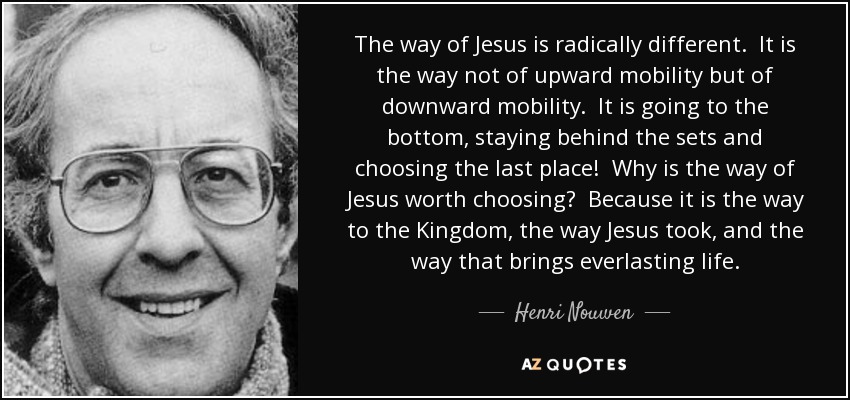
In a world pre-occupied with power and control, safety and security, influence and throwing its weight around, there is Jesus. He did just the opposite of engaging in upward mobility; he practiced downward mobility, and in doing so Christ descended into greatness as Lord and Savior.
Jesus did not consider equality with God as something to be grasped. The pre-incarnate Christ did not sit in heaven as the second person of the Trinity and hold onto his lofty position with tight fists – he did not grasp it tightly. When Jesus came to this earth, there was a humble willingness to open his hands and relinquish his rights and privileges as God. Christ made himself nothing, taking the very nature of a servant. Jesus gladly, not reluctantly, emptied himself for us. Jesus became one of us.
The television series, Undercover Boss, is a reality show in which high-level corporate executives leave the comfort of their offices and secretly take low-level jobs within their companies to find out how things are really working and what their employees are honestly thinking about their jobs and what is happening. In the process of this undercover mission, they learn of the perceptions about their companies, the spirit of their work forces and — maybe — something about themselves as well.
None of the executives cease to be executives. They just make a willing decision to take the lowest level job in their own company to hopefully benefit the employees and the entire corporation. The best episodes are when the most generous executives go above and beyond helping the employees around them at the end of the show.
Jesus descended to earth. He never ceased to be God. Yet, Christ willingly put his kingly robe in the closet and donned Dickies and work boots. He came among us and purposely limited himself to identify with us fully – and secured for us the greatest generosity imaginable – an answer to the problem of guilt and shame through forgiveness of sins.
Jesus became a servant. He completely tied himself to us. Jesus did not come to this earth seeking to be served, but sought to serve and give his life as a ransom for many. Christ kept going lower and lower to the point of descending to the greatest humiliation of all – death on a cross. Jesus endured the ultimate shame of the ancient world by dying a terrible death. The King of the universe was killed by vicious humanity so that he might redeem and save those very same people from their terrible plight of bondage to evil.
We are to be humble people, embracing a lowly status of slaves to God and to one another. The ancient Philippian church had a real problem with pride which is why Paul talked about emulating the mind and attitude of Christ in his humiliation. The following are exhortations Paul gave to the Philippians, which were to reflect the practice of humility in relationships:
Whatever happens, conduct yourselves in a manner worthy of the gospel of Christ (1:27).
Do nothing out of selfish ambition or vain conceit, but in humility consider others better than yourselves (2:3).
Continue to work out your salvation with fear and trembling (2:12).
Do everything without complaining or arguing (2:14).
Join with others in following my example and take note of those who live according to the pattern we gave you (3:17).
Do not be anxious about anything, but in everything, by prayer and petition, with thanksgiving, present your requests to God (4:6).
Because of Christ’s humble obedience to the Father, he was exalted from the lowest place to the highest place. King Jesus is on the throne, above everyone and everything. Because of his descent to this earth, Christ has ascended in glory and honor. We can now see God in a new way, through Jesus. And when we do, it causes us to kneel in prayer and profess that Jesus Christ is Lord.
In the ancient world, this was subversive language. If Jesus is Lord, Caesar is not, and ultimate allegiance does not belong to the Roman Empire. If Jesus is Lord, the local gods are not. And in our day, it is no different. Historical characters and religious deities may come and go, but the issue of ultimate allegiance still pertains to us. If Jesus is Lord, no politician or celebrity is owed lordship status. Pride and arrogance are to be put down at every turn in favor of humble service and loving actions.
If we are to follow Jesus Christ truly and really, we will practice downward mobility and embrace humility. Bowing, kneeling, and prostrating will become second nature to us as we give our unflagging allegiance to Jesus. We will accept our creaturehood and God as Creator. We will live in the reality that Jesus is Sovereign over all creation.
As we enter the Christian Holy Week, let us acknowledge and know the humiliation and exaltation of Christ….
Just watch my servant blossom! Exalted, tall, head and shoulders above the crowd! But he didn’t begin that way. At first everyone was appalled. He didn’t even look human— a ruined face, disfigured past recognition. Nations all over the world will be in awe, taken aback, kings shocked into silence when they see him. For what was unheard of they’ll see with their own eyes, what was unthinkable they’ll have right before them.
Who believes what we’ve heard and seen? Who would have thought God’s saving power would look like this?
The servant grew up before God—a scrawny seedling, a scrubby plant in a parched field. There was nothing attractive about him, nothing to cause us to take a second look. He was looked down on and passed over, a man who suffered, who knew pain firsthand. One look at him and people turned away. We looked down on him, thought he was scum. But the fact is, it was our pains he carried— our disfigurements, all the things wrong with us. We thought he brought it on himself, that God was punishing him for his own failures. But it was our sins that did that to him, that ripped and tore and crushed him—our sins! He took the punishment, and that made us whole. Through his bruises we get healed. We’re all like sheep who’ve wandered off and gotten lost. We’ve all done our own thing, gone our own way. And God has piled all our sins, everything we’ve done wrong, on him, on him.
He was beaten, he was tortured, but he didn’t say a word. Like a lamb taken to be slaughtered and like a sheep being sheared, he took it all in silence. Justice miscarried, and he was led off— and did anyone really know what was happening? He died without a thought for his own welfare, beaten bloody for the sins of my people. They buried him with the wicked, threw him in a grave with a rich man, Even though he’d never hurt a soul or said one word that wasn’t true.
Still, it’s what God had in mind all along, to crush him with pain. The plan was that he gives himself as an offering for sin so that he’d see life come from it—life, life, and more life. And God’s plan will deeply prosper through him.
Out of that terrible travail of soul, he’ll see that it’s worth it and be glad he did it. Through what he experienced, my righteous one, my servant, will make many “righteous ones,” as he himself carries the burden of their sins. Therefore I’ll reward him extravagantly— the best of everything, the highest honors— Because he looked death in the face and didn’t flinch, because he embraced the company of the lowest. He took on his own shoulders the sin of the many, he took up the cause of all the black sheep. (Isaiah 52:13-53:12, MSG)
Jesus healing blind Bartimaeus by Johann Heinrich Stöver, 1861. St John’s Church, Hesse, Germany
They were on their way up to Jerusalem, with Jesus leading the way, and the disciples were astonished, while those who followed were afraid. Again, he took the Twelve aside and told them what was going to happen to him. “We are going up to Jerusalem,” he said, “and the Son of Man will be delivered over to the chief priests and the teachers of the law. They will condemn him to death and will hand him over to the Gentiles, who will mock him and spit on him, flog him and kill him. Three days later he will rise….”
Then they came to Jericho. As Jesus and his disciples, together with a large crowd, were leaving the city, a blind man, Bartimaeus (which means “son of Timaeus”), was sitting by the roadside begging. When he heard that it was Jesus of Nazareth, he began to shout, “Jesus, Son of David, have mercy on me!”
Many rebuked him and told him to be quiet, but he shouted even more, “Son of David, have mercy on me!”
Jesus stopped and said, “Call him.”
So, they called to the blind man, “Cheer up! On your feet! He’s calling you.” Throwing his cloak aside, he jumped to his feet and came to Jesus.
“What do you want me to do for you?” Jesus asked him.
The blind man said, “Rabbi, I want to see.”
“Go,” said Jesus, “your faith has healed you.” Immediately he received his sight and followed Jesus along the road. (NIV)
“Irony” and “ironic” are terms describing when an outcome of an event is contrary or different from what would be expected. Here are a few examples of irony: The firehouse burnt down. The police officer got arrested. When I was a kid, my family physician’s name was Dr. Fail (really!).
There is an overarching ironic lesson to our Gospel story today. The people following Jesus with 20/20 vision are spiritually blind. Their great need is the same as blind Bartimaeus: to have their eyes opened to Jesus and to what God was doing around them. Bartimaeus was marvelously and miraculously given sight by Jesus – the others, however, remained unchanged and in the dark.
Irony #1: Many followed Jesus, but only a few were his followers.
All kinds of people physically followed Jesus around for all kinds of reasons while he was here on this earth. Some wanted to bask in the latest celebrity buzz that Jesus generated. Others wanted to see all the cool stuff Jesus did, like healing people. Some were plain curious. And a few were interested in being like Jesus by showing selfless compassion. Jesus continually sought to press the crowd following him into authentic disciples who would follow his teaching.
Many people desire to conform and go with the flow. That’s great if the crowd is good, and not so good if the group is going in a bad direction. In the Old Testament, a few unruly complainers got the Israelites all stirred up with the result of making a golden calf and turning away from God. However, sometimes it is right and necessary to go against the crowd, which leads us to the next irony….
Irony #2: Out of all Christ’s followers, it is a blind man that sees Jesus for who he is, the Son of David.
Spiritual blindness afflicted many people, yet Bartimaeus discerned it was Messiah who was walking by him. So, he went against the crowd and shouted to Jesus. Blind Bartimaeus didn’t care how he looked to others, and it didn’t matter to him that he stuck out like a sore thumb.
Sometimes we might forget that Jesus often avoided crowds, and that most of his life occurred away from the centers of power and influence. Jesus swam upstream of the prevailing notions of righteousness. Christ did not cow-tow to the crowd, but instead, paid attention to those in need and forgotten by others. Jesus did not “work the crowd” to get ahead and further his agenda. He did not cozy-up to the rich and powerful. And he deliberately avoided celebrity status. Jesus showed extraordinary love to an overlooked person. He used his immense power for one powerless person.
Irony #3: The ones following Jesus were the ones trying to keep a blind man from Jesus.
It seems to me one of the ironies about the church is that Christ’s own followers can be the greatest obstacle to others following him. I can imagine a group of gossipy church folk shushing Bartimaeus: “Don’t bother Jesus, he is such a busy man! He has important work to do!” I can also picture them standing next to blind Bartimaeus saying, “Just stop, man, you’re embarrassing yourself.”
But Bartimaeus would not stop. He shouted all the louder. True and genuine faith is a needy person crying out in desperation for Jesus to help. Jesus asked a beautiful question: “What do you want me to do for you?” “I want to see,” Bartimaeus responded. So, Jesus had compassion on him and gave him his sight. Here we have two men, Jesus and Bartimaeus, ignoring all the people around them, and having a divine encounter.
This all makes me wonder why it is so hard for us to simply say what we want. It could be that we don’t want to buck the crowd, or to look different. Maybe we don’t want to admit our need in front of others. So, we just stick to superficial conversations and insist that everything is okay, when it isn’t.
Jesus said, concerning the crowd, “Although they see, they don’t really see.” (Matthew 13:13) If we are concerned about how we will be seen by others, we will likely not be seen by God, and will miss Jesus when he walks right in front of us.
Conclusion
How might we raise our ability to see Jesus and truly follow him as he desires us to?
Listen to Jesus. Jesus was headed to Jerusalem and had a lot on his mind and heart with anticipating his passion and death. What made Christ attentive to Bartimaeus out of all the people around him was that he was listening. If we want to see Jesus and follow him, we must be listeners and attentive to compassion, like Jesus, to the needy and lowly among us.
I recently read a story from a Christian who lived during Nazi Germany. He said, “I considered myself a Christian. We heard stories of what was happening to the Jews, but we tried to distance ourselves from it, because what could anyone do to stop it? A railroad track ran behind our small church, and each Sunday morning we could hear the whistle in the distance and then the wheels coming over the tracks. We became disturbed when we heard the cries coming from the train as it passed by. We realized it was carrying Jews like cattle in the cars! Week after week the whistle would blow. We dreaded to hear those wheels because we knew we would hear the cries of the Jews in route to a death camp. Their screams tormented us. So, when we heard the whistle blow, we began singing hymns. By the time the train came past our church, we were singing at the top of our voices. If we heard the screams, we sang more loudly, and soon we heard them no more. Years have passed, and no one talks about it anymore. But I still hear that train whistle in my sleep. God forgive me. Forgive all of us who called ourselves Christians yet did nothing to intervene.”
Respond to Jesus. Once Jesus listened, he responded by asking a question. Christ took the time to heal Bartimaeus. Jesus could have simply healed him without even stopping. He could have even started a healing factory where everyone with a need just moved through a line and got healed. Jesus was doing more than giving sight; he was giving a blessing – the blessing of time and relationship.
The gospel is personal, which is why we ought to resist being non-relational in ministry to others. It’s about more than meeting a physical need. It is about blessing other people with the gift of relationship. It begins with recognizing self as the one who needs Jesus. It starts with having our own eyes opened to see our own need and then the great need of people around us.
God of all compassion, I confess that it is natural for me to do things my way. I recognize that I am limited, but that you know all things. I yield my spiritual eyesight to you so that my spiritual vision will be clear. Jesus Christ came to give sight to the blind and to open our eyes. I commit my ways to you so that I can see your ways and not my own. Amen.
Therefore, my dear friends, as you have always obeyed—not only in my presence, but now much more in my absence—continue to work out your salvation with fear and trembling, for it is God who works in you to will and to act to fulfill his good purpose.
Do everything without grumbling or arguing, so that you may become blameless and pure, “children of God without fault in a warped and crooked generation.” Then you will shine among them like stars in the sky as you hold firmly to the word of life. And then I will be able to boast on the day of Christ that I did not run or labor in vain.But even if I am being poured out like a drink offering on the sacrifice and service coming from your faith, I am glad and rejoice with all of you. So, you too should be glad and rejoice with me. (NIV)
Here is what I would like you to do. Go back and read these verses for today….
Now, I want you to read them again, but with this understanding: Every pronoun in the verses is plural, not singular….
Did that last reading make a difference for you? You see, we all tend to read with certain lenses. Reading with American glasses usually means we read such biblical passages, like our New Testament lesson today, with individualist lenses. But this would be a misreading of the text.
These words from Holy Scripture are directed at the community. They are meant to be read with a collective understanding. So, when the Apostle Paul told the Philippian church to “work out your salvation with fear and trembling,” he wasn’t aiming it toward individual persons. He meant everyone together was to help one another live out their common salvation. In other words, deliverance is more than an individual affair – it is also a communal concern.
This also shapes how we understand the admonition to do everything without being a grump and a complainer. The community works together to encourage each other and weeds out all arguing and bickering. Practically speaking, no one individual is going to get over being a crotchety curmudgeon without the help of the group. Since people are hard-wired by God for community, always trying to be radically independent will almost always end in being a faultfinder and bellyacher.
Group work is human work, and vice versa.
Interdependence with others is the proper road to travel, without veering into either ditch of independence or dependence. Community dynamics are necessary to life. Mutual giving and receiving are a must. Both sharing and accepting need to occur for any sort of relational health.
The reason the Apostle Paul wrote his letter to the Philippian Church was because they weren’t getting along, weren’t playing well with others. Christianity is a team sport. Everyone must work together, even when it comes to salvation. Deliverance from sin, death, and hell – salvation from guilt, shame, disconnection, and relational separation from both God and others – is a matter for the collective community. That’s why no one is baptized alone or observes the Lord’s Table all by themselves.
Today’s New Testament lesson is not a text dealing with individual salvation but is an ethical text dealing with the outworking of salvation in the believing community for the sake of the world. Paul’s present concern was with a group of believers being God’s people. Individuals were to stop their selfish in-fighting and get along with each other.
To do that, the entire group was to set aside selfish ambition and put the concerns of others ahead of their own personal agendas. Everyone is to think of the needs of the group. When we do that, we then discern that murmuring and grumbling are simply not helpful. And, what’s more, such an attitude can damage, even destroy a group through bitterness resulting in gangrene of the church body.
Instead, we are to be blameless and pure in all our dealings with one another. Here are a few basic ways this communal concern works itself out practically:
No one cries alone.
No one suffers in silence.
No one falls through the cracks.
There is always someone present to share joy with.
There is always someone around to hear your story.
There is always somebody there to pick you up.
When such a dynamic dominates any group, then it will be hard to find any grumblers, any sort of in-fighting, and little discontent. Rather, there is a great deal of carrying one another’s burdens, a lack of judgment toward others, and a settled hope that, even though the world might be going to hell in a handbasket, we will be okay because we have each other.
So then, the church is to be an inclusive community, inviting persons into a hospitable space of care and support. Church as factory cannot do this. Church made up of special interest groups is not able to do this. Church as simply a Sunday affair will never get it done.
However, Church poured out as an offering to the world will get it right. Church as oriented toward faithful service for the common good of all has it. Church as the community of the redeemed, living out their faith together as one people of God cannot be stopped or restrained from blessing the entire planet.
Do you want to go it alone? That is what Satan did, and it hasn’t worked out so well for us.
Will you think of the needs of the group? That is what Jesus did, and it resulted in our salvation.
We are to work out that salvation, together, so that our collective faith is strengthened, and the world is delivered from its great loneliness. So, put your best foot forward and think of the needs of the group.
Holy God, we your people come with deep gratitude for our common call as believers for the life of your big world. Draw us into communion with you and all creation. Living with intentional awareness and openness to change, we seek to expand the expression of our collective obedience to the mission of Jesus to love God and neighbor, inviting others to walk with us in sharing our gifts. Free our hearts to recognize and attend to Christ in hidden and unexpected places. We renounce and reject societal barriers created by the misuse of power and authority by selfish individuals. Transform us to listen deeply to one another and to the brokenness of the world. Bless our efforts to be the change we want to see in the world, through the enablement of your Holy Spirit. Amen.












 Rev. Tim Ehrhardt