How To Be Honest, Just, and Fair (Proverbs 1:1-7)

Solomon writing Proverbs by Gustave Doré (1832-1883)

The proverbs of Solomon, son of David and king of Israel.

Here are proverbs that will help you recognize wisdom and good advice, and understand sayings with deep meaning. 

They can teach you how to live intelligently and how to be honest, just, and fair. They can make an inexperienced person clever and teach young people how to be resourceful. 

These proverbs can even add to the knowledge of the wise and give guidance to the educated, so that they can understand the hidden meanings of proverbs and the problems that the wise raise.

To have knowledge, you must first have reverence for the Lord. Stupid people have no respect for wisdom and refuse to learn. (Good News Translation)

At the beginning of this year, if you like making new year’s resolutions, or are looking for a good practice to adopt, I have a suggestion: Consider committing yourself to the reading, reflection, and study of the biblical proverbs. At the least, read a chapter of Proverbs every day throughout this month. Since there are 31 chapters, and 31 days in the month of January, you have a guide in what to read every day.

The pursuit of wisdom is a noble aspiration for the New Year. One of the best places to go in that pursuit is the biblical book of Proverbs because it is all about living wisely and not foolishly. To acquire and live by wisdom means learning how to grow in being right, just, and fair in all our interactions and dealings with others.

Honest

“Honest” is “right” or “righteous.” For King Solomon of old, this is a relational term – to be righteous, to have honest and right relationships with God and other people. Righteousness involves experiencing peaceful, harmonious, and fruitful relations. 

For the Christian, right living is to know the wonderful freedom and joy of an unhindered relationship through Jesus Christ in dependence upon the Holy Spirit. When it comes to fellow human relations, a person characterized by righteousness does not, for example, let the sun go down on their anger. It is to know personal peace as well as to be a peacemaker, so that relationships do not remain strained, but enjoy harmony.

Just

“Just” is closely related to “right.” We might tend toward primarily understanding justice as a punitive act – and that is certainly a part of the term. God punishes the wicked with appropriate timing and wisdom; and deals with those who withhold righteousness and love through their uncaring, inattentive, or evil acts. 

Solomon understood justice as mostly concerned with providing a person with the necessities of life. So, for example, if someone is hungry and needs food, or does not have clean water to drink, it is a “just” act for us to provide those critical needs. God is deeply concerned for justice, and expects people to act in this same manner.

Fair

“Fair” is to be egalitarian. Fairness and equity binds righteousness and peace together by avoiding prejudice toward others and their needs. It means to not show favoritism because there is an unshakable belief in the equality of all people, no matter where they are from, what they do, or who they are.

Therefore, if we exercise righteousness and justice exclusively with individuals and groups we like, but ignore others in need, there is no fairness. To give our love and service to all persons without strings attached, or without being concerned to get paid back, is the practice of being fair in everything we do and say.

To live in the way of being honest, just, and fair in all our interactions is to be wise. Conversely, the classic fool is one who judges others, creates discord, and ranks persons according to their own personal standard of who deserves help, and who does not. Trying to have a useful and gracious conversation with a fool is like trying to reason with a toddler – you will get nowhere. 

A good way of pursuing the wise and biblical virtues of honest righteousness, restorative justice, and egalitarian fairness is to ask God to open our eyes to those within our sphere of influence who need both physical and relational needs met. Then, follow through by loving those persons for whom God brings into our lives.

Almighty God, the essence and source of wisdom, you are always right, just, and fair in all things. I praise you for your infinite and abundant wisdom.

Whereas you abound in wisdom, I am lacking. Please help me to grow in wisdom, as I increase in my knowledge and respect of your divine presence.

By means of your Spirit, please increase my depth of insight as I study your Holy Word. Hold me back from leaning on my own understanding and enable me to wholeheartedly embrace the wisdom from above.

Since you are a just God who shows no favoritism, lead me into being like you in my dealings with others through the example of Jesus Christ, in the strength of the Holy Spirit. Amen.

A New Year’s Blessing (Numbers 6:22-27)

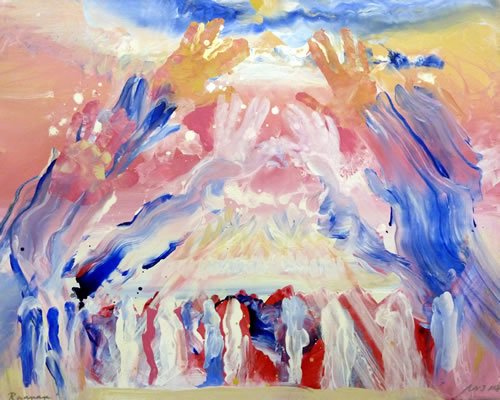
The Priestly Blessing, by Yoram Raanan

The Lord spoke to Moses, saying, “Speak to Aaron and his sons, saying: Thus you shall bless the Israelites: You shall say to them:

The Lord bless you and keep you;
the Lord make his face to shine upon you and be gracious to you;
the Lord lift up his countenance upon you and give you peace.

“So they shall put my name on the Israelites, and I will bless them.” (New Revised Standard Version)

Perhaps we are living in a famine of blessing. Maybe so many people are short-tempered, rude, drive their cars recklessly, ignore others’ needs, swear like sailors, and speak enough sarcasm to bury the earth six feet deep in cynicism, because they are not being blessed; and it could be they haven’t been blessed for a very long time, even never.

At the beginning of this New Year, we are reminded of deep longings and hopes for fresh starts. I invite you to consider the value and significance of giving and receiving a blessing.

Life operates by blessing, not cursing.

The world cannot stand up under the curse. The new earth will endure forever with a blessing.

People wither without a blessing. They die when cursed. Not necessarily in body. Most definitely in spirit.

Something must be said about the word “blessing.” It gets used (and misused) a lot, especially by Christians.

As with most words in the Old Testament, “blessing” is a relational word. It means to have God’s stamp of approval on your life. It’s meant to convey that the Lord’s presence is with us.

To be blessed by God is a multi-dimensional experience – receiving promises, enjoying peace, having right relationships with both God and other people, and knowing divine comfort and security.

A blessing isn’t simply having lots of money, plenty of family, or a good job. One could have none of those and still be blessed by God. And being blessed is not getting everything you want. Some people continually get what they want and are cursed, not blessed.

Blessing is tied not to human activity but to divine initiative.

We can’t finagle a blessing out of God. Plenty of folks try to do that, and, like Jacob, they might get away with it in their family – but it will not work with God. The grace of blessing is freely bestowed by a benevolent and merciful Lord.

Everything comes down to God. The Lord is not stingy but generous – not subject to the whimsy of human cajoling but deeply influenced by the unending unity, harmony, and love within the divine godhead.

In other words, divine blessing is a gift – not something earned or cleverly received through trickery or manipulation.

Blessing one another is also a gift. In fact, God clearly communicated to Moses and Aaron how they were to bless the people with powerful words.

I believe we all intuitively know that words and language have the power of life and of death, of blessing and cursing. And withholding words of blessing and keeping silent is to withhold goodness and love from another.

Speaking words of blessing and backing up those words with an active commitment, is vital to humanity’s spiritual and emotional health.

Fathers and mothers everywhere across the world stand in a unique and special position as those who have the power of bestowing a blessing on their children – a blessing of being with them, approving of them, affirming their gifts and abilities, envisioning for them a special future of how God can use them.

Those words of blessing have the power to help children navigate the world with assurance and confidence. Armed with blessing, they can filter-out the choices in front of them and walk in the way of God.

Notice in the New Testament Gospels how the God the Father blessed the Son:

And when Jesus had been baptized, just as he came up from the water, suddenly the heavens were opened to him and he saw the Spirit of God descending like a dove and alighting on him. And a voice from heaven said, “This is my Son, the Beloved, with whom I am well pleased.” (Matthew 3:16-17, NRSV)

God provided a constant presence and an active commitment through the Spirit; God spoke words of approval and affirmation; God the Father had a special future for Jesus the Son, which helped Jesus to repel the words of Satan. Since Jesus needed and received a blessing from his Father, how much more do we?

Jesus passed the blessing to his disciples with a promise of presence and commitment:

Jesus came near and spoke to them, “I’ve received all authority in heaven and on earth. Therefore, go and make disciples of all nations, baptizing them in the name of the Father and of the Son and of the Holy Spirit, teaching them to obey everything that I’ve commanded you. Look, I myself will be with you every day until the end of this present age.” (Matthew 28:18-20, CEB)

Jesus informed the disciples his presence would be with them; communicated an active commitment to give them authority to do the job of disciple-making; pictured for them a special future of reaching the nations; affirmed and approved them. “The Great Commission” is really a statement of God’s blessing.

One reality needs to be recognized and affirmed with all confidence: You and I already possess God’s blessing; there is no need to try and earn it. The words of blessing state what is, in fact, already true.

We have the privilege and the ability to reverse the world’s curse and turn it into blessing.

Those blessed with money can be a blessing by giving it away.

Those blessed by growing up in a loving family can provide love to others who are unloved and need a special blessing.

Those blessed with wisdom can mentor and instruct those who need wisdom.

Those blessed with the mercy of God can be merciful to others.

Those blessed with a wonderful relationship with God can pray people into the kingdom of God.

Parents, it is never too late to bless your children, even if they are adults. Children, it is never too late to bless your parents and your siblings, even if they are prickly and hard. To not bless is to curse.

Bless your family through words that build up, and do not tear down. Use those words to picture a special future of what God can do. Follow through with those words by demonstrating an active commitment to embodying blessing.

I leave you with this blessing for the New Year:

May God answer you when you are in distress; may the name of Jesus protect you. 

May the Lord send help when you need it and give you support when you cry out to him. 

May the God of heaven remember your good deeds done in faith and accept you just as you are. 

May the Lord give you the desire of your heart and make all your plans succeed.

When the Almighty goes out of the way to answer your prayers, then I will be the first to shout with joy!

I know the Lord is God. There is a special future for you beyond what you can even ask or think. And I will be there on the sidelines, encouraging you all the way.

Some people trust in the political process, others trust in the strength of the economy; but we trust in the name of the Lord our God. 

May God answer when you call.

May God bless you with an everlasting love. 

May you know Christ, and him crucified, risen, and coming again. 

May God’s presence and power be with you now and forever. Amen.

Who Is Jesus? (Luke 2:22-40)

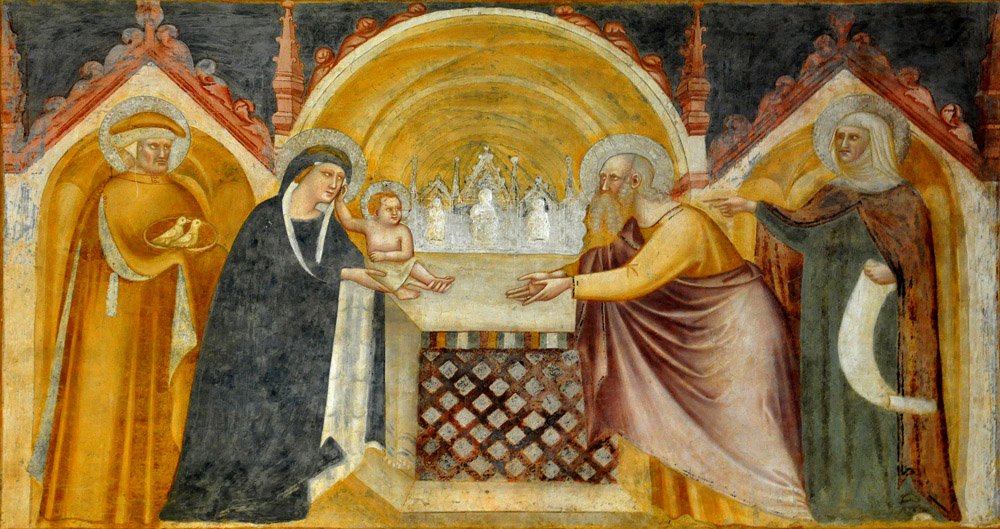
The Presentation in the Temple, 14th century fresco in Pomposa Abbey, Codorigo, Italy

When the time came for the purification rites required by the Law of Moses, Joseph and Mary took him to Jerusalem to present him to the Lord (as it is written in the Law of the Lord, “Every firstborn male is to be consecrated to the Lord”), and to offer a sacrifice in keeping with what is said in the Law of the Lord: “a pair of doves or two young pigeons.”

Now there was a man in Jerusalem called Simeon, who was righteous and devout. He was waiting for the consolation of Israel, and the Holy Spirit was on him. It had been revealed to him by the Holy Spirit that he would not die before he had seen the Lord’s Messiah. Moved by the Spirit, he went into the temple courts. When the parents brought in the child Jesus to do for him what the custom of the Law required, Simeon took him in his arms and praised God, saying:

“Sovereign Lord, as you have promised,
    you may now dismiss your servant in peace.
For my eyes have seen your salvation,
    which you have prepared in the sight of all nations:
a light for revelation to the Gentiles,
    and the glory of your people Israel.”

The child’s father and mother marveled at what was said about him. Then Simeon blessed them and said to Mary, his mother: “This child is destined to cause the falling and rising of many in Israel, and to be a sign that will be spoken against, so that the thoughts of many hearts will be revealed. And a sword will pierce your own soul too.”

There was also a prophet, Anna, the daughter of Penuel, of the tribe of Asher. She was very old; she had lived with her husband seven years after her marriage, and then was a widow until she was eighty-four. She never left the temple but worshiped night and day, fasting and praying. Coming up to them at that very moment, she gave thanks to God and spoke about the child to all who were looking forward to the redemption of Jerusalem.

When Joseph and Mary had done everything required by the Law of the Lord, they returned to Galilee to their own town of Nazareth. And the child grew and became strong; he was filled with wisdom, and the grace of God was on him. (New International Version)

The Gospel accounts of Matthew, Mark, Luke, and John actually contain very little information about the childhood of Jesus. That’s because the Gospels are not biographies – in the sense we think of them – but rather they are narratives that seek to answer a fundamental question about faith and life on this earth: Who is this Jesus?

C.S. Lewis went about exploring that very question. He reasons with us in his classis work, Mere Christianity:

“I am trying here to prevent anyone saying the really foolish thing that people often say about Him: I’m ready to accept Jesus as a great moral teacher, but I don’t accept his claim to be God. That is the one thing we must not say. A man who was merely a man and said the sort of things Jesus said would not be a great moral teacher. He would either be a lunatic — on the level with the man who says he is a poached egg — or else he would be the Devil of Hell. You must make your choice. Either this man was, and is, the Son of God, or else a madman or something worse. You can shut him up for a fool, you can spit at him and kill him as a demon or you can fall at his feet and call him Lord and God, but let us not come with any patronizing nonsense about his being a great human teacher. He has not left that open to us. He did not intend to.”

C.S. Lewis, Mere Christianity

St. Luke’s account of Christ’s childhood stories, seeks to make some important theological points about Jesus:

  • born a Jew amongst devout religious Jews in a thoroughly Jewish society, under Roman authority (Luke 2:1-7)
  • born of a woman, born under the law (Galatians 4:4-5)
  • obedient to his heavenly Father (Luke 2:49; Mark 3:35)
The Presentation in the Temple, 14th century marble statue in the National Museum of the Middle Ages, Paris, France

So, as such, the presentation of Jesus in Jerusalem at the temple is motivated by specific requirements of the law of Moses:

The Lord said to Moses, “Say to the Israelites: ‘A woman who becomes pregnant and gives birth to a son will be ceremonially unclean for seven days…. On the eighth day the boy is to be circumcised. Then the woman must wait thirty-three days to be purified from her bleeding. She must not touch anything sacred or go to the sanctuary until the days of her purification are over….

“‘When the days of her purification for a son… are over, she is to bring to the priest at the entrance to the tent of meeting a year-old lamb for a burnt offering and a young pigeon or a dove for a sin offering….

“‘These are the regulations for the woman who gives birth to a boy… But if she cannot afford a lamb, she is to bring two doves or two young pigeons, one for a burnt offering and the other for a sin offering. In this way the priest will make atonement for her, and she will be clean.’” (Leviticus 12:1-8, NIV)

What’s more, every first-born male (as Jesus was) specifically belongs to the Lord, and is set apart.

The Lord said to Moses, “Consecrate to me every firstborn male. The first offspring of every womb among the Israelites belongs to me… you are to give over to the Lord the first offspring of every womb….”

“In days to come, when your son asks you, ‘What does this mean?’ say to him, ‘With a mighty hand the Lord brought us out of Egypt, out of the land of slavery. When Pharaoh stubbornly refused to let us go, the Lord killed the firstborn of both people and animals in Egypt.

This is why I sacrifice to the Lord the first male offspring of every womb and redeem each of my firstborn sons.’ And it will be like a sign on your hand and a symbol on your forehead that the Lord brought us out of Egypt with his mighty hand.” (Exodus 13:1-2, 12, 14-16, NIV)

Luke was making the connection that when Joseph and Mary presented Jesus to the Lord in Jerusalem, they were essentially dedicating his life to God. Jesus will be the means of redemption for all the people.

Mary would have remembered the words the angel Gabriel told her, that her son will not only be holy, but also be called the Son of God. The life of Jesus – conception, birth, and presentation at the temple – is demonstrably dedicated fully and completely to his heavenly Father. Deliverance for both Jews and Gentiles is focused in the person of Jesus.

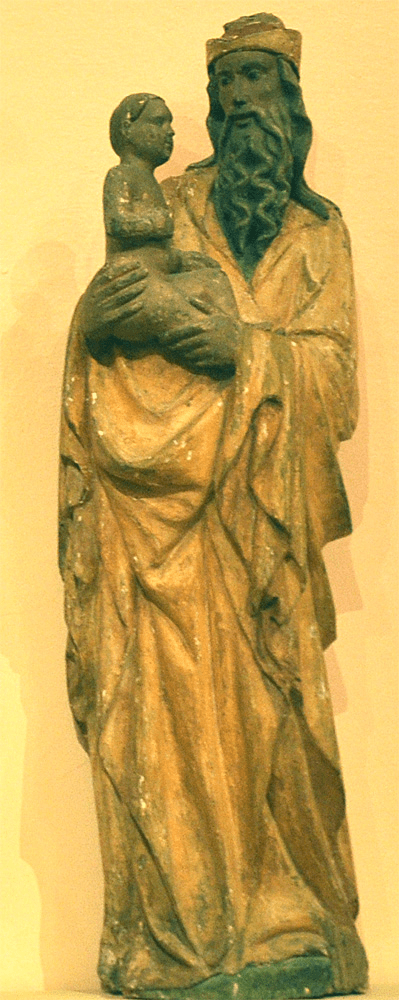
Simeon and the Child Jesus, 16th century statue in Zadar, Croatia

Simeon and Anna show up at the presentation of Jesus as devout Jews who are awaiting the fulfillment of God’s promises of consolation and redemption for Israel.

“I, the Lord, have called you in righteousness;
    I will take hold of your hand.
I will keep you and will make you
    to be a covenant for the people
    and a light for the Gentiles.” (Isaiah 42:6, NIV)

Break forth; shout together for joy,
    you ruins of Jerusalem,
for the Lord has comforted his people;
    he has redeemed Jerusalem.
The Lord has bared his holy arm
    before the eyes of all the nations,
and all the ends of the earth shall see
    the salvation of our God. (Isaiah 52:9-10, NRSV)

Simeon and Anna became the spokespersons for the redemption that is to come through Jesus. They both got a glimpse of the salvation that would, one day, reveal itself to the whole world. Forgiveness of sins, deliverance from death and hell, and freedom from guilt and shame all become laser focused on the suffering servant of God.

Who is Jesus? He is the ultimate meaning of Christmas, the incarnation of the Son of God, the Savior of the world. Amen.

Listen to Lady Wisdom (Proverbs 9:1-12)

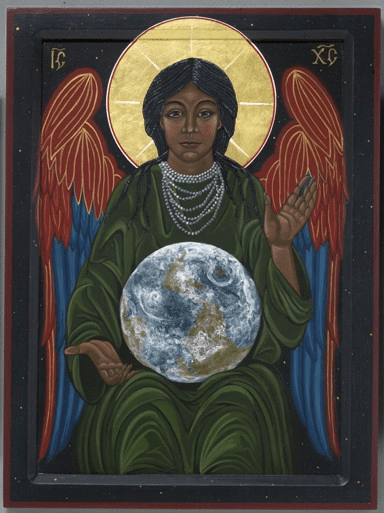
Sophia, Divine Wisdom, by Mary Plaster

Wisdom has built her house;
    she has set up its seven pillars.
She has prepared her meat and mixed her wine;
    she has also set her table.
She has sent out her servants, and she calls
    from the highest point of the city,
    “Let all who are simple come to my house!”
To those who have no sense she says,
    “Come, eat my food
    and drink the wine I have mixed.
Leave your simple ways and you will live;
    walk in the way of insight.”

Whoever corrects a mocker invites insults;
    whoever rebukes the wicked incurs abuse.
Do not rebuke mockers or they will hate you;
    rebuke the wise and they will love you.
Instruct the wise and they will be wiser still;
    teach the righteous and they will add to their learning.

The fear of the Lord is the beginning of wisdom,
    and knowledge of the Holy One is understanding.
For through wisdom your days will be many,
    and years will be added to your life.
If you are wise, your wisdom will reward you;
    if you are a mocker, you alone will suffer. (New International Version)

Life is full of choices. Whether we quibble about how much free will or deterministic fate a person actually has, or has not, we are still left with the ability to choose how we shall proceed and/or respond to basic life situations.

The two basic choices in life were often displayed in early film and television cartoons by having an angel on one shoulder and a devil on the other. The stereotypical portrayal helps us see that there is always a choice between good and evil.

Although our choices in life are quite personal and specific to a particular situation, the choice between good and evil is much bigger than this. It is choosing a certain way to look at the world, which then influences and informs the concrete decisions we make in life.

In our lesson for today, wisdom is personified as a lady calling out to us as people. In contrast, foolishness or folly is equally personified. The two ladies are continually speaking to us.

Lady Wisdom leads the community of sages who know how to live a right, just, and good life; she invites others to join her at the table and learn her ways. On the other hand, Lady Folly heads a group of simpletons who are driven by the passions of the moment; she easily attracts those who want cheap and easy solutions.

Wisdom’s message is a passionate appeal to take the path of insight through God’s revealed will. We are encouraged to leave empty-headed ways of thinking, and live with awareness, insight, and direction. The term “wisdom” in Scripture is the ability to apply sound biblical instruction and divine commands to concrete situations in our lives. 

For the spiritual person, especially, it is vital and imperative to daily listen to Lady Wisdom and follow her instructions.

The fact of the matter for too many people is that they are too impatient to let Lady Wisdom teach them her ways. It takes too much time, and is too hard for them. So, they turn to Lady Folly, who makes bogus promises of satisfaction without all the time and effort.

Idolatry (running toward other gods) immorality (running to victimize another) lying (running the mouth without any truth to it) and arrogance (running to get quick power and authority) often results from the inability to wait on the lessons that Lady Wisdom deeply desires to impart to us. 

Wisdom is not gained quickly; her teachings must be learned slowly with careful application over time. We are much too prone to wanting the simple solutions to complex problems that Lady Folly offers. But Lady Wisdom calls us to leave such simplistic thinking and take the high road of authenticity, self-awareness, and attention to the common good of all persons.

Therefore, rather than rushing to Google for answers to our questions; instead of allowing another person to make decisions for us; in place of implementing sheer pragmatic plans; allow Lady Wisdom to penetrate the mind and the heart so that what comes out is thoroughly good, benevolent, just, and helpful. 

And the best place to begin in starting down the road of wisdom is to give the Lord proper place in our lives. The skills for a good life gets its start through respect of God and obedience to the Lord. To truly have understanding and a wise life, one must get to know God. 

Nobody can talk themselves into wisdom, because it takes a reverent spirit, listening ears, and measured words to be able to put Lady Wisdom’s instruction into practice. There are no substitutes.

All-Wise God, the One who is never in a hurry and who is always holy, create in me a wise mind and a wise heart. Help me to sit still long enough for wisdom to bring spiritual growth and maturity to my life, through Jesus Christ my Lord, in the power of the Holy Spirit. Amen.