The Lamb of God (John 1:29-34)

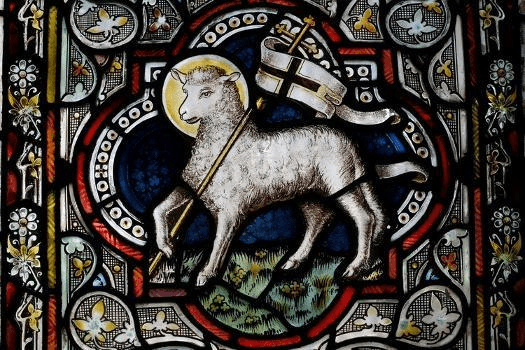
Stained glass of the Agnus Dei (Lamb of God), Chamonix, France

The next day John saw Jesus coming toward him and said, “Look, the Lamb of God, who takes away the sin of the world! This is the one I meant when I said, ‘A man who comes after me has surpassed me because he was before me.’ I myself did not know him, but the reason I came baptizing with water was that he might be revealed to Israel.”

Then John gave this testimony: “I saw the Spirit come down from heaven as a dove and remain on him. And I myself did not know him, but the one who sent me to baptize with water told me, ‘The man on whom you see the Spirit come down and remain is the one who will baptize with the Holy Spirit.’ I have seen and I testify that this is God’s Chosen One.” (New International Version)

The Gospel of John is all about finding and seeing Jesus – and then believing. Jesus is seen from various angles, namely because, as the embodiment of God, he requires a multi-perspectival look. In today’s lesson, we see John the Baptist exhorting everyone to take a look at Jesus as the Lamb of God.

Throughout the Apostle John’s Gospel, we see the gradual unfolding of belief amongst people, including the faith of John the Baptist. The Baptist’s initial understanding was that he was in the presence of someone of much greater worth than himself. Only by means of God’s Spirit is John able to gain increased insight concerning Jesus.

It’s important to point out that faith is never a static sort of thing. Rather, faith is always moving in a direction; it’s dynamic. Faith is more than a gift that’s put in a box and given and received. There is continual discovery to faith. It’s as if we’ve been given the gift of a Russian doll, and there are ever-increasing gifts within the gift. There are multiple levels of belief to explore and discover.

Spiritual insight is an initial gift of faith. There is, however, more. With insight there follows the ability to distinguish between material and immaterial realities. This is one reason why the Gospel of John can be difficult to understand – because within one verse, statement, or story, there are double, even triple, meanings to it.

John often invites us to see the spiritual reality that is there underneath the physical. It will take eyes of faith to see, because sheer physical sight will not see the entire reality. And at the end of faith is Jesus, to confess and believe that he is indeed the very Son of God.

The Holy Spirit in today’s lesson actually serves as the divine witness to John the Baptist’s burgeoning development of faith in Christ; John sees Jesus not only as coming from God, but as God.

The confirming voice of the Spirit at the baptism of Jesus lets everyone know that this Lamb of God, Jesus, the Son of God, will take away the sin of the world in his eventual Passover death.
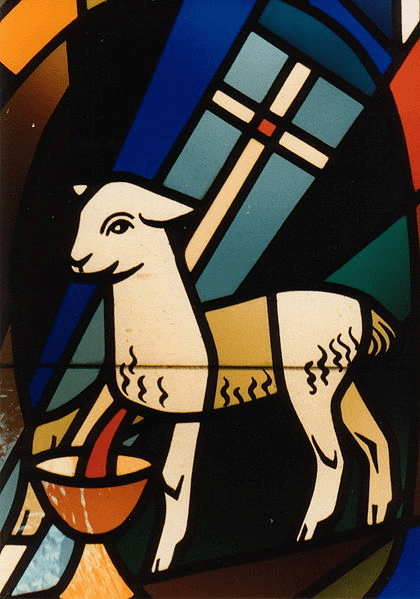
Stained glass of the Agnus Dei, El Cajon, California

To take away sin means to remove it and purify the person from it. John’s increased understanding discerns that his words and his baptism with water don’t bring this removal and purification; but they do point to Jesus. Christ as the one who is able to immerse people in the cleansing bath of grace.

Jesus Christ is qualified and able to call, gather, and cleanse not only Israel, but also the world and all the scattered children of God. Thus, John the Baptist’s ministry is to reveal Jesus to Israel; it’s directed to the entire world and to the taking away of the world’s great sin, once and for all.

The reference to Jesus as the “Lamb of God” is a familiar one to Christians. Lambs are common throughout the Bible. A lamb, however, that takes away sin is somewhat novel (although a scapegoat symbolically takes aways Israel’s sin into the desert, Leviticus 16:8-10). Passover lambs, lambs offered twice daily and in several offerings and acts of worship, were a part of many guilt and purification rituals in the Old Testament. (Leviticus 9:1-13; 14:1-13)

It seems to me that the Apostle John understood Jesus as the Lamb which removes sin by being the representative and once for all sacrifice to end all sacrifices. There is no longer any need to keep offering these various lambs day after day, festival after festival, year after year; Jesus is the efficacious one who ends it all and finally purifies and atones with potent deliverance from sin.

Day after day every priest stands and performs his religious duties; again and again he offers the same sacrifices, which can never take away sins. But when this priest [Jesus] had offered for all time one sacrifice for sins, he sat down at the right hand of God, and since that time he waits for his enemies to be made his footstool. For by one sacrifice he has made perfect forever those who are being made holy. (Hebrews 10:11-14, NIV)

And what is more, it’s this same Lamb of God who will again show up – even though slain, and yet lives – to gather together all the nations of the earth, lead them as the singular Good Shepherd, vanquish all the enemies who oppose goodness, and establish divine light in a sort of eternally lit menorah that blesses the world. (Revelation 5:6-12; 6:1; 7:17; 14:1: 1714; 21:22-23)

The baptism with water of Jesus by John the Baptist, therefore, confirmed and anticipated the baptizing (purifying) work of the Holy Spirit that only Jesus would accomplish. For John baptized with water, but Jesus baptizes with both water and Spirit – demonstrating his singular ability as Savior and Lord.

In this Christian season of Epiphany, Jesus – the Lamb of God who takes away sin and purifies with the Spirit – is Christianity’s eternal light and life.

The bright star still compels people to come and see, as well as leads the little Christs called “Christians” to take their light and let it shine wherever they go. It is a light of mercy and mystery, grace and goodness, wonder and wisdom. It is, I believe wholeheartedly, the light the world needs in order to bring an end to division and connect one another in peace and goodwill.

May it be so, to the glory of God. Amen.

Set Apart for a Purpose (Exodus 30:22-38)

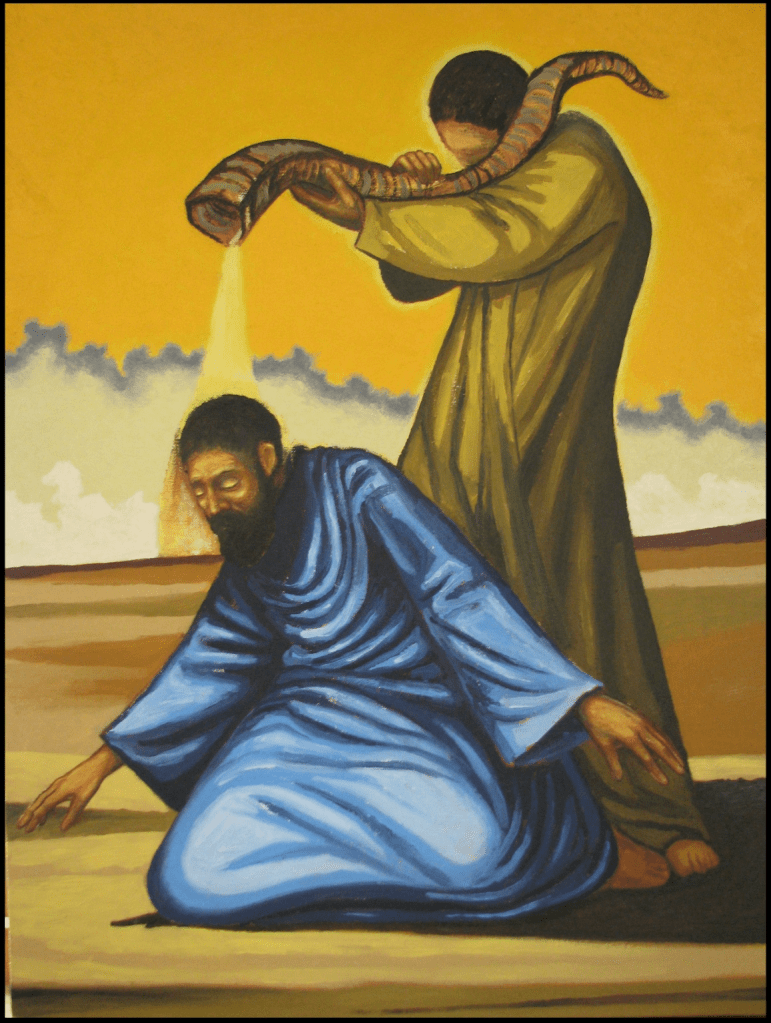
Aaron is anointed by Moses, by Jack Baumgartner

Then the Lord said to Moses, “Collect choice spices—12 1⁄2 pounds of pure myrrh, 6 1⁄4 pounds of fragrant cinnamon, 6 1⁄4 pounds of fragrant calamus, and 12 1⁄2 pounds of cassia—as measured by the weight of the sanctuary shekel. Also get one gallon of olive oil.

Like a skilled incense maker, blend these ingredients to make a holy anointing oil. Use this sacred oil to anoint the Tabernacle, the Ark of the Covenant, the table and all its utensils, the lampstand and all its accessories, the incense altar, the altar of burnt offering and all its utensils, and the washbasin with its stand. Consecrate them to make them absolutely holy. After this, whatever touches them will also become holy.

“Anoint Aaron and his sons also, consecrating them to serve me as priests. And say to the people of Israel, ‘This holy anointing oil is reserved for me from generation to generation. It must never be used to anoint anyone else, and you must never make any blend like it for yourselves. It is holy, and you must treat it as holy. Anyone who makes a blend like it or anoints someone other than a priest will be cut off from the community.’”

Then the Lord said to Moses, “Gather fragrant spices—resin droplets, mollusk shell, and galbanum—and mix these fragrant spices with pure frankincense, weighed out in equal amounts. Using the usual techniques of the incense maker, blend the spices together and sprinkle them with salt to produce a pure and holy incense. Grind some of the mixture into a very fine powder and put it in front of the Ark of the Covenant, where I will meet with you in the Tabernacle.

You must treat this incense as most holy. Never use this formula to make this incense for yourselves. It is reserved for the Lord, and you must treat it as holy. Anyone who makes incense like this for personal use will be cut off from the community.” (New Living Translation)

It’s not everyday that you get a scripture text like this one to reflect upon. Yet, since all of Holy Scripture is given to us and for us, it’s good to occasionally have to work through the place and purpose of seemingly mundane passages within the Bible.

The ancient world of the Israelites had a relationship with their God in which everything and every part of their lives were to be holy – both worship and daily life were infused with reminders that they were set apart entirely to God and for God.

Therefore, what the people wore, what they ate, and how they went about daily tasks of living and worshiping was dictated to them from the Lord. The purpose of all the detailed instructions was to reinforce the importance of being a holy people, a kingdom of priests, who could show the world how a community of persons devoted to Yahweh lived, talked, and acted.

Concerning the people’s worship of God, chapters 25-31 of Exodus provide detailed plans for the sacred space and symbols which were to be used in that worship. Elaborate specifications were given for their construction and placement.

Today’s Old Testament lesson deals with the special formula for anointing oil. In keeping with the holiness which is to be pervasive throughout all of Israelite life, this particular oil has a specific use, and is never to be used outside of that ordained purpose.

The sanctity of the oil is communicated in the strongest of terms; profane use of it is strictly forbidden. And all of the work is to be done during six days of the week, because the Sabbath is a day set apart as different, with an abundant rest from labor.

The anointing oil is used for symbolic marking in the service of God. The priests (the Levites Aaron and his sons) were to use the oil, since they were the only ones set apart to do the priestly work. The articles used for worship were also marked with the anointing oil. (Exodus 29:4-7)

None of this liturgical action was in any sort of way magical; it communicated the important theological concept that God is holy, and therefore, holiness is to be woven into every facet of Israelite life. The anointing oil was a sign of God’s acknowledgement and approval that the objects and the people being anointed were to be exclusively used for worship.

Holiness and being set apart aren’t only ancient ideas and practices; it’s also an important part of the New Testament and the way we are to live today. That’s because holiness isn’t merely something God does; it is inherent to God’s very nature. Therefore, as people created in God’s image and likeness, we too, are to live sanctified lives, set apart to live as humans are designed to live.

“You must be holy because I, the Lord your God, am holy.” (Leviticus 19:2, NLT)

“You must be holy because I, the Lord, am holy. I have set you apart from all other people to be my very own.” (Leviticus 20:26, NLT)

But now you must be holy in everything you do, just as God who chose you is holy. For the Scriptures say, “You must be holy because I am holy.”

1 Peter 1:15-16, NLT

Followers of Christ are set apart for a purpose – to be holy and sanctified in all they say and do. And, much like the ancient followers of God, Christians are to worship the Lord alone, living differently than the rest of the world.

It is God’s will that you should be sanctified. (1 Thessalonians 4:3a, NIV)

You are a chosen people, a royal priesthood, a holy nation, God’s special possession, that you may declare the praises of him who called you out of darkness into his wonderful light. Once you were not a people, but now you are the people of God; once you had not received mercy, but now you have received mercy. (1 Peter 2:9-10, NIV)

We have an opportunity, as people anointed and set apart for God’s good purposes, to bring mercy as we have received mercy, love as we ourselves have received love; and to maintain the integrity of holiness everywhere we go.

In today’s mass produced factory products, consumers only see the end results; they are ignorant of the person and process that made the product. Most things we buy and use come to us without any history of how they were made and who made them.

Yet, the people and the processes used in making anything is significant because holiness cannot be factory-made. There is always a connection between the person, the process, and what is being produced for the end product.

In God’s economy, it isn’t enough just to have anointing oil composed of the right ingredients; the individual and the craft employed are what make it truly an oil for anointing the holy.

People, in truth, are neither interchangeable on a factory floor assembly line, nor with the worship of God. The individual person offering their process will always have a particular outcome unique to that mix of person, process, and product. The belief that singing, praying, serving, and whatever else happens in worship is to be done with consistency – no matter who does it – is both impossible and not expected by God.

Though the ingredients of a particular spiritual experience always remain the same, Holy Scripture suggests that the subtle differences each individual brings to the craft of worship is good and necessary; without that uniqueness, there cannot be holiness.

Sanctify your church by the truth, O Lord; your word is truth.

Sanctify us by the truth, O Lord; your word is truth.

Sanctify me by the truth, O Lord; your word is truth. Amen.

The All-Sufficient One (Genesis 17:1-13)

When Abram was ninety-nine years old, the Lord appeared to him and said, “I am God Almighty; walk before me faithfully and be blameless. Then I will make my covenant between me and you and will greatly increase your numbers.”

Abram fell facedown, and God said to him, “As for me, this is my covenant with you: You will be the father of many nations. No longer will you be called Abram; your name will be Abraham, for I have made you a father of many nations. I will make you very fruitful; I will make nations of you, and kings will come from you. I will establish my covenant as an everlasting covenant between me and you and your descendants after you for the generations to come, to be your God and the God of your descendants after you. The whole land of Canaan, where you now reside as a foreigner, I will give as an everlasting possession to you and your descendants after you; and I will be their God.”

Then God said to Abraham, “As for you, you must keep my covenant, you and your descendants after you for the generations to come. This is my covenant with you and your descendants after you, the covenant you are to keep: Every male among you shall be circumcised. You are to undergo circumcision, and it will be the sign of the covenant between me and you. For the generations to come every male among you who is eight days old must be circumcised, including those born in your household or bought with money from a foreigner—those who are not your offspring. Whether born in your household or bought with your money, they must be circumcised. My covenant in your flesh is to be an everlasting covenant. (New International Version)

There were 13 years between the events of chapters 16 and 17 of Genesis. God’s servant, Abram, did not hear from God in those years. Then, all of a sudden, the Lord showed up, with a new self-reference as “God Almighty.”

“God Almighty” (“El Shaddai,” the all-sufficient God) appeared to Abram. The Lord brought a self-revelation to Abram as the all-competent God, the adequate God, the God who has the big picture and knows what to do with it.

Within those 13 years before El Shaddai showed up, Abram tried his own plan for acquiring an heir to God’s covenant promises. It didn’t go quite as designed. Along with Abram, people in every age need to discover or recover the presence of God Almighty, El Shaddai, the Lord who is completely sufficient for anything and everything in life.

Our role, much like Abram’s, is to bring a wholehearted devotion to our walk with God – not looking for some extra supplement to the Lord, as if divine resources and help is inadequate or untrustworthy. We are to have a sincere and obedient stance toward God Almighty.

Too many people seek to serve two masters, as if this will help cover all the bases of what we need. But Jesus was savvy to this, understanding that it only complicates things:

“No one can serve two masters. Either you will hate the one and love the other, or you will be devoted to the one and despise the other.”

Jesus (Matthew 6:24; Luke 16:13, NIV)

God Almighty wanted Abram to know and believe that El Shaddai doesn’t allow any dual allegiances – mainly because all of us can only really serve one master.

This realization and determination to serve God Almighty alone elicits El Shaddai giving Abram a new name: Abraham. Knowing God in a new or different way always changes us, as if we are new people with new names. For Abram, now Abraham, the change is one of moving from the “exalted father” who had his own ideas, to the “father of many nations” who will bless all those with the same discovery and determination to let God be God, without all the puny human interference.

And You Shall Circumcise the Flesh of Your Foreskin, by Gerard Hoet (1648-1733)

With any seminal change of life, a very real and tangible sign is important, in order to never forget who God is, and who we as people are. For Abraham and those born to him, circumcision was that sign.

And what a sign it was! God actually told Abraham that all the males in his household were to have their foreskin removed. If anything, this was a sign given which could never get lost! It was enduring, always there, and unforgettable. It is a constant reminder that the people of Abraham, the Hebrews, are to be different and singularly devoted to El Shaddai.

In Christianity, we are to have a circumcision of the heart, and not necessarily the flesh. It is the heart, which is to be completely devoted to God Almighty, that is, the entirety of a person’s life. The whole person is to be oriented to one master who rules both body and soul.

A person is not a Jew who is one only outwardly, nor is circumcision merely outward and physical. No, a person is a Jew who is one inwardly; and circumcision is circumcision of the heart, by the Spirit, not by the written code. Such a person’s praise is not from other people, but from God. (Romans 2:28-29, NIV)

The one devoted to God Almighty in Jesus Christ is to use body, mind, emotions, and spirit for good divine purposes. Christians are meant to rely solely and completely upon Christ. They are to take every action, every thought, every feeling, every imagination and make it captive to Christ.

To be circumcised is to be set apart for good and noble purposes, to have a heart fully devoted to God Almighty as the ever-living, ever-loving, all-sufficient Sovereign of the universe.

God Almighty, open our eyes that we may see; incline our hearts that we may desire; and order our steps that we may follow the way of your commandments, now and forever, through Jesus Christ our Lord, who with you and the Holy Spirit are one God, for all time. Amen.

Baptism of the Lord (Mark 1:4-11)

The Baptism of Jesus, by Rosalind Hore

So John the Baptist showed up in the desert and told everyone, “Turn back to God and be baptized! Then your sins will be forgiven.”

From all Judea and Jerusalem crowds of people went to John. They told how sorry they were for their sins, and he baptized them in the Jordan River.

John wore clothes made of camel’s hair. He had a leather strap around his waist and ate grasshoppers and wild honey.

John also told the people, “Someone more powerful is going to come. And I am not good enough even to stoop down and untie his sandals. I baptize you with water, but he will baptize you with the Holy Spirit!”

About that time Jesus came from Nazareth in Galilee, and John baptized him in the Jordan River. As soon as Jesus came out of the water, he saw the sky open and the Holy Spirit coming down to him like a dove. A voice from heaven said, “You are my own dear Son, and I am pleased with you.” (Contemporary English Version)

Why is the baptism of Jesus important?    

The baptism of the Lord is a regular staple each year on the Christian Calendar, because Christ’s baptism is a theologically profound event that announces the fact of his divinity in a dramatic way. The story of his baptism helps us understand Christ’s identity, as well as his mission.

Because God the Father acknowledged Jesus as God the Son, we are encountering God’s will for us through the words and actions of Christ. Jesus is the hinge upon which all history turns. The centrality of Jesus for everything we say and do is confirmed and expected through the event of his baptism.

Baptism is a ritual that signals new life. Jesus came to be baptized by John in the Jordan River – not because he personally needed to repent of sin – but so that he might identify with us as humans and signal for us the true way of life for people.

Jesus’ Baptism, by Laura James

With the Father’s affirmation of Christ, the Lord Jesus is our authority. All authority on heaven and earth has been given to him. He is the author and finisher of our faith. So we must pay careful attention to Jesus.

Here we are, two millennia removed from the earthly ministry of Christ. For some, the name of Jesus might be so familiar that they end up ignoring him. Or, others might become so disappointed with Jesus that, over time, they simply slip away from him. That’s why the author of the book of Hebrews exhorted: 

We must give our full attention to what we were told, so we won’t drift away. The message spoken by angels proved to be true, and all who disobeyed or rejected it were punished as they deserved. So if we refuse this great way of being saved, how can we hope to escape? The Lord himself was the first to tell about it, and people who heard the message proved to us that it was true. (Hebrews 2:1-3, CEV)

By remembering our own baptisms, and the authoritative claim Christ has upon us, we are able to keep what is most important in front of us at all times.

Why is the descent of the Holy Spirit significant?

If God the Father established the authority of Jesus over all things, then the Holy Spirit coming upon Jesus empowered him to exercise that authority over everything, especially the demonic realm. Jesus was given the Spirit so that he would confront evil in the world.

Our own baptisms are a participation in the baptism of Christ. We receive the same power. We are called to the same practice of self-denial in order to confront evil in our lives and in the world. The descent of the Spirit in Christ’s baptism opens to us a road of carrying our cross daily, and losing our lives in order to save them.

In Christ, we died to guilt and shame. We were baptized into Christ, and were therefore baptized into his death.  That means Jesus has opened the way for us to live a new life and no longer be slaves to sin. It furthermore means that we have been given the Spirit to deal with the continuing presence of sin in this life. 

Through Jesus Christ the Spirit of life set us free from sin and death. Therefore, we have been given the power to resist the devil and set our minds on what the Spirit desires. 

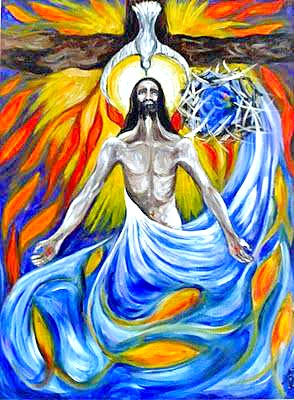
Baptism of Christ, by He Qi

So, we have an obligation, and it’s not to the sinful nature. Our responsibility is to put to death the misdeeds of the body. We can do this because we have not been given a spirit that makes us slaves to fear, but have received the spirit of sonship. (Romans 8:1-17)

Thus, God is not only Father of Jesus, but our Father, as well. We can cry “Abba and have all the help of heaven behind us in our quest to follow Jesus. This is all possible because of the descent of the Spirit in Christ’s baptism – a baptism that we participate in through our own baptisms.

How does heaven opening help me today?

Heaven was ripped and torn open, letting us know the striking reality that God does not remain far away, but has come near to us in the Son, the Lord Jesus.

Long ago in many ways and at many times God’s prophets spoke his message to our ancestors. But now at last, God sent his Son to bring his message to us. God created the universe by his Son, and everything will someday belong to the Son. God’s Son has all the brightness of God’s own glory and is like him in every way. By his own mighty word, he holds the universe together. After the Son had washed away our sins, he sat down at the right side of the glorious God in heaven. (Hebrews 1:1-3, CEV)

Heaven was again ripped open at the death of Christ. The curtain of the temple that separated the inner sanctuary from everything else was torn in two from top to bottom – signifying that once and for all, God is near, and has become close to us in the person of Jesus Christ.

So whenever we are in need, we should come bravely before the throne of our merciful God. There we will be treated with undeserved grace, and we will find help. (Hebrews 4:16, CEV)

What is our appropriate response to the baptism of the Lord?

Since Jesus is the rightful ruler of the universe; the authority over all things; a faithful high priest always living to intercede for us; the power to transform and give new life; the Deliverer from sin, death, and hell; then our proper response is confession, repentance, and the expectation of change.

The Lord’s baptism exposes all the things we rely upon other than Jesus, such as our own ability to set goals and accomplish them through sheer willpower; ideas and ingenuity; hard work and experience.

Yet we can rely on Jesus, and have the sort of change that he can bring. Rather than expecting everyone else, and every circumstance to change, God calls us to change through the empowering presence of the Holy Spirit – the same Spirit given to Jesus.

We have the opportunity and the invitation to trust Jesus. Just as it took humility for Jesus to be baptized by John in the Jordan River, so it takes humility for us to come to Christ and admit our need for help and inner transformation.

Almighty ever-living God,
who, when Christ had been baptized in the River Jordan,
and as the Holy Spirit descended upon him,
solemnly declared him your beloved Son,
grant that your children by adoption,
reborn of water and the Holy Spirit,
may always be well pleasing to you. Amen.