I'm just a common ordinary pastor, chaplain, father, grandfather, and dog owner who loves the smell of a genuine leather Bible and the aroma of its message. I'm on a quest to track down the best Bibles, how to best read and use them, and to discover the encouragement inside.
But someone will ask, “How are the dead raised? With what kind of body will they come?” How foolish! What you sow does not come to life unless it dies. When you sow, you do not plant the body that will be, but just a seed, perhaps of wheat or of something else. But God gives it a body as he has determined, and to each kind of seed he gives its own body.
Not all flesh is the same: People have one kind of flesh, animals have another, birds another and fish another. There are also heavenly bodies and there are earthly bodies; but the splendor of the heavenly bodies is one kind, and the splendor of the earthly bodies is another. The sun has one kind of splendor, the moon another and the stars another; and star differs from star in splendor.
So will it be with the resurrection of the dead. The body that is sown is perishable, it is raised imperishable; it is sown in dishonor, it is raised in glory; it is sown in weakness, it is raised in power; it is sown a natural body, it is raised a spiritual body.
If there is a natural body, there is also a spiritual body. So it is written: “The first man Adam became a living being”; the last Adam, a life-giving spirit. The spiritual did not come first, but the natural, and after that the spiritual. The first man was of the dust of the earth; the second man is of heaven. As was the earthly man, so are those who are of the earth; and as is the heavenly man, so also are those who are of heaven. And just as we have borne the image of the earthly man, so shall we bear the image of the heavenly man. (New International Version)
We have so far experienced, in this Christian Year:
Advent and the anticipation of Christ’s birth; a celebration of that birth in the Christmas season
Epiphany with it’s light shining on the salvation we enjoy for all kinds of people
Lent, as we moved slowly and silently toward the cross and practiced spiritual disciplines
Holy Week, by walking with Jesus in Jerusalem, to the Garden of Gethsemane, up the hill to where he was crucified
But that is not the end of the story. Christ is risen! On Easter Sunday we celebrated Christ’s resurrection from death. Now, we are in the season of Eastertide, an extended time of celebration in which we revel in new life. Life is possible and real because the resurrection of Jesus from death is real.
The resurrection is crucial and central to the entire Christian life. That’s why the Apostle Paul concluded his letter to the Corinthians with a long defense of its truth.
Today’s lesson zeros in on a particular point in Paul’s argument for the importance and place of resurrection in Christianity. He insisted that the resurrection – the spiritual body – is unique; it’s not like any other sort of body. And this is the body that believers will have in the future. Just as Christ was resurrected, we too, shall experience a resurrection.
We shall be transformed from being like Adam, the original person with a physical body, to being like the risen Christ, the first with a spiritual body.
Sometimes the Apostle Paul’s arguments can seem thick and hard to get through. So, allow me to put his line of thinking in a context which I deal with every day. In my work as a hospital chaplain, I visit patients on the cardiac units. The following is the sort of conversation I sometimes have:
Patient: “Ever since I had my heart operation, I don’t feel close to God. I’ve always had a good relationship with the Lord. But I don’t sense it. It’s as if God is distant. Did I do something wrong? Maybe God is punishing me.”
Chaplain: “Sounds like you really love God.”
Patient: “Yeah, I do. I don’t get it, why I’m like this now.”
Chaplain: “Think about this with me for a minute. Your body was just traumatized. Somebody opened up your chest and messed with your literal physical heart. And that doesn’t only affect your body. It messed with your spiritual heart, too. The two hearts are different, in some ways. But there’s a close relationship between the physical heart and the spiritual heart. Trauma is trauma. It impacts your whole person, not just part of you.”
Patient: “So, am I always going to feel this way?”
Chaplain: “It’s going to take a long time to physically heal from what your body has been through. It won’t take near as long for your spiritual heart to heal – but it will heal. You’ll be close to God again. But it probably isn’t going to happen today. What’s more, it’s possible that when you heal, you’ll actually feel even closer to God than before; after having been through this, it will be like you have a new lease on life.”
Paul’s understanding of the resurrection is not far off from these sort of interactions I have with hospital patients. We live the Christian life in the tent of this body, not knowing anything different. But we will eventually die. And when that happens, we never go back to the way things were when we were living on this earth.
We don’t just get resuscitated; we eventually get resurrected. We don’t become disembodied people after death, and at the end of the age when Christ returns. No, instead, we get a body – it’s our body, but it’s different, it’s changed, because it is a spiritual body. And it’s likely to be like nothing you’ve ever experienced before.
Life on this old fallen planet of ours is sometimes characterized by adversity, trouble, hardship, and even sometimes traumatic situations. But it will not always be this way. The resurrection of Jesus Christ from death changes everything.
Death will give way to life. There will be a spiritual body. We shall be healed in the complete sense of the word – physically, mentally, emotionally, and spiritually – without any more death, disease, and destruction. Suffering will lead to glory.
This is a Christian perspective on resurrection. Since Christ is risen from death, and now has a spiritual body, so too, will his followers be raised to life with just such a body – so that we can be with the Lord forever, as it was intended when God originally created people in God’s image.
Resurrection means hope. We have the confident expectation that promises of an eternal spiritual body is coming. Just as a tiny seed is transformed into a plant, so we will be changed. For those who have had to struggle with the constant debilitations of the body, this is truly good news. And it’s no April Fools.
Lord Jesus, You suffered death but conquered it. You laid in the tomb, but on the third day, You rose again. You are the resurrection, our hope and our life. O glorious and victorious Redeemer, help us not to be afraid of death, for we must pass through it to see you face to face. And on the last day we will rise again because You said so. Amen.
Mosaic of Mary Magdalene in the garden with Jesus, Resurrection Chapel, Washington National Cathedral, Washington D.C.
Early on the first day of the week, while it was still dark, Mary Magdalene came to the tomb and saw that the stone had been removed from the tomb. So she ran and went to Simon Peter and the other disciple, the one whom Jesus loved, and said to them, “They have taken the Lord out of the tomb, and we do not know where they have laid him.”
Then Peter and the other disciple set out and went toward the tomb. The two were running together, but the other disciple outran Peter and reached the tomb first. He bent down to look in and saw the linen wrappings lying there, but he did not go in.
Then Simon Peter came, following him, and went into the tomb. He saw the linen wrappings lying there, and the cloth that had been on Jesus’s head, not lying with the linen wrappings but rolled up in a place by itself.
Then the other disciple, who reached the tomb first, also went in, and he saw and believed, for as yet they did not understand the scripture, that he must rise from the dead. Then the disciples returned to their homes.
But Mary stood weeping outside the tomb. As she wept, she bent over to look into the tomb, and she saw two angels in white sitting where the body of Jesus had been lying, one at the head and the other at the feet. They said to her, “Woman, why are you weeping?” She said to them, “They have taken away my Lord, and I do not know where they have laid him.”
When she had said this, she turned around and saw Jesus standing there, but she did not know that it was Jesus. Jesus said to her, “Woman, why are you weeping? Whom are you looking for?” Supposing him to be the gardener, she said to him, “Sir, if you have carried him away, tell me where you have laid him, and I will take him away.”
Jesus said to her, “Mary!” She turned and said to him in Hebrew, “Rabboni!” (which means Teacher). Jesus said to her, “Do not touch me, because I have not yet ascended to the Father. But go to my brothers and say to them, ‘I am ascending to my Father and your Father, to my God and your God.’”
Mary Magdalene went and announced to the disciples, “I have seen the Lord,” and she told them that he had said these things to her. (New Revised Standard Version)
Do Not Hold On To Me, by He Qi
Although Peter and John have a role in this story about Christ’s resurrection, the main character is Mary Magdalene. This is significant and symbolic for several reasons:
It was Mary who experienced one of the most profound and deep changes of life due to the ministry of Jesus. Mary had been an immoral woman and spiritually enslaved to the machinations of seven demons. Jesus thoroughly delivered her from her personal hell.
Mary was forever thankful to Jesus for changing her life, and so, she followed Christ and supported him in any way she could.
Mary was at the foot of the cross when Jesus died. While other disciples were keeping their distance out of fear, Mary was bold in standing with the other women for all to see that they were completely devoted to Jesus. Mary never turned her back on Jesus.
It was Mary who was there on the Sunday morning of Christ’s resurrection. Whereas the other followers were nowhere to be found, Mary came to the grave, still with a heart given to Jesus and grieving over his death.
Because Mary had been given a new chance at life, she was deeply thankful and everything she had belonged to Jesus. Mary Magdalene was forgiven much, and, so she loved much. Here she is, after her Lord’s crucifixion, death, and burial, at the grave of Jesus.
Mary came to the tomb on Easter Sunday still living in a Good Friday world – grieving, sad, and discouraged. She soon discovered, however, that Christ is risen!
In the midst of your days of disappointment, loss, or sadness, how have you been surprised by joy and the presence of the risen Christ? How has your grief been turned to gratitude? Have you seen the risen Lord?
Let Mary Magdalene’s experience be of encouragement to you. Mary was given new life and was transformed by the Lord. Yet, on Easter Sunday she did not immediately get what the heck was going on. Jesus rising from death was not anywhere on her radar.
The empty tomb and the angels did not immediately lead her to faith – not until she saw Jesus, and even then, she did not recognize him. Only when Jesus called her name did Mary recognize him and respond, believing it was her Lord.
And Jesus is still calling out names. He is calling your name. Jesus had said to his disciples that the sheep listen to the shepherd’s voice; he calls his own sheep by name and leads them out (John 10:3-4). One little word can change our lives forever: our name.
Easter opens a whole new world for us, as it did for Mary – a future of announcing good news and proclaiming resurrection.
There is a simple reason why the grave clothes were left in the tomb just lying there – they were not needed anymore! We no longer need the grave clothes of discouragement, defeat, and despair. We no longer need to weep and wonder because Christ is risen! Jesus Christ has called us by name, and we hear his voice.
The twentieth century theologian, Karl Barth, said that what brings people to worship God – not just on Easter, but any day – is an unspoken question clinging to our minds and hearts: Is it true? Is it true that God lives? Is it true that Jesus is alive? Could it be true that I can live a new life in Christ? Is it true that I can rebuild my life? Is it all true?
Mary Magdalene approached the tomb and found that it was true: Christ Jesus is risen from death!
Today, all over the world, followers of Jesus are testifying that this day and it’s deep implications for life is real: Christ is risen, and there is new life in Jesus. Believers across the globe are worshiping the risen Lord because they declare along with us, “I have seen the Lord!”
God has always been in the business of changing lives. British author A. N. Wilson, used to be known for his scathing attacks on Christianity and proclaimed the death of God. Yet he celebrated Easter in 2009 at a church with a group of other church members, proclaiming that the story of Jesus is the only one that makes sense out of life and its challenges. Wilson said:
“My own return to faith has surprised none more than myself…. My belief has come about in large measure because of the lives and examples of people I have known—not the famous, not saints, but friends and relations who have lived, and faced death, in light of the resurrection story, and in the quiet acceptance that they have a future after they die.”
The moment Jesus calls a person’s name, the power of the resurrection is enabled—the same power that raised Jesus from the dead.
Come now, see what you consider as immovable slabs of stone in your life—bitterness, insecurity, fear, self-doubt or cynicism. Those immense rocks can be rolled away. To know Jesus is to know the power of the resurrection.
We don’t need to merely hear testimonies of changed lives like Mary Magdalene’s; we can experience new life ourselves.
There is one word, one name, which has forever changed the world: “Jesus.” And Jesus wants to change the world by uttering one simple word, one name, your name, so that you can exclaim with great joy, “I have seen the Lord!”
Loving Lord Jesus, you are our freedom. When I was lost in a dark hole of guilt and shame, you liberated me. You lifted me from sin, death, and hell.
Almighty God, hear today our prayers for the salvation of the world. Grant mercy to everyone who has turned away from you. Open their hearts and minds with your gracious light. Gather your children from the east and the west, from the north and the south.
O God, bring people everywhere out of the darkness of disease and death, and into your marvelous light. Hear our prayers and answer us. May the benevolent way of Jesus be the hope of the world; among all nations may your salvation come.
Gracious Lord, our neighbors, relatives, friends, and co-workers, along with the sick, the poor, the prisoner, the widow, and all creation are in your hands. Therefore, fill us all with your love and your mighty resurrection power! And, grant us peace through Jesus Christ, our risen Lord. Amen.
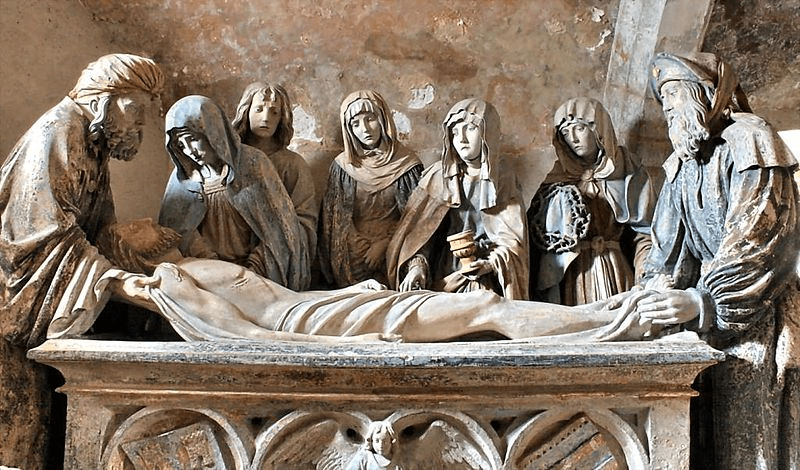
The Entombment, by the French sculptor Maître de Chaource, 16th century
After these things, Joseph of Arimathea, who was a disciple of Jesus, though a secret one because of his fear of the Jews, asked Pilate to let him take away the body of Jesus. Pilate gave him permission, so he came and removed his body. Nicodemus, who had at first come to Jesus by night, also came, bringing a mixture of myrrh and aloes, weighing about a hundred pounds.
They took the body of Jesus and wrapped it with the spices in linen cloths, according to the burial custom of the Jews. Now there was a garden in the place where he was crucified, and in the garden there was a new tomb in which no one had ever been laid. And so, because it was the Jewish day of Preparation and the tomb was nearby, they laid Jesus there. (New Revised Standard Version)
Today is Holy Saturday – a quiet place sandwiched between the ignominy of the cross and the celebration of resurrection – a day of solitude, silence, and stillness.
This isn’t a particularly popular day. People don’t rave about Holy Saturday, in fact, many Christians haven’t had a thought that this day could have any significance. Yet, this very day has its place in the scheme of the Christian life.
There cannot be resurrection and new life without a death and dying to self. There must be suffering before there can be glory. Whenever Christians quickly jump to triumphal language about victory and speak little-to-nothing about suffering, then we are left with a cheap grace which has been purchased with the counterfeit currency of velocity.
This day is meant for us to get out of our heads and wrap our hearts around the important reality that Jesus Christ was truly in the grave – very much dead.
It was real suffering on Good Friday, and it is a real death in the grave on Holy Saturday. There is no movement. All is silent and still. Jesus is in the solitude of a dark tomb.
My friends, there is absolutely no getting around the fact that if we want a Resurrection Day with all its celebration and glory, then we cannot and must not circumvent Holy Saturday.
On Holy Saturday, Christ’s disciples were experiencing an awful and real grief. Jesus suffered. He was tortured and humiliated. Jesus died. It was surreal for the disciples. They could barely believe there could ever be a day like today. Their Lord was dead and buried in a tomb.
Holy Saturday sits us down and asks some hard questions:
Are you ready to follow Jesus and suffer as he did?
Are you willing to stop your striving, manifested through constant movement, and embrace solitude, silence, stillness with its contemplation and embrace of suffering?
Will you have sense enough to pray?
Will you practice a Christian counter-cultural shift and face the ridicule of friends so that you might take some much-needed time to be with Jesus in the tomb?
Are you so antsy and anxious that you just want to leap into Easter with no solidarity with your Lord who is in the grave?
You may think that I’m being a bit too hard, or harsh, or cold…. That’s because Jesus is cold. He has a bonified cold dead body. It’s no fake death. There’s no “swoon theory” here, as if Christ only passed-out and did a weird divine fainting spell. No, he is dead. And if you and I want to live with Jesus, we must die with Jesus.
Anyone who tries to promise a new life apart from journeying with Jesus into the grave is a spiritual charlatan.
Only through death can there be life.
On this Holy Saturday, let us intentionally slow down, do less, give ourselves a large chunk of unstructured time, and put aside routine things for a while. In its place, fill the time with unfettered access to God in Christ.
O God, Creator of heaven and earth: Grant that, as the crucified body of your dear Son was laid in the tomb and rested on this holy Sabbath, so may we await with him the coming of the third day, and rise with him to newness of life; who now lives and reigns with you and the Holy Spirit, one God, for ever and ever. Amen.
Today’s Gospel lesson encompasses the full two chapters of events surrounding the arrest, torture, crucifixion, and death of Christ. Jesus died not only for white European heritage persons (like me) but for people of all races and ethnicities everywhere. And so, it is good and appropriate that the following comes from the First Nations Version: An Indigenous Translation of the New Testament.
Every English translation of the Bible is accomplished by people translating from their own cultural perspectives and understandings. This particular translation comes through the cultural lens of American Indigenous peoples. And, in my view, this is a much needed addition to the many versions of the Bible now in print.
We have so many various translations, because we deem Holy Scripture important enough to be translated for all of the various peoples who exist – with all of their particular societal assumptions, and angles on spirituality.
So, please read this slowly, out loud if you can, and let the redemptive events of Jesus be seen in a way that will help your own understanding of Christ and his loving sacrifice for the whole world. This is Good Friday…
When he finished sending up his prayers, he and the ones who walked the road with him walked across the Valley of Darkness (Kidron) and entered a garden with many olive trees.
Speaks Well Of (Judas), the betrayer, knew about this place because Creator Sets Free (Jesus) would often go there with his followers. The betrayer came into the garden, and with him came a band of lodge soldiers sent from the scroll keepers, head holy men, and Separated Ones (Pharisees), representing the elders of the Grand Council. The air was filled with the smell of burning torches as they entered the garden carrying clubs and long knives.
Creator Sets Free (Jesus) knew all this would happen, yet he turned to the soldiers and asked, “Who have you come for?”
With one voice they answered back, “Creator Sets Free (Jesus) from Seed Planter Village (Nazareth)!”
The betrayer, Speaks Well Of (Judas), was standing there with the lodge soldiers when Creator Sets Free (Jesus) answered, “I am he!”
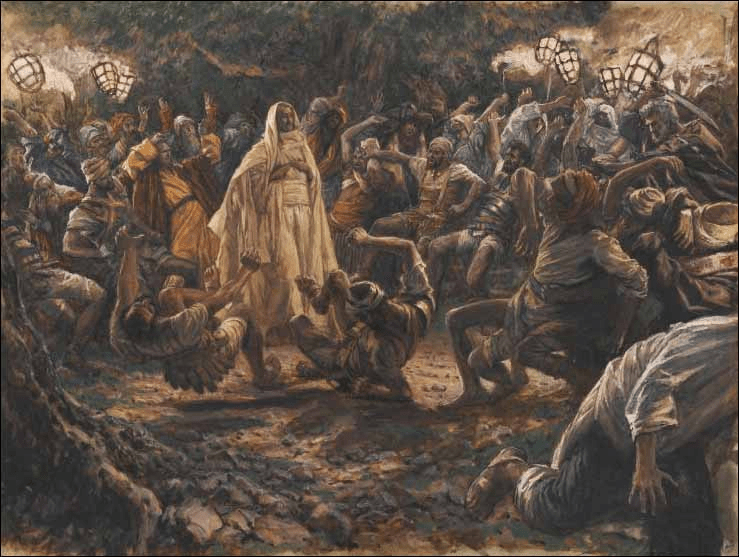
The Guards Falling Backwards, by James J. Tissot (1836-1902)
At the sound of his voice they all moved back and fell to the ground.
He asked them again, “Who have you come for?”
They answered, “Creator Sets Free (Jesus) from Seed Planter Village (Nazareth).”
“I told you already, I am the one you are looking for,” he said, “Let these other men go.”
He said this to fulfill his promise, “None of the ones you gave to me have been lost.”
Right then, Stands on the Rock (Peter) drew his long knife from its sheath and cut off the right ear of the servant of the chief holy man. The servant’s name was Chieftain (Malchus).
Creator Sets Free (Jesus) turned to Stands on the Rock (Peter) and cried out, “Enough of this! Put your long knife back into its sheath. Shall I not drink the cup of suffering my Father has asked of me?”
The lodge soldiers, along with their head soldier and the Grand Council representatives, the took hold of Creator Sets Free (Jesus), tied him securely with cowhide strips, and took him first to Walks Humbly (Annas), one of the high holy men. He was the father of the wife of Hollow in the Rock (Caiaphas), the chief holy man who had advised the Grand Council by saying, “It will be better if one man dies for all the people.”
Stands on the Rock (Peter) and one other follower had been watching from a distance. Since this follower was known by the chief holy man, he entered the courtyard of the house. But Stands on the Rock (Peter) stood outside the gate. This follower spoke to the gatekeeper, a young woman, who then let Stands on the Rock (Peter) in.
The Denial of St. Peter, by Gerard Seghers, c.1620
She said to him, “Are you not one of his followers?”
“No!” he told her, “I am not.”
The night was growing cold, so some of the men, along with the solider guards from the lodge, built a fire in the courtyard to keep warm. Stands on the Rock (Peter) stood there with them, trying to stay warm.
Back inside, the chief holy man began to question Creator Sets Free (Jesus) about his followers and his teachings. Creator Sets Free (Jesus) said to him, “I have spoken openly to all, in the gathering houses and the sacred lodge. I said nothing in secret. Why ask me? Ask the ones who heard me. They will know.”
One of the head soldiers struck him in the face and said, “Is that how you answer a chief holy man?”
Creator Sets Free (Jesus) answered him back, “If I have spoken wrongly, tell what I said wrong. If I spoke what is true, then by what right do you strike me?”
Walks Humbly (Annas) decided to send Creator Sets Free (Jesus) to Hollow in the Rock (Caiaphas), the chief holy man. So they took him, still bound by ropes, to Hollow in the Rock (Caiaphas).
Outside in the courtyard, Stands on the Rock (Peter) was still warming himself by the fire. The other asked him, “You are not one of his followers, are you?”
“No!” Stands on the Rock (Peter) denied. “I am not!”
One of the servants of the chief holy man, a relative of the man whose ear had been cut off, looked at him, and said, “Yes, you are! I saw you in the garden with him!”
Stands on the Rock (Peter) shook his head in denial – and right then a rooster began to crow.
Creator Sets Free (Jesus) was taken from the house of Hollow in the Rock (Caiaphas) to the lodge of the governor of the People of Iron (Romans). The tribal leaders stayed outside, for they did not want to become ceremonially unclean by going inside. It was early in the morning, and many of them had not yet eaten the ceremonial meal of Passover.
Spear of the Great Waters (Pilate) came outside to meet them.
They took Creator Sets Free (Jesus) and stood him before Spear of the Great Waters (Pilate). He took a good long look at him, then turned back to the crowd.
“What has this man done wrong?” he asked them.
“If he were not a criminal, would we have brought him to you?” they answered.
“Take him away!” Spear of the Great Waters (Pilate) said to them. “Use your own law to decide what to do.”
“Our tribal law will not permit us to put him to death,” they answered.
This proved that Creator Sets Free (Jesus) was right when he told them how he would die – by being nailed to a tree-pole – the cross.
Christ Before Pilate, by Duccio di Buoninsegna, 1310
Spear of the Great Waters (Pilate) went back into his lodge and had Creator Sets Free (Jesus) brought to him, so he could question him in private.
Once inside, he said to him, “Are you the chief of the tribes of Wrestles with Creator (Israel)?
“Is this your question,” Creator Sets Free (Jesus) asked, “or are you listening to others?”
“I am not from your tribes,” Spear of the Great Waters (Pilate) answered. “It is your own people and their head holy men who have turned you over to me. What have you done?”
“My way of ruling is a good road. It is not in the ways of this world. If it were, my followers would have fought to keep me from being captured.”
“So, then, you are a chief,” he said back to him.
“It is you who have said it,” Creator Sets Free (Jesus) answered. “I was born for this and have come into the world for this purpose – to tell about the truth. The ones who belong to the truth will listen to my voice.”
Spear of the Great Waters (Pilate) shook his head and said, “What is truth?”
Then Spear of the Great Waters went outside to the tribal leaders and said to them, “I find no guilt in this man. By your own tradition we set free one criminal during your Passover Festival. Do you want me to release Creator Sets Free (Jesus), your chief?”
“No! Not him,” the crowd roared back. “Release Son of His Father (Barabbas)!”
Son of His Father (Barabbas) was a troublemaker who had caused an uprising.
Spear of the Great Waters (Pilate) turned Creator Sets Free (Jesus) over to his soldiers to have him beaten. The soldiers twisted together a headdress from a thorn bush, pressed the thorns into his head, and wrapped a purple chief blanket around him. They bowed down before him, making a big show of it, and kept mocking him, saying, “Honor! Honor to the Great Chief of the tribes of Wrestles with Creator (Israel).”
Christ Mocked by Soldiers, by Georges Rouault (1871-1958)
They took turns hitting him on his face until he was bruised and bloodied.
Spear of the Great Waters (Pilate) stood before the crowd again and said, “I bring to you the one in whom I have found no guilt.”
Creator Sets Free (Jesus) was brought forward, blood flowing down his bruised face. He was wearing the headdress of thorns and the purple chief blanket that was wrapped around him.
“Behold the man!” Spear of the Great Waters (Pilate) said to them, “Take a good long look at him!”
The crowd stared at him in stunned silence.
But then the head holy men and the lodge guards began to shout, “Death! Death on the cross!”
“Then take him and kill him yourselves,” Spear of the Great Waters (Pilate) said to them. “I find no guilt in him!”
They answered him back, “Our law tells us he must die, for he has represented himself as the Son of the Great Spirit.”
When Spear of the Great Waters (Pilate) heard this, his fear grew stronger, so he took Creator Sets Free (Jesus) back inside his lodge.
“Who are you, and where are you from?” he questioned him.
Creator Sets Free (Jesus) stood there and remained silent.
“Speak to me! Do you not know I have the power of life and death over you? I can have you killed or set you free,” he warned him. “Have you nothing to say?”
“The only power you have is what has been given you from above,” he answered. “The ones who turned you over to me carry the greater guilt.”
Spear of the Great Waters (Pilate) tried harder to have Creator Sets Free (Jesus) released, but the people would not have it.
They stood their ground, saying, “If you release a man who says he is a chief, you are not honoring the ruler of your people, for anyone who claims to be a chief challenges his power.”
When Spear of the Great Waters (Pilate) heard this, he took Creator Sets Free (Jesus) and went to the Stone of Deciding, called Gabbatha in the tribal language, and sat down. It was now midday on the Day of Preparation for the Passover Festival.
He brought Creator Sets Free (Jesus) before the people and said, “Here is your chief.”
“Take him away! Take him away!” the crowd shouted with one voice. “Nail him to the cross!”
“Would you have me nail your chief to the cross?” he asked them.
This time the head holy men answered back, “We have no other chief than the Ruler of the People Iron (Caesar).”
Spear of the Great Waters (Pilate) then turned Creator Sets Free (Jesus) over to the soldiers to have him put to death on a tree-pole – the cross – so they took him away.
The cross was an instrument of torture and terror used by the People of Iron (Romans) to strike fear into the hearts of any who dared to rise up against their empire. The victim’s hands and feet would be pierced with large iron nails, fastening them to the cross. The victims would hang there, sometimes for days, until they were dead. This was one of the most cruel and painful ways to die ever devised by human beings.
The soldiers placed a wooden crossbeam on his back and forced him to carry it to the place where he would be executed.
Creator Sets Free (Jesus) carried the crossbeam to the Place of the Skull, which is called Golgotha in the tribal language. There they nailed his hands and feet to the cross, along with the two others, and placed his cross between the two of them.
Spear of the Great Waters (Pilate) fastened a sign to the top of the cross where they attached the crossbeam with these words written on it:
CREATOR SETS FREE
FROM SEED PLANTERS VILLAGE
CHIEF OF THE TRIBES
OF WRESTLES WITH CREATOR
This was near Village of Peace (Jerusalem). So that many of the Tribal Members could read it, the sign was written in Aramaic, their tribal language, but also in Latin and Greek, the languages of the People of Iron (Romans).
The chief head holy men and the tribal leaders said to Spear of the Great Waters (Pilate), “Do not write ‘chief of the tribes.’ Instead write, ‘He said he is chief.’”
But he answered, “What I have written will stand.”
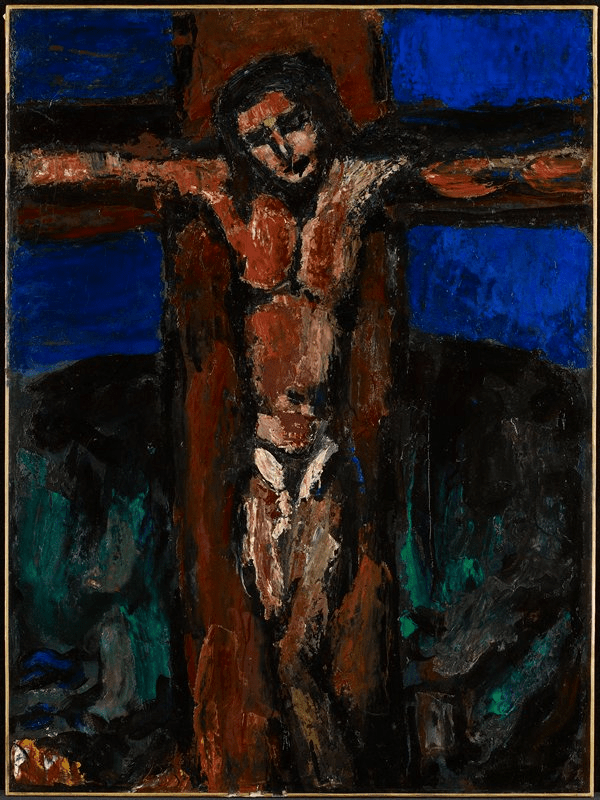
The Crucifixion, by Georges Rouault
The soldiers stripped his clothes from him when they nailed his hands and feet to the cross. They tore one of his garments in to four pieces, one for each guard. His long outer garment was woven together into one piece, so they said, “Let us not tear this, we can draw straws for it.”
This gave full meaning to the Sacred Teachings that said, “They divided my clothes between them and gambled for my garment.” This is what the soldiers did as they kept watch over Creator Sets Free (Jesus).
Standing near the cross was Bitter Tears (Mary), the mother of Creator Sets Free (Jesus), who had come to see him, along with her sister. Two other women also came with her, Brooding Tears (Mary) the wife of Trader (Clopas), and Strong Tears (Mary) from Creator’s High Lodge (Magdala). He Shows Goodwill (John), the much loved follower of Creator Sets Free (Jesus), was also there with them.
When Creator Sets Free (Jesus) looked down and saw them, he said to his mother, “Honored woman, look to your son.” The he said to his follower, “Look to your mother.”
From that time the follower took Bitter Tears (Mary) into his family and cared for her.
Creator Sets Free (Jesus), knowing he had done all the ancient Sacred Teachings had foretold, said, “I thirst.”
There was a vessel of sour and bitter wine standing nearby. One of the soldiers dipped a cloth in it to soak up some wine. He wrapped the cloth around the tip of a hyssop branch and held it up to the mouth of Creator Sets Free (Jesus).
He then tasted the bitter wine, turned his head to the sky and cried out loud, “It is done!”
He then lowered his head to his chest and, with his last breath, gave up his spirit.
Creator Sets Free (Jesus) was dead.
Soon the sun would set and a special Day of Resting would begin when no work could be done. It was time to prepare for this day, so the Tribal members asked Spear of the Great Waters (Pilate) to have the legs of the men on the crosses broken, which would make them die sooner. Then they could take the bodies down and prepare them for burial.
The soldiers came and broke the legs of the two men on each side of Creator Sets Free (Jesus). When they came to him, they saw he was already dead. Instead of breaking his legs, one of the soldiers took a spear and pierced his side. Blood and water flowed out from the wound.
The one who saw these things with his own eyes is telling the truth about this – so that all will believe. This was foretold in the ancient Sacred Teachings that say, “Not one of his bones was broken,” (Psalm 34:20) and, “They will look upon the one they have pierced.” (Zechariah 12:10)
Christ being lifted by Joseph of Arimathea and Nicodemus, by Antonio Canova (1757–1822)
He Gets More (Joseph) from High Mountain (Arimathea), a man with many possessions, was a follower of Creator Sets Free (Jesus), but in secret, because he feared the tribal leaders. Since it would soon be sunset, when the Day of Resting would begin, he went to Spear of the Great Waters (Pilate) and asked permission to remove the body of Creator Sets Free (Jesus) from the cross.
Spear of the Great Waters (Pilate) released the body to him. So he and another man, Conquers the People (Nicodemus), who had come to Creator Sets Free (Jesus) in secret at night, took his body away to prepare it ceremonially for burial. Conquers the People (Nicodemus) had brought a mixture of myrrh and oils weighing about seventy-five pounds. Together they ceremonially wrapped his body for burial in the traditional way, using strips of cloth and herbal spices and oils.
So because it was the Day of Preparation for the Passover Festival, and the day of resting was about to begin, they laid the body of Creator Sets Free (Jesus) in a nearby burial cave that had never been used and then returned to their homes.










 Rev. Tim Ehrhardt