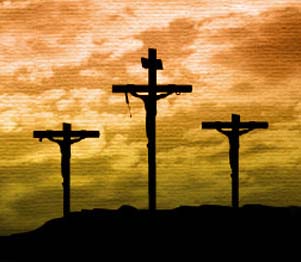
Good Friday


            What makes Good Friday good?  For Christians all across the world, this day reminds us that the grace of God in Christ makes Good Friday good.  The good news is that when Jesus died on the cross, it was neither simply a terrible act of violence nor just another crucifixion by the Romans; it was a courageous rescue operation that broke our bonds and set us free from the tyranny of the world, the flesh, and the devil.  
            What has God liberated you from?  Do you have and enjoy freedom in Jesus Christ, or are you still in bondage and need to be freed?  One of the harshest masters in our culture is the enslaving master of shame.  It locks us in an inner prison of the soul and makes sure that we do not tell our secrets.  Shame’s slaves are legion:  a well-respected mother secretly struggles with alcoholism, afraid to divulge what really keeps her going throughout her day; a much-loved man keeps looking at pornography, with no one suspecting his dark insatiable lust; a woman cannot bring herself to share with anyone that years ago she had an abortion, and barely a day goes by without the guilt raging within her; a family is too ashamed to ask for help, and are wondering how they will pay the bills this month; a couple suffers in agonizing silence, lonely and too scared to speak to anyone in the church for fear that they will be labeled as weak and unspiritual.  And on and on the examples can go.  
            All these people live in the icy grip of shame, which is why they keep up appearances on the outside, but on the inside are hurting and dying a thousand deaths.  A load of guilt has kept them hostage.  They are ashamed because they feel they have not lived-up to others’ expectations of them.  And that sense of not measuring-up has enslaved them.  
            But here is what makes Good Friday good.  This good news, the greatest story of all, of Christ’s crucifixion tells us that Jesus not only bore our guilt, he bore our shame.  Let us fix our eyes on Jesus, the author and perfecter of our faith, who for the joy set before him endured the cross, scorning its shame, and sat down at the right hand of God.  Consider him who endured such opposition from sinful men, so that you will not grow weary and lose heart (Hebrews 12:2-3).  Because Jesus did not allow himself to be bound by any shame, he freely took our place.  He took on the shame that should have been ours – the cruelty, the rejection, the mockery, and the sheer humiliation of shame – he took it all for us.  And since Jesus became shame for us, there is no need for us to be ashamed of anything anymore.  Our addictions, our failures, and our sinful secrets were crucified on the cross with Jesus.  By faith in this substitutionary sacrifice on our behalf we experience real and genuine freedom.
            We are all to come to the foot of the cross and find forgiveness, love, and healing in Jesus’ name.  Christian author Richard Foster has said:  “By living under the cross we can hear the worst possible things about the best possible people without so much as batting an eye.  If we live in that reality, we will convey that spirit to others.  They know it is safe to come to us.”  Good Friday is good because it frees us from our pride and self-centeredness and allows the new community of Jesus-lovers to help others break their bondage to shame and guilt.
            Grace is neither just a word, nor simply a nice idea – it is a powerful spiritual reality to be lived and experienced.  Today is the day of salvation.  Today is the day of forgiveness.  Today is the day to let go of our crushing burdens and tell our secrets in Jesus’ name.  Today is the day to rid ourselves of bitterness and the petty nursing of grudges against others.  Today is the day to repair that damaged relationship and apologize for being such an obnoxious and stubborn sinner.  Today is the day of salvation.  Jesus is waiting for you with outstretched arms.  See the wounds on his hands and his feet – wounds that heal and bring new life.

Holy Week


            This week is probably my most favorite of the year.  It is Holy Week.  Yes, I know its March Madness time, but nothing compares to the maddening irony of Jesus entering Jerusalem on Palm Sunday in triumph as a king, yet is part of his journey to the cross.  The shouts of “Hosanna!” would soon turn to “crucify him!”
 
            One of the greatest things, I believe, that an observance of Holy Week (Palm Sunday, Maundy Thursday, and Good Friday) does for us is center our lives in and around the person and work of Jesus Christ.  After all, as believers and followers of Christ it only makes sense that all of our lives would completely center in Him!  But Holy Week uncovers to us that our lives have been too much centered in self, in many other things with competing lords and masters.
 
            A few weeks ago I went on a week-long prayer retreat, as I try to do every year.  Whenever I get away and engage in the disciplines of solitude, silence, fasting, contemplation and prayer it does not take me long to discover that most of my life is being lived in an unhealthy rhythm that centers round a grueling schedule with many responsibilities and demands.
 
            Perhaps the greatest gift we can give to God is the precious gift of time – unhindered, unfettered, unadulterated time with no other agenda except the enjoyment of the divine.  What is more, maybe the greatest gift church leaders can offer a congregation is the gift of having truly met with God which spills over into a heart of compassion for people.
 
            Clarity is a rare quality in today’s Christian ministry leader.  Yet it can only come at the cost of extended time listening to God.  It is no wonder that pastors and ministry staff burn-out so quickly and become so easily discouraged.  Blessed is the Christian who eschews the world’s values of extreme busyness and constant activity in favor of walking, even slowly sauntering in the way of Jesus.
 
            If Holy Week teaches the contemporary Christian leader anything, it is that we have lost our way.  After all, if we have given any credence to the season of Lent we will discern that our lives are off-kilter.  We must come back to re-connecting with our vocation of soul-craft and using words, being wordsmiths of the gospel in such a manner as to doctor people to grace and forgiveness in Jesus Christ.  Tedious, patient construction of souls is our divine task.
 
            May the remembrance of Christ’s death, and the hope of His resurrection inspire and renew your spirit toward centering all of life around Jesus.

The Least Among Us


            Use your imagination on this one: going out to eat, sitting down, looking at the menu and ordering a delicious meal.  Then the food comes and you don’t touch a bite of it; you just pay the bill and leave.  That would be really weird.  It would be just as weird as having faith in God but not being committed to acts of love and kindness.  True faith works itself out in tangible acts of grace and love.  Simple acts of mercy and care:  giving food to the hungry; giving drink to the thirsty; showing hospitality to strangers; giving clothing to the threadbare; taking care of the sick; and, visiting those in prison – nothing flashy.  These are the kinds of behind-the-scene actions that Jesus heightened as commendable (Matthew 25:31-46).


Can you think the thought that every person has access to Christ through a needy person?  Jesus made it clear that he identifies so closely with the needy that when we seek to meet needs in people, it is as if we are ministering to Jesus himself.  He has a special place for the poor, the poor in spirit, and those who help the poor.
 
            We need to remember something important:  Jesus was, during his earthly life, all of those six things just mentioned.  We cannot disconnect Jesus from the fact that during his ministry he was a homeless Jew who needed food, drink, clothing, and ended up in prison and sentenced to death.  I need to not try and fashion Jesus into someone who was just like me, that is, a white middle-class guy.  Jesus didn’t have dreams of an upwardly mobile life with plenty of discretionary income so he could do things he wanted and deserved to do.  Jesus could have come to this earth born into privilege and focused on spreading his wealth.  Instead he was born in poverty, grew up in poverty, and chose poverty his entire earthly life.  It certainly is not a sin to be wealthy, but it is not the life that Jesus himself chose.  And if we aspire to be more like Jesus, we might want to rethink some of our most cherished values that center in the American dream.
 
Can you think the thought that we will be judged by whether we received Christ or not, in the way we treat the least persons among us?  Here is a radical thought (not to Jesus; just to us):  we are to do more than reach out to the poor-we are called to invite them into our lives. We are not to just increase our charitable giving while giving needy people the metaphorical stiff-arm.  We are to stretch ourselves more and more when it comes to how we relate and give to the poor. We are to stretch and give of our time and our very selves. We all must even ask the very difficult question: at what point do we consider giving until we become one of the poor? I do not have an answer to that; I just know we need to take up our crosses and follow Jesus, and, so, we must all struggle with what that means in each of our lives.  Let’s be honest: all of us, including me, are just downright selfish which is why the Lenten season is so important; we must confess our selfishness because we cannot fix ourselves – we need God to change us.
 
Can you think the thought that the way we treat other people, either good or bad, affects God deeply?  Inviting other people in our lives might seem small, but has a huge effect.  It would be good for us to take note of who are the poor and needy among us today.  Hopefully, because we know that our lives affect God deeply, Jesus will someday make the following statements to us:
I was a fetus and you brought me to term and gave me birth.
I was an orphan and you adopted me.
I was unemployed and you gave me a job.
I was in sexual slavery and you rescued me.
I was lonely and you befriended me.
I was wrongly accused and you stood up for me.
I was crying and you cried with me.
I was illiterate and you taught me to read.
I was bullied and you defended me.
I was poor and you got to know me as person and not as a project.
I was worthless and you treated me with dignity.
I was lost and you found me.
 
            I do not want us and our churches to miss Jesus because we overlooked those who are poor and needy.  We can get so inwardly focused on what we ourselves need and want that we completely lose sight that Jesus is walking right in front of us.
 
Can you think the thought that what locks most people in poverty today is not laziness but illiteracy?  At one time, literacy was defined simply as the ability to read. Today, as information and technology drive American society, that definition has been broadened. The Workforce Investment Act of 1998 defines literacy as “the ability to read, write and speak English, compute and solve problems at levels of proficiency necessary to function on the job, in the family of the individual, and in society.”  The illiteracy rates continue to rise in part not because more people are unable to read but because the level of skills needed to survive in society continues to rise.
 
            The National Institute for Literacy says that 14% of all Americans are functionally illiterate.  The connection is not hard to see:  illiteracy makes one unable to get a job because the person cannot even fill out an on-line application, and if they have help and actually get a job they lose it because they don’t have the skills to maintain the job.  If basic skills aren’t developed, many people will eventually turn to some kind of crime to get money. 
 
Maybe one person or one church can’t change the world.  But each one of us can turn one person around to literacy.  And if we have done it for that one person we have done it for Jesus himself.  

Fear Factor


Several years ago I spent about six months working in an assisted living facility.  One of the residents, who still had a house he had not sold yet, admitted to me that he had nearly $100,000 dollars in cash in his house.  It was well hidden, he assured me, within every door jamb of the house!  Having experienced the run on the banks that began the Great Depression, this man had no trust for institutions and was afraid to invest his money.
            Investment is only as good as our level of trust.  When Jesus told his story about three servants whom he gave a pile of money, he was saying something about the servants’ level of trust (Matthew 25:14-30). Two of the servants saw the master as gracious and generous and freely took their talents and confidently used them to create even more money.  They took risks, they invested, they worked, and they acted all with the idea that they were secure in their relationship with their master.  However, the third servant’s view of his master was different.  This servant saw his master as stern and serious and angry, and, so this is why he did nothing with his money because he was afraid.
He was afraid because his view of the master was not accurate.  If we see God as primarily being angry all the time, then we will not use the incredible gifts he has given us for fear of messing up and bringing his wrath upon us.  The truth is:  God is a gracious and generous God.  He has generously and graciously gifted each and every one of us, and he expects us to use those gifts and not hide them away in a door jamb!  He wants us to be like Him:  generous and gracious.  We must address this fear if we want to hear the saying:  “well done, good and faithful servant.”
            Fear is maybe the devil’s greatest tool to prevent God’s people from being productive Christians in serving the church and the world.  Beneath that fear are powerful feelings of inferiority, inadequacy, and a low view of self which is really born of a low view of God.  Fear paralyzes a person’s potential to serve God’s kingdom.  Being afraid wastes what impact a person could have for God, and waters-down life so that it is ineffective.


Fear destroys dreams and godly desires.  Psalm 37:4 encourages us to delight ourselves in the LORD, and he will give us the desires of our hearts.  We are to enjoy the gracious and generous God, and in our enjoyment of Him He will place within us godly dreams that He will absolutely delight to fulfill.  Our enjoyment of God gives us the security and confidence to act upon those godly desires and produce a wonderful harvest that we can turn right around and give back to God.  
But put fear in the mix, and it dilutes and destroys everything.  It makes you do nothing.    Not only did the third servant do nothing, like his ancestor Adam he went into hiding and didn’t put his life to work.  One of the things that church leaders need to understand is that Christian discipleship is not primarily about getting parishioners to have the answers right on some bible study workbook; it is about action and service and that will only rightly happen as we have a solid robust view of God instead of a wrong view of God that leads to us being immobilized by fear.
In the Old Testament book of Numbers, the Israelites were immobilized by fear.  God had a grand vision and a big dream for his people to enter the Promised Land.  But ten of the twelve spies who came back after checking out the land were paralyzed by fear.  “The land has giants, and we are like grasshoppers” they said.  Caleb and Joshua, however, had a different view of taking the land because they had a different view of God.  They didn’t see giants – they saw a gracious and generous God who could easily take care of whoever might be in the land, and they wanted to act on the faith they had in a mighty and merciful God.  The God of the other spies wasn’t big enough to handle the giants.  Their low view of themselves as grasshoppers betrayed their low view of God.
Pastor David Seamands has rightly observed that “we wrap a lot of our fears in morbidly sanctified self-belittling.  We piously cover this self-despising and call it consecration and self-crucifixion.”  In other words, we feel good about feeling bad.  We use those feelings to make spiritual excuses for not exploring what God’s dreams and vision is for us.  It is high time we have bold God-sized dreams!  It is time for us to get into the world with our witness in a far greater way because we serve a God who sees giants as gnats, and we will, too, if we have a high view of God.
What holds us back?  Fear of criticism; fear of taking a risk; fear of going outside of the way we’ve always done it; and, the crippling fear of what others may think or say.  If you once dreamed something and you think your dream is dead because you destroyed it by your sins and bad habits, you are wrong.  Dreams are destroyed by fear, by being tricked into thinking that we are nothing but grasshoppers and God doesn’t care, and so we do nothing.
Fear ruins relationships, with both God and others.  Seeing God as angry and belittling is right where Satan wants all of us.  Fear ends up isolating us from people.  The most common way of coping with feelings of fear, insecurity, and inferiority is by withdrawing from other people.  You cannot give yourself fully to your spouse, your kids, your church, and to the world without a healthy robust view of and relationship with God. 
 
Fear sabotages Christian service.  “I can’t!” is the cry of the person locked in fear.  Perhaps you have noticed that God isn’t typically in the business of using superstars to do His work.  Moses was tongue-tied, Abraham was really a wimp, Matthew a lowly tax-collector, and the disciple Mark was a momma’s boy.  The less talented a person is the more God gets to show off His power and His ability through him or her.
            So, give God a chance.  Give him a chance to work in and through your life.  Explore the dimensions of church ministry because you have a God behind you that is gracious and generous.  May your mustard seed of faith grow to produce a harvest of righteousness.