Genesis 45:25-46:7

            The patriarch Jacob had lived years with the belief that his beloved son was dead and gone, having been the victim of a horrible mauling.  But he was amazed to find out that Joseph was not only alive but in charge of all Egypt.  By this time in Jacob’s life he was an old man with not many years left.  He must certainly have had some fear about going to Egypt and what that would mean for him and his family because God came to him and said, “Do not be afraid to go down to Egypt, for there I will make you into a great nation.  I myself will go down with you….”
 
            Fear is likely one of the most pervasive commonalities of people of all ages from all eras – which is why the most repeated command in all of Holy Scripture is the exhortation by God to not be afraid.  The prescription to not fear always contains the reason:  God is with us.
 
            If the Bible were to have an actual title, it would not be inappropriate to have the title “God With Us.”  The story of Scripture from beginning to end is one of humanity having a love/hate relationship with God and often fickle in faith.  But, in contrast, God continues to be the same.  He maintains his covenant loyalty no matter people’s failures of faith and commitment; his presence is with them.
 
            The height and fulfillment of that divine presence came with the sending of the Son, the Lord Jesus.  His name is Immanuel, God with us.  The closer we get to Jesus, the more we realize God is near and the less we have to fear.  Even despite suffering, pain, and, in the case of the ancient Israelites, slavery in Egypt, God is with us through the hard circumstances of life.
            Father God, thank you for the gift of your Son, Jesus.  Help me so to know him so that I will live in faith and confidence no matter the situations of my life.  Amen.

Psalm 46

            For centuries the psalms have been the beloved prayer book of God’s people.  Pious Jews would know all one-hundred fifty of them by memory; medieval monks would recite them all over the course of a week, going over each one fifty-two times a year.  The psalms do more than present sound theology for modern humans; they give voice to our deepest feelings and greatest fears.
             Psalm 46 is one of the finest pieces of Hebrews poetry you will find.  Its message is one of comfort; its God is one who is in control; its prose is simply beautiful.  “God is our refuge and strength, a very present help in trouble.  Therefore we will not fear though the earth gives way, though the mountains be moved into the heart of the sea, though the mountains tremble at its swelling.”  The psalms inspire trust in God, and help relieve the chaos that seems to envelop all around us.
             It is therefore a small thing to recite this psalm many times, and allow it to become part of memory.  Being able to draw from its well in times of trouble and meditate on it can be significant in the heat of a situation.  Knowing this psalm intimately is not a shot that inoculates us from difficulty and brings instant deliverance.  But it can point us to a faithful and trusted God who knows what he is doing and is always with us, even in the cataclysmic events of our lives.
             O God, you are my refuge and my strength.  Bolster my faith in all the difficult situations around me so that I might not fear, but trust you.  I will be still and wait for your deliverance without trying to orchestrate my own.  In Jesus’ name I pray, Amen.

Follow Me


            Jesus is something else.  He had this way of doing things that was not at the whim or desire of anybody around him.  Sometimes Jesus spoke in parables when people expected him to be clear.  Sometimes Jesus did not say anything when others wanted him to speak.  And sometimes he just did not beat around bush at all and bluntly spoke.  Calling the disciples was one of those times.
 
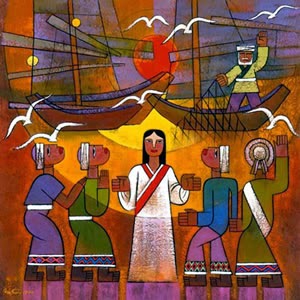
What would make you drop everything and pursue an entirely new life?  What would it take for you to follow Jesus as if your life depended on it?  What would cause you to not make any excuses and simply follow Jesus?  I am impressed with the fact that the original disciples immediately obeyed Jesus when he plainly commanded them to “Come, follow me and I will make you fishers of men” (Mark 1:16-20).  They did not question Jesus as to whether this was a short term project or a long term assignment he was calling them to.  They did not ask Jesus how following him would look to other people, or how it would impact their fishermen’s stock portfolio.  They simply dropped everything and followed Jesus.  If those disciples followed Jesus with the same reason I originally decided to follow him, it was because Jesus is such a compelling person, so gracious, interesting, and loving that it is really no decision at all.  Everything else pales in comparison with Jesus.
 
Take the time to read all the Gospels and the book of Acts and you will find this:  Followers of Jesus follow Jesus; and, those who are not following Jesus are not his followers.  It is that simple.  Followers follow, and those who do not follow are not Christ’s followers.  What you will not find when reading the Gospels and the book of Acts is that following Jesus is optional or that somehow a person can be a Christian without following Jesus.
 
            Jesus commands us to follow him and he will make us fishers of humanity.  “But,” you might retort, “I do not know how to fish for people.”  Here is a simple observation:  Jesus said that he would make us fishers of people.  In other words, Jesus is not walking around looking for people with skills that he can use.  Rather, Jesus calls people and makes them into fishermen; he develops people and forms them with the ability to follow his call.  If that is true (and it is), then this has significant implications on multiple levels for church ministry.  At the very least it means that our pre-occupation with leadership and developing leaders needs to take a back seat to simple following of Jesus.  If that seems weird or counter-intuitive, then welcome to God’s upside-down kingdom.
 
            Jesus will train us; our responsibility is to answer the call to follow.  When I was five years old my Dad took the training wheels off my bike and told me to ride it.  I told him I couldn’t.  He told me to get on the bike and he would run beside me.  I got on the bike and started to ride with him holding it.  When I began to panic approaching a tree, I started talking to my Dad.  He didn’t answer… because he wasn’t beside me.  He dropped out from shagging me a long way back. 


            We are not called to follow Jesus based on our superior skills, but on the lack of them so that Jesus will do in us a work of total allegiance and loyalty to the kingdom of God.  Jesus will make sure to develop the prowess we need in order to do what he has called us to do.  We must hear and answer the call of Jesus to follow and to make us fishers of people.  Church ministry goes nowhere without this basic biblical building block.  Focus on following, and see what Jesus can do.

The Egalitarian Zap


            What happens when we die?  Depending on who you ask, you will get various answers to that question.  Popular evangelicalism will typically respond something along these lines:  When we die we go to heaven.  What will we be doing when we die?  The answer to this gets as many answers as people who respond, it seems.  Again, a popular level response from many evangelicals will go something like this:  “After this life is over we will experience eternal life where we will all understand everything.”  If I could put a chapter and verse from the Bible on this, I would.  However, there is simply no warrant to this notion that after death we will just magically know everything, as if what we do now does not really matter but just believing the right things is what is important.  The Dean of the seminary I attended, Jim Grier, referred to this idea as “the egalitarian zap.”  That is, the concept that no matter what our level of understanding is now, and despite any differences between people’s morality and grasp of Scripture, we will all get zapped with divine understanding so that everyone in heaven knows everything; we will all have equal comprehension.
 
            Maybe this is a popular idea among evangelicals because the biblical language and reality of a New Heaven and a New Earth gets left out of the equation.  If the end game of Christianity is not simply going to heaven when we die and getting zapped so that all are intellectually equal, but is really heaven getting pulled down to earth so that God’s love, justice, and peace reigns forever and ever, then what we do here and now impacts eternity.  It means that church ministry has important work to do that will have permanent effect, even beyond the human soul; ministries that deal with tangible human need, like tackling sex-trafficking and addressing global poverty are not ancillary to God’s kingdom endeavor.
 
            It has always been God’s vision to restore and renew all things on earth back to their original design so that a return to the garden is in order.  What is proposed here might be so off the radar for many Christians that quoting Revelation 21 at length is needed: 
 
            Then I saw a new heaven and a new earth, for the first heaven and the first earth had passed away, and the sea was no more.  And I saw the holy city, new Jerusalem, coming down out of heaven from God, prepared as a bride adorned for her husband.  And I heard a loud voice from the throne saying, “Behold, the dwelling place of God is with man.  He will dwell with them, and they will be his people, and God himself will be with them as their God.  He will wipe away every tear from their eyes, and death shall be no more, neither shall there be mourning, nor crying, nor pain anymore, for the former things have passed away.
            And he who was seated on the throne said, “Behold, I am making all things new.”  Also, he said, “Write this down, for these words are trustworthy and true.”  And he said to me, “It is done!  I am the Alpha and the Omega, the beginning and the end.  To the thirsty I will give from the spring of the water of life without payment.  The one who conquers will have this heritage, and I will be his God and he will be my son.  But as for the cowardly, the faithless, the detestable, as for murderers, the sexually immoral, sorcerers, idolaters, and all liars, their portion will be in the lake that burns with fire and sulfur, which is the second death….
            And I saw no temple in the city, for its temple is the Lord God the Almighty and the Lamb.  And the city has no need of sun or moon to shine on it, for the glory of God gives it light, and its lamp is the Lamb.  By its light will the nations walk, and the kings of the earth will bring their glory into it, and its gates will never be shut by day – and there will be no night there.  They will bring into it the glory and the honor of the nations.  But nothing unclean will ever enter it, nor anyone who does what is detestable or false, but only those who are written in the Lamb’s book of life.
 
            This is a vision from God for a new society where the boundary between heaven and earth is no more.  It is an earth the way God dreamed it would be, without the devil and death.  It is a place where there will be no obstacles to living the way we were intended to live.  It is a new earth where all kinds of people, the nations, engage in all kinds of activity, just without the sinister specter of sin lurking behind it animating every move.  It will not be some kind of flat non-material dimension where everything is the same.  It is a grand vision from God; it is a new creation.  And it is here, and, at the same time, it is still to come; it is the great already/not yet.


            So, let us, then, embrace the church as the vehicle that proclaims and brings near the kingdom of God.  What we do now does matter.  We will not get zapped someday, just shed of our sinful proclivities.  After all, we pray this (hopefully) each week:  Your kingdom come, your will be done on earth as it is in heaven.  Amen, may it be so.