1 Corinthians 3:10-23 – We Are God’s Temple

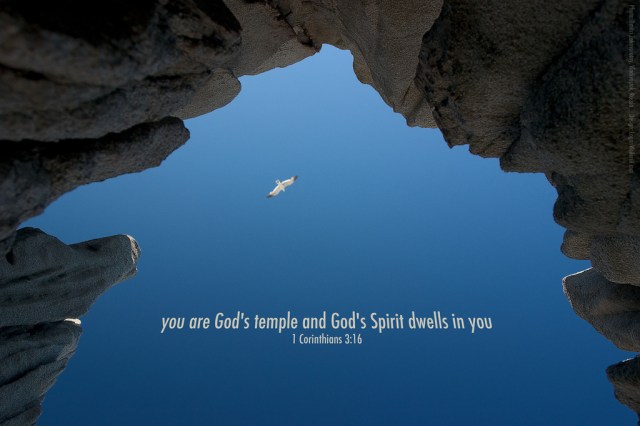
you are god's temple

“Do you not know that you are God’s temple and that God’s Spirit dwells in you? If anyone destroys God’s temple, God will destroy that person. For God’s temple is holy, and you are that temple.” (NRSV)

You have an incredibly special position and status which no one can ever take away.

We were made by and for God.  In the beginning, the creative activity of God achieved its pinnacle in the formation of a man and a woman.  Only humanity carries within them the image and likeness of God.  People are unique, special, and set apart as the creatures who can enjoy a close relational fellowship with their creator.

But humanity fell into disobedience, which introduced sin and death into God’s world.  Ever since that time, God has been on a rescue mission.  The Holy Scriptures are an unfolding drama of redemption in which a heart-stricken God goes out of his way to make and keep promises to a sinful people.  The Israelites, a people set apart from all other people, were meant to be devoted to God in such a way that the world would be drawn to their relationship with him and with the created order.

Yet again, even with an impressive temple where people met God in sacred rituals and activities, the people went astray and followed their ancestors into worshiping other gods.  God, ever the gracious one who does not forget his covenant of love, sent his Son, Jesus, as the ultimate fulfillment of all his good promises.  Through the redemptive events of Christ’s cross, resurrection, and ascension the deliverance from all that is wrong and broken in this world is reversed.  We are blessed with pardon and redemption from the slavery of sin.  We are given a renewed status as God’s people.

If this were not enough, God has given us his Spirit to help us.  As Christians, followers of Jesus Christ, we are never alone.  God, in his great mercy, makes us his people and the temple where he dwells by his Spirit.  In the Old Testament, the sacred space of worship was a physical building.  Approaching the holy God meant entering a holy temple, set apart for connection between the divine and the human.  But the midpoint of history in which all events hinge, is the cross of Christ.  His redeeming work has transformed the world.

god's people

Now, we are the temple of God, the sacred place where God meets with us.  The glory of God is to be found, once again, in the apex of his creation: human beings.  It is in this rich understanding of God’s activity and humanity’s new status that the Apostle Paul appeals with a pointed rhetorical question: “Do you not know that you are God’s temple and that God’s Spirit dwells in you?”

The Corinthian church was in grave danger of doing the thing that all lost humanity had done through the ages.  They were breaking down into divisions and conflicts and were not thinking of others as God’s special people.  Paul names them collectively as God’s temple.  They were not individual temples but one holy sacred temple together.  This theology and anthropology was meant to teach, persuade, chastise, and encourage the Christians that there was no place for special-interest groups in the church; no room for following pet teachers and preachers; and, no reason to ostracize others who didn’t agree exactly as you do.

As believers in Jesus Christ, we are all together the people of God, the temple in which God dwells.  This makes us a holy people, set apart for the exclusive worship of our triune God.  We are to live up, not down, to who we are in Christ, in the Spirit, in the realm of God’s kingdom.

We are meant to return to the foundation of the temple.  If the foundational works of this great temple of God are the redemptive events of Jesus, with Christ himself as the chief cornerstone of the structure, then we are meant to return in this great season of Lent to Jesus.  With meekness and humility, we are to come to God in Christ by the Spirit and confess our many sins, repent of them all, and return to God as the special, holy, and loved people we are as the temple.

god's people 2

For far too long these few verses in the letter to the Corinthians have been used as the argument for not smoking or drinking too much or generally not caring for our physical bodies.  I’m not saying none of that is in view, but this was not Paul’s understanding of it.  He was thinking much more along the lines of church unity, harmony, mutual love, grace, encouragement, and making decisions which are best for the common good of all.  To break Paul’s instruction down to individual habits which harm the body is a woefully truncated view of his teaching.

Instead, we are to have a high view of one another.  We, together, are the people of God.  We, together, are meant for holy worship of the triune God.  We, together, are the complex expression of God’s creative action – a temple set in the middle of a watching world.

Therefore, we are to be concerned for one another.  We are to act as one holy people of God.  We are to reflect the love, unity, and fellowship of the Holy Trinity in our life together.  Let us then encourage each other toward love and good deeds; upholding the common good; and, extending grace in all circumstances.  For this is what temple living looks like.

Holy God, you have set us apart together as your holy people.  Help so to live up to our status as your beloved creatures that we are continually mindful of you, one another, and the grace you give for all circumstances.  May our foundation be strong in the person and work of Jesus Christ, your Son and our Savior, as the Spirit dwells in us together.  Amen.

John 2:13-22 – Sacred Space

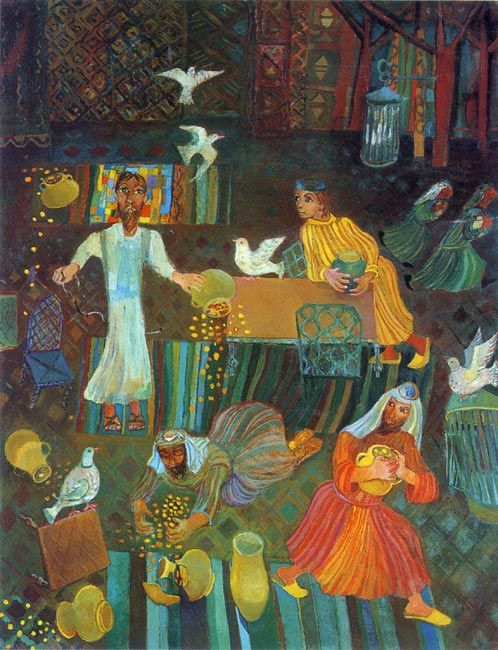
jesus and the moneychangers

“Not long before the Jewish festival of Passover, Jesus went to Jerusalem.  There he found people selling cattle, sheep, and doves in the temple. He also saw money-changers sitting at their tables.  So he took some rope and made a whip. Then he chased everyone out of the temple, together with their sheep and cattle. He turned over the tables of the money-changers and scattered their coins.  Jesus said to the people who had been selling doves, ‘Get those doves out of here! Don’t make my Father’s house a marketplace.’  The disciples then remembered that the Scriptures say, ‘My love for your house burns in me like a fire.’” (CEV)

Jesus, the human which he is, has a complexity to him.  Our Lord is not one-dimensional.  Christ not only extends grace and mercy, healing the least and the lost of society; he also turns his burning love for the Father on those who would treat the sacred with sacrilege.  There is a time for gentleness and meekness, and there is a time for zeal and action, done with flavor!

Jesus had a zero-tolerance policy toward using the representation of God, the temple, as the means to make money.  As people from all over the Middle East poured into Jerusalem for the Passover, savvy marketers set up their wares.  Knowing that not everyone could bring animals for sacrifice, the money-changers were more than ready to take advantage of the situation by providing sheep and cattle at inflated prices.  The temple looked more like a marketplace than a worship space, and Jesus would have none of it.

Christ the Lord was consumed with zeal for his Father’s house.  Jesus single-handedly took on the businessmen and drove them out of the temple courts with a homemade whip.  Whereas the people seemed to settle for the status quo of secular Passover protocol, Jesus restored worship to its rightful place in the life of God’s people.

Jesus still has zeal for proper worship.  As he did in the temple all those centuries ago, Christ rearranges the furniture and upsets how things have become.  Like an extreme makeover, the Lord overturns tables designed for selfish gain and re-establishes a connection between us and God.  He upholds holiness and righteousness so that you and I will have a clean and clear path of relationship with the sovereign God of the universe.

Sacred space is important, both as a physical room or building as well as in our own spiritual hearts.  That space becomes the meeting place between us and God.  The Lord wants a meaningful dialogue with us, and he will guard that place of connection with great zeal.

Christ Jesus, the one who zealously loves, you have gone before me and cleared the way for me to enter God’s presence.  Thank you for your movement toward me, and your careful guarding of our relationship.  May my time with you on this Lord’s day be an offering of praise and thanksgiving.  Amen.

Mark 9:2-8 – Shining the Light on Our Fears

20160719_161140

“Six days later Jesus took Peter, James, and John with him. They went up on a high mountain, where they could be alone. There in front of the disciples, Jesus was completely changed.  And his clothes became much whiter than any bleach on earth could make them.  Then Moses and Elijah were there talking with Jesus.

Peter said to Jesus, ‘Teacher, it is good for us to be here! Let us make three shelters, one for you, one for Moses, and one for Elijah.’  But Peter and the others were terribly frightened, and he did not know what he was talking about.

The shadow of a cloud passed over and covered them. From the cloud a voice said, ‘This is my Son, and I love him. Listen to what he says!’  At once the disciples looked around, but they saw only Jesus.” (Contemporary English Version)

The transfiguration of Christ was a glorious experience on the mountain.  But we are told that Peter, James, and John, the inner circle of Christ’s disciples, were terribly frightened.  Peter, always the extrovert of the group, nervously babbled-on without making any sense because he was so nervous and afraid.

Have you ever wondered why Jesus would take three of his disciples with him to experience such an incredible vision?  Why did Jesus show these men something so otherworldly that they nearly soiled themselves?  I will tell you why I think Jesus put his close disciples in such a position as this:

Because the way to see Jesus as our only hope, we must face our fears, insecurities, and anxieties squarely without hiding.

Jesus did not relieve their anxiety.  He let them feel the full impact of their fear.  His glory shone show brightly that they couldn’t hide from what was happening to them and what was in their minds and hearts.  Only through shining the light on the shadowy place of our fears and insecurities will we accept that we need a savior.  That savior is Jesus, the light of the world, the Lord over fear, anxiety, and discouragement.

The invitation which Jesus extends to us is to move further into our fears so that we can see how desperately we need him.  Nobody seeks a savior when they don’t believe they need deliverance from anything.  But the one who sees what is truly inside of them – the fear of connection; the scary prospect of confrontation; the anxiety of what will happen; or, the discouragement of failure – is the one who is then able to hear the voice of God and listen to Jesus give the answer to our most pressing life issues.

Jesus Christ wants to change us from the inside-out.  He helps us by showing us not to avoid the fears which cause us to be beside ourselves, but through confronting those anxieties with him.  You and I are never alone; we always have the glorious presence of Christ with us as we walk through dark valleys and ascend high mountains.  It is the wonderful existence and omnipresence of God in Christ through the Spirit which makes all the difference.  We were created for connection with the divine, not for separation and loneliness in our fears.

Glorious Christ, you love me with a grace and mercy which always has my best interests in mind.  Help me through my most pressing fears and failures so that I might see your glory, hear your voice, and know your constant presence.  Amen.

Psalm 19 – Living Wisely

20180302_062505

Most of life, as you well know, is lived in the mundane.  We drive the same well-worn roads to work; spend most of the time at our jobs doing routine ordinary things; repeatedly say the same things to our kids, day after day; engage in ordinary chores; and, worship in predictable ways each week.  Excitement is certainly to be had, but it is more the exception than the rule.  Yet, it is the patience, perseverance, and plodding that comes with living wisely which is the norm for realizing a thriving and flourishing spiritual life.

Psalm 19 is a celebration of God’s self-revelation.  Through both nature and law, the Lord has graciously made himself known to humanity.  What’s more, God’s moral and ethical teachings provide insight for living a good life.  This is to the benefit of the common good of all persons.

Wisdom in the Old Testament is the combination of knowledge and practice.  It is the application of God’s self-revelation to concrete situations in life.  We live wisely when we get to know the sovereign God of creation and use his revealed mores and ethos as our guide in daily experiences.

We need God’s gracious revealed law.  It’s not just for theology nerds or spiritual eggheads; God’s law is for everyone – the learned and the unlearned.  Every one of us needs the guidance and direction of God’s Holy Word, and the careful application of it to all our circumstances.  That’s wisdom.

You and I are shaped and formed as godly people as we allow God’s Word to awash us and seep into our souls.  Reading this psalm out loud slowly and contemplatively more than once is an opportunity to let our common ordinary experiences transform into divine appointments.

Self-revealing God of creation, your words are sweeter than honey and more precious than gold.  May I be humble and wise as I meditate and think about how you are the center of everything in my life; through my Lord Jesus Christ, who lives and reigns with you and the Holy Spirit; one God, now and forever.  Amen.