Psalm 27 – Waiting Patiently

The Waiting Room by South African artist Gerard Sekoto (1913-1993)

The Lord is my light and my salvation—
    so why should I be afraid?
The Lord is my fortress, protecting me from danger,
    so why should I tremble?
When evil people come to devour me,
    when my enemies and foes attack me,
    they will stumble and fall.
Though a mighty army surrounds me,
    my heart will not be afraid.
Even if I am attacked,
    I will remain confident.

 The one thing I ask of the Lord—
    the thing I seek most—
is to live in the house of the Lord all the days of my life,
    delighting in the Lord’s perfections
    and meditating in his Temple.
For he will conceal me there when troubles come;
    he will hide me in his sanctuary.
    He will place me out of reach on a high rock.
Then I will hold my head high
    above my enemies who surround me.
At his sanctuary I will offer sacrifices with shouts of joy,
    singing and praising the Lord with music.

 Hear me as I pray, O Lord.
    Be merciful and answer me!
My heart has heard you say, “Come and talk with me.”
    And my heart responds, “Lord, I am coming.”
Do not turn your back on me.
    Do not reject your servant in anger.
    You have always been my helper.
Don’t leave me now; don’t abandon me,
    O God of my salvation!
Even if my father and mother abandon me,
    the Lord will hold me close.

 Teach me how to live, O Lord.
    Lead me along the right path,
    for my enemies are waiting for me.
Do not let me fall into their hands.
    For they accuse me of things I’ve never done;
    with every breath they threaten me with violence.
Yet I am confident I will see the Lord’s goodness
    while I am here in the land of the living.

Wait patiently for the Lord.
    Be brave and courageous.
    Yes, wait patiently for the Lord. (NLT)

The message of the Advent season is perfectly and succinctly encapsulated in this heartfelt psalm to wait patiently for the Lord. Oh, how impatient we can be as people!  Not only do we anticipate the celebration of Christmas with the coming Christ child, but we long for deliverance, courage, help, strength, and, of course, patience.

The way to wait patiently is through hope. And hope is one of those things which needs to be continually be fortified. Whatever it is that we desire to see realized – the return of a wayward son or daughter; revitalization and revival within the church; courage to face the high wall of adversity; protection and deliverance from mean-spirited people; an end to pandemic; freedom from racism and injustice – whatever the situation we long for, patience is to be our breakfast every morning to help us through each day, living one day at a time, putting one foot forward.

Apart from patience and faith in God, we will lose our spiritual zeal and settle for a mediocre existence with tepid relationships and lukewarm engagement of the world. God desires more for us than simply having a marriage in which two people only exist under the same roof; for church to be more than buildings, budgets, and butts in the pews; for our work to be more than a necessary evil to make a living; for our lives to be more than fear, worry, and anxiety; more than broken dreams, messed up relationships, and situations gone sideways.

The confident expectation of hope neither eliminates trouble from our lives nor magically makes everything better. Deep faith, like the psalmist expressed, does not change reality – but it does change us. The way in which we view and handle our troubles is understood differently through the filter of faith and the lens of hope. The mammoth adversity in our lives is no longer feared because of settled trust in God; the danger which lurks about has no teeth to hold us when we are secure in the Lord.

The actions we ourselves take toward God amidst the fallen nature of this world are to wait and hope, be strong and take courage. It is precisely when we are totally discombobulated that these actions are to take effect. “I believe…” and “I have confidence…” become the beginning pronoun and verbs to every sentence we utter. So, let us flesh out those words:

I believe the Lord is the Light which keeps me safe and illumines my path.

I believe the Lord is my Fortress, a castle to protect me.

I believe the Lord is an Army surrounding me, defending my life.

I believe the Lord is the Rock of my salvation, keeping me secure.

I believe the Lord is a Parent who holds me close and does not let go.

I believe the Lord is the righteous, just, and good Judge, always extending grace and mercy to me.

Therefore, I have confidence and courage to engage the world, knowing God has my back.

I have confidence God will handle malevolent persons, systemic evil, and sinister forces on my behalf.

I have confidence I can approach God, since God’s character is always gracious and loving.

I have confidence to pray with authority, understanding God is the Sovereign of the universe.

I have confidence better days are ahead, that the Christ is soon coming.

I have confidence God bends to attentively listen to me praying.

I have confidence God is neither angry at me nor hidden from me.

I have confidence God shall lead me, guide me, and teach me in the way I ought to go.

Rather than losing heart, we can be strengthened with solid theology. Making daily affirmations of faith, persevering in hope, and performing small acts of love are our daily tasks while we wait and watch….

Almighty and everlasting God, the One who sees, knows, and protects, by the power of your Holy Spirit, you are refining us, purifying our discipleship, pulling us into following Jesus in this scary new world of uncertainty. Grant us mercy and grace to trust you more deeply, for the only secure place is with you, our light and our salvation, the stronghold of our life. We pray in the name of Jesus, the first-born of your new creation, and our hope, our life. Amen.

Psalm 27 by British songwriter and producer Jonathan Ogden

Acts 2:36-42 – From Sorrow to Salvation

Baptism by American artist Ivey Hayes (1948-2012)

“Therefore, let all Israel be assured of this: God has made this Jesus, whom you crucified, both Lord and Messiah.”

When the people heard this, they were cut to the heart and said to Peter and the other apostles, “Brothers, what shall we do?”

Peter replied, “Repent and be baptized, every one of you, in the name of Jesus Christ for the forgiveness of your sins. And you will receive the gift of the Holy Spirit. The promise is for you and your children and for all who are far off—for all whom the Lord our God will call.”

With many other words he warned them; and he pleaded with them, “Save yourselves from this corrupt generation.” Those who accepted his message were baptized, and about three thousand were added to their number that day.

They devoted themselves to the apostles’ teaching and to fellowship, to the breaking of bread and to prayer. (NIV)

Imagine we are all standing around in a huge modern-day lobby, ready to listen to Peter. We understand big events like this must be well-organized, so everyone is getting a name tag.  But the name tags are given to us with not only our first names; they also include our hidden guilt and shame.  People walk up to the registration table. “Name?” “Bob.”  “What are you ashamed of, Bob?”  “I stole some money from my boss once, and he never found out.” The person takes a marker and writes, Bill: Embezzler. 

Next person: “Name?” “Jill.” “Jill, what are you guilty of?” “I deliberately slandered a group of people. I said things that were not true about them because I did not like them.” So, the person writes on Jill’s nametag, Jill: Slanderer. “Name?” “George.” “What kind of guilt and shame are you carrying?” “I’ve been coveting my neighbor’s Corvette… and his wife.” George: Coveter. Person after person comes. 

Then, up to the table comes Jesus. “What is your shame, Jesus?” Well, in truth, none. So, Jesus starts walking down the line. He comes to Bob and says, “Bob, give me your name tag,” and puts it on himself. “Jill, give me your name tag.” He puts it on himself. “George, give me your name tag.” It goes on himself.

Soon Jesus is covered with name tags and a bunch of icky shame and awful guilt. Apart from Jesus, we cannot take the name tags off because we cannot shed the labels of who we really are. Christ bore the cross covered with all our guilt and shame attached to him. It was all crucified with him.

When the people of the Apostle Peter’s day understood who Jesus was and what he had done for them, they were deeply troubled in their spirits and their souls were horribly upset. They were cut to the heart with the things they had done which sent Christ to the cross. The crowd’s remorse was so deep and profound that they were beside themselves with spiritual pain and asked Peter,

“What shall we do!?”

Peter called them to “repent and be baptized.” To repent is to have a complete change of mind and heart; it is to express a courageous naming of shame, guilt, and sin. Repentance, then, leads to a 180 degree turn of direction to our lives. Repentance is realizing what we have become, and seeing it is not a good place to be.

Sometimes we lack awareness of how serious our situation really is and how at risk we really are. It may be hard to imagine our offense is bad enough to crucify Jesus. Perhaps we have self-justified our morsels of gossip or our lack of attention to the poor, only choosing to see our hard work and sincere efforts to do good.

For others, the problem with repentance runs deeper, having been raised in a legalistic environment. These folks lug around a guilt-laden backpack that would bend the knees of a mule. And most of the guilt, they realize, is neurotic—not based on any real transgression.  Every bad thought and each failure of faith is obsessed over to the point that they cannot shake the pangs of constant shame.

The good news is that the kingdom of God is near. In the name of Jesus Christ there is forgiveness, healing, and new life. If today there is a realization of being in a bad place in your life, whatever that place is, the cross of Christ addresses the deepest needs of your life. What shall we do?  Repent and be baptized.

Repentance, baptism, forgiveness of sins, and receiving the Spirit are all linked together in today’s New Testament lesson. Baptism is the sign and seal of God’s promise of forgiveness in Jesus; it visually shows us that God washes away our guilt and shame in the name of Jesus.

Baptism is a different kind of nametag, identifying that we belong to God. One who repents and embraces new life in Jesus Christ de-thrones all other competing lords and identifies as a beloved child of God.

The result of that ancient mass repentance and baptism was that three-thousand people were added to a small church of one-hundred-twenty persons! Since repentance leads to action, the new believers went to work devoting themselves to the apostles’ teaching and orienting their lives completely around Jesus through their constant fellowship together.

Allow me to be a bit more specific about what repentance looks like and does not look like. The prayers of the mildly repentant sound something like this:

“Easy-going God: We have occasionally had some minor errors of judgment, but they’re not really our fault. Due to forces beyond our control, we have sometimes failed to act in accordance with our own best interests. Under the circumstances, we did the best we could. We are glad to say that we’re doing okay, perhaps even slightly above average. Be your own sweet Self with those who know they are not perfect. Grant us that we may continue to live a harmless and happy life and keep our self-respect. And we ask all these things according to the unlimited tolerances which we have a right to expect from you. Amen.”

I like eggs.  I eat them nearly every day.  Fresh eggs are the best.  Sometimes I make an omelet, with, of course, bacon, green pepper, and cheese.  When I am making my omelet, if I crack open a rotten egg, I do not go ahead and mix it in with the others in the hope that the other good eggs will overwhelm the rotten one.

Grace can only be grace when we have a true realization of our guilt and shame. Grace is radical. It throws out the rotten omelet altogether and makes a new one so incredibly delicious that we never want to go back to the old way of making them. And it is for everyone who calls on the name of the Lord.

Godly sorrow, like the kind in today’s story, leads to repentance. In the Apostle Paul’s first letter to the Corinthian church, he called them out and insisted they turn from their old way of life.  In his second letter, he followed up with this: 

I know I distressed you greatly with my letter. Although I felt awful at the time, I don’t feel at all bad now that I see how it turned out. The letter upset you, but only for a while. Now I’m glad—not that you were upset, but that you were jarred into turning things around. You let the distress bring you to God, not drive you from him. The result was all gain, no loss.

Distress that drives us to God does that. It turns us around. It gets us back in the way of salvation. We never regret that kind of pain. But those who let distress drive them away from God are full of regrets, end up on a deathbed of regrets.

And now, isn’t it wonderful all the ways in which this distress has goaded you closer to God? You’re more alive, more concerned, more sensitive, more reverent, more human, more passionate, more responsible. Looked at from any angle, you’ve come out of this with purity of heart. And that is what I was hoping for in the first place when I wrote the letter. (2 Corinthians 7:8-11, MSG)

There are (many) times we need to feel awful before we feel wonderful – awful concerning how much we have hidden our shame and never let it see the purifying light of the gospel – but wonderful of how over-the-top good grace really is, once we have exposed the guilt and let Jesus replace it with God’s mercy.

O merciful God, we bring long-held grudges and recent grievances, and we chew them over, even at the foot of your cross. We tiptoe around chasms of misunderstanding, we pick our way anxiously among stumbling-blocks of language and culture, and blame each other for every misstep, even while singing of your Spirit. We tremble to name the troubles we see in the Church and the world, for fear of our own sins finding us out, for fear that we will become easy targets for everyone’s hostility. Have pity on us, for our hands are not strong enough and our hearts are not big enough to hold all together in love. We beg you to come to us, foolish as we are, downcast and despairing. We beg you to send us a breath of your Spirit with the perfume of resurrection and hope, through Jesus Christ, the Light of the world. Amen.

Luke 2:21-40 – All I Want for Christmas Is Hope

Welcome, friends! The season of Advent is all about hope – a confident expectation that Jesus is coming. Click the video below and let us wait and watch together for the Savior.

For a kid version of Simeon and Anna’s story, click the video below:

God’s Story: Anna and Simeon by CrossroadsKidsClub.net

And for the story set to song…

Now You let me go in peace (Simeon’s song) – Nina Åström feat. Phil Keaggy

May starlight guide your steps toward the place of wonder.
May angels sing their news as you travel to the manger.
May promise fill these days as we watch at the edge of birth.
May hope inform you, Emmanuel will be with us soon, in human skin. Amen.

All I Want for Christmas Is Hope

The Presentation by John August Swanson

On the eighth day, when it was time to circumcise the child, he was named Jesus, the name the angel had given him before he was conceived.

When the time came for the purification rites required by the Law of Moses, Joseph and Mary took him to Jerusalem to present him to the Lord (as it is written in the Law of the Lord, “Every firstborn male is to be consecrated to the Lord”), and to offer a sacrifice in keeping with what is said in the Law of the Lord: “a pair of doves or two young pigeons.”

Now there was a man in Jerusalem called Simeon, who was righteous and devout. He was waiting for the consolation of Israel, and the Holy Spirit was on him. It had been revealed to him by the Holy Spirit that he would not die before he had seen the Lord’s Messiah. Moved by the Spirit, he went into the temple courts. When the parents brought in the child Jesus to do for him what the custom of the Law required, Simeon took him in his arms and praised God, saying:

“Sovereign Lord, as you have promised,
    you may now dismiss your servant in peace.
For my eyes have seen your salvation,
  which you have prepared in the sight of all nations:
a light for revelation to the Gentiles,
    and the glory of your people Israel.”

The child’s father and mother marveled at what was said about him. Then Simeon blessed them and said to Mary, his mother: “This child is destined to cause the falling and rising of many in Israel, and to be a sign that will be spoken against, so that the thoughts of many hearts will be revealed. And a sword will pierce your own soul too.”

There was also a prophet, Anna, the daughter of Penuel, of the tribe of Asher. She was incredibly old; she had lived with her husband seven years after her marriage, and then was a widow until she was eighty-four. She never left the temple but worshiped night and day, fasting and praying. Coming up to them at that very moment, she gave thanks to God and spoke about the child to all who were looking forward to the redemption of Jerusalem.

When Joseph and Mary had done everything required by the Law of the Lord, they returned to Galilee to their own town of Nazareth. And the child grew and became strong; he was filled with wisdom, and the grace of God was on him. (Luke 2:21-40, NIV)

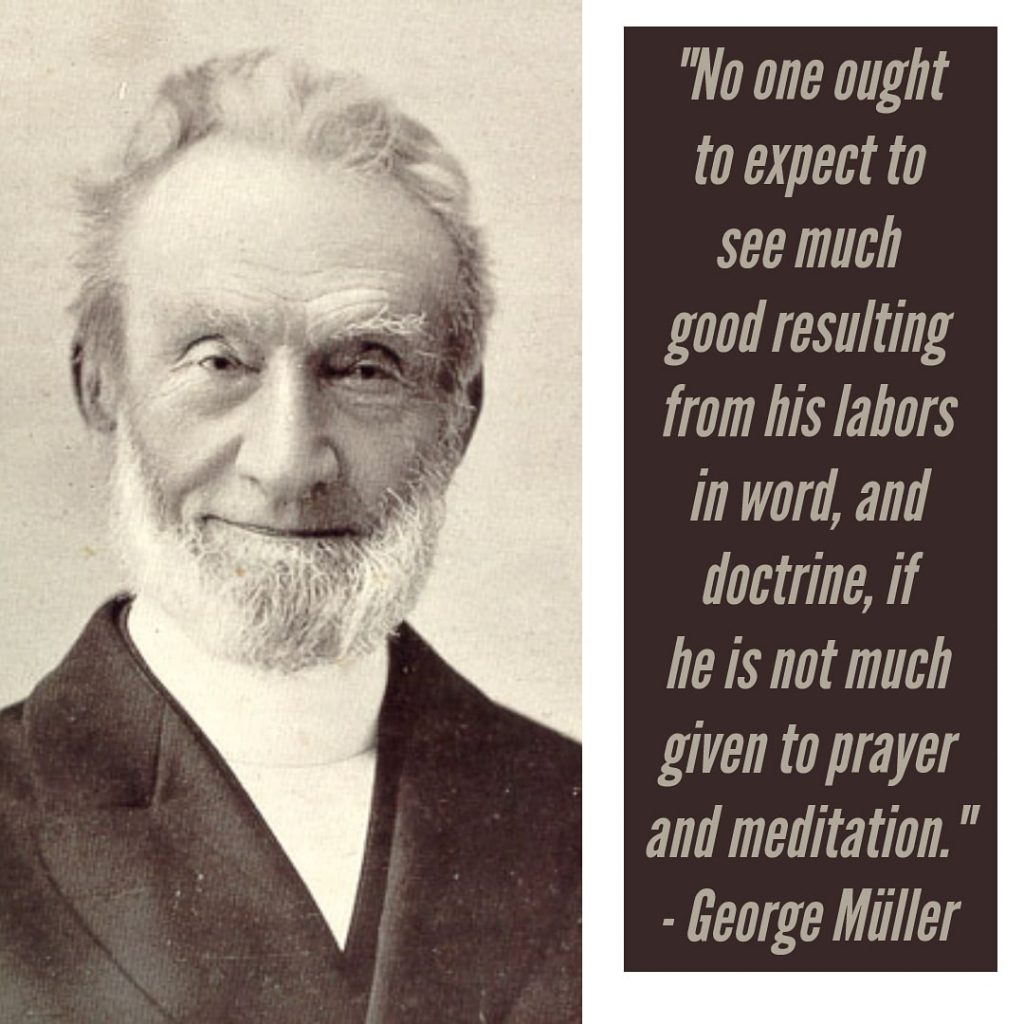
George Mueller (1805-1898) was a man full of hope in God.  For sixty-six years he preached in a small chapel in Bristol, England, yet what he is best known for is his orphanage. 

After being in ministry for a few years, Mueller became deeply concerned for the street children of the city and decided to start an orphanage.  The problem was he had no money.  So, with nothing but his hope in Christ he prayed God would provide. For the next sixty-four years, that was how George Mueller operated.

In that course of time, he built an orphanage, where he cared for and educated over eighteen-thousand children; educated over one-hundred-thousand more children in other schools at the Orphanage’s expense; distributed hundreds of thousands of Bibles and tens of millions of religious tracts; supported one-hundred-fifty missionaries; travelled over two-hundred-thousand miles as a missionary himself; and proclaimed the Gospel to over three million people around the world.

In all that time, Mueller never asked for one penny from anyone, his children never missed a meal, and he never had a debt.

We are not all called to be like George Mueller, or even like Simeon and Anna in our Gospel story.  However, all of us are called to grab hold of God’s promises with such faith and hope that, even though we may not yet see it realized, we live as though it has already happened.  This is what it means to participate with God. 

When George Mueller had a need, he pleaded to God and banked on the promise of God. Mueller prayed for more than money; he prayed for individuals, as well. Sometimes he prayed for someone for as long as fifty years. He never stopped praying for anyone or anything until he got his request. That is how convinced George Mueller was that God would answer his prayers.

All the promises of Holy Scripture revolve around Jesus Christ.  Jesus is the fulfillment of hope for persons of every nation and ethnicity. Christ is our Redeemer, and his salvation is limitless and includes all kinds of people.  Simeon and Anna, despite their age, despite the fact they lived their entire lives without seeing the Deliverer, never lost hope in the promise of God and never gave up praying and looking for the Savior.

Hope in the Bible is not wishful thinking but confident expectation which is grounded in the promises of God. Since all those promises have not yet been fully realized, we must have a quiet confidence and a patient spirit to anticipate the light at the end of the tunnel. Listen to what the Roman church needed to hear about this: 

We groan inside as we wait to be adopted and for our bodies to be set free. We were saved in hope. If we see what we hope for, that is not hope. Who hopes for what they already see? But if we hope for what we do not see, we wait for it with patience. (Romans 8:23-25, CEB)

Simeon and Anna gave testimony about the hope of all the earth.  We have a moving scene of the old man, Simeon, being led by the Spirit of God to enter the temple and take hold of the baby Jesus and cradle him in his arms.  Simeon’s hope is being realized as he declared that this little baby will be the means of salvation for all people.

This salvation comes at a great cost – and all of history hinges on this little child in Simeon’s arms.  Will people move toward or away from God?  Anna came along and, as the George Mueller of the ancient world, devoted herself constantly to prayer and anticipated the coming of the Messiah.  Anna confirmed the testimony of Simeon that this baby is the hope of Israel, the Redeemer of both Jew and Gentile.

Presentation in the Temple by British artist Sylvia Lauder

Today you decided to be here and join me; yet it was more than your own consideration.  The Holy Spirit of God, like Simeon of old, led you and I to this place of virtual meeting, perhaps because we long to see our hope realized – to find in the Christ child all we have longed for and have been waiting to see happen in our lives. 

God wants us to see Jesus. So, close your eyes, because the hope of all life cannot be seen with human eyes…

See him as a little baby…

See him as he grows with wisdom and favor with both God and others…

See him as he teaches, ministers, and heals the outcast and loves the common person…

See him as he is arrested, beaten, and taken outside of the city…

See them take the hammer and nail his hands and feet to a cross…

See him as you kneel before a terrible cross and watch him die, not for himself, not because he deserved it, but because of the world’s great sin and because humanity has lost their way…

See him as he is placed in the grave…

See him rise from death…

See him ascend to heaven…

See the Lord Jesus Christ in all his glory…

See that he has done all of this for you!  Do not lose hope!  Do not give up!  Search the Scriptures for the promises of God. Grab hold of them and rely on them as if your life depended on it – and it does!

Why did Simeon and Anna not lose hope?  How could they remain so devout?  Why, over the years and the decades when all seemed dark and despondent, did they not give up searching for the Christ of God? 

Because we become just like who we worship. 

If we spend all our time, thoughts, and energy on money, we will live and die with whatever the markets are doing… 

If we spend all our time, thoughts, energy on our job and our work, we will live and die with our ability to produce and get things done… 

If we spend all our time, thoughts, and energy on watching out for ourselves because we believe no one cares, then we will live and die lonely and dejected… 

But if we spend our time, use our thoughts, and expend our energy in the hope of all the earth, Jesus, the Savior of the world, then we will experience the deepest needs of our lives being met – we will become like Jesus, showing love, giving grace, and enjoying unhindered relationship with God.

No tragedy can dim the hope that comes from knowing God will walk with you through the valley. Hope is neither cheap, nor easy. Genuine hope typically arises from the ash heap of unfulfilled dreams, messed-up plans, and broken hearts. We often need to experience hopelessness before we can realize hope itself. It is the absence of hope that holds the invitation to forsake old ways and strike out on a new path to find our heart’s truest desire. Author Joan Chittester has wisely said:

“The challenge of hopelessness is the challenge to re-enter humanity, to take our part in it knowing that the lack of hope has much within it to shape our life. Losing hope leads us to understand that misfortune is not failure. It is at most simply a digression through life intended to make us reassess our course, our goals, and our aspirations.”

Indeed, hopelessness need not lead to despair. The profound lack of hope is ironically what reawakens and rekindles hope within us. It is the process of reassessment that is the opportunity to hope again with a sharper and a greater assurance of hope – to create space in becoming fully alive to the hope that has always been there – maybe just underneath all of life’s accumulated stuff.

For me, hope rekindles when I withdraw to a quiet place, either sitting down in my favorite chair or walking along a secluded wooded path. I allow and encourage the sixth sense of faith and imagination to inform my other five senses. This helps my heart to enlarge, the empty places of my soul to be filled with the hope of Christ. It is in this inner place, where our hearts join the heart of God, that we find an alternative way to the true hope for which we have been striving for so long to realize.

For the grace of God has appeared that offers salvation to all people. It teaches us to say “No” to ungodliness and worldly passions, and to live self-controlled, upright and godly lives in this present age, while we wait for the blessed hope—the appearing of the glory of our great God and Savior, Jesus Christ, who gave himself for us to redeem us from all wickedness and to purify for himself a people that are his very own, eager to do what is good. (Titus 2:11-14, NIV)

We have a sure and certain hope which presently now shapes our lives as we wait patiently. Just as we await a coming vaccine and deliverance from COVID-19 which presently now forms our living with masking, social distancing, and sheltering in place – so we look forward to the coming of our glorious Savior and the realization of our salvation in its fullness. Meanwhile, much like Simeon and Anna, we presently now devote our lives to prayer and wait….