Psalm 125 – She Rocks!

The God Who Surrounds Us by Irv Davis

The people who trust in the Lord
    are like Mount Zion:
    never shaken, lasting forever.
Mountains surround Jerusalem.
    That’s how the Lord surrounds his people
    from now until forever from now!
The wicked rod won’t remain
in the land given to the righteous
    so that they don’t use their hands to do anything wrong.
Lord, do good to people who are good,
    to people whose hearts are right.
But as for those people who turn to their own twisted ways—
    may the Lord march them off with other evildoers!

Peace be on Israel! (CEB)

Psalms 120-134 comprise a collection of short songs of ascent meant to guide Jewish pilgrims in their communal trek up to the city of Jerusalem, and ultimately to the temple mount.  The rhythm of the pious ancient Israelites centered round particular festivals, seasons, and Sabbath. 

Taking the annual pilgrimage to the Holy City was an especially anticipated time of year.  This yearly cycle bolstered their faith and gave the people some needed spiritual stability. The sameness of the routine and the ritual helped to remind the faithful of the solid theology that God cannot be moved and will always be there.

One of the most fundamental of all truths about God is divine consistency and constancy, that the Lord is forever present with God’s people. If God seems or feels distant or inattentive, it comes not from a place of uncaring. as though absent, aloof, or not listening.  It simply means the Lord self-reveals on a divine timetable, not a human one. Our responsibility in the entire affair is to engage in consistent rhythms of spirituality that place us in a position to receive grace when God decides to give it.

Therefore, we must not despair but anticipate meeting with God, just as the Israelites of old looked forward and upward to their annual worship at the top of the mountain. 

God continually surrounds people, even when we do not always perceive it to be so. 

Basic sound theology, as we possess abundantly in the psalms, is neither gender specific nor gender neutral. To have a full orbed understanding of the God of the psalms means we use both male and female pronouns in our descriptions.

To limit God as an old white guy, or only as male, truncates a strong view of true divinity.

What I am suggesting here is that we avail ourselves of the full compliment of metaphors to present a more complete picture of God. Language is our vehicle in communication about the Lord, so let us use it to its entire extent to present the Lord in all his/her grandeur, majesty, holiness, and strength.

For example, as the psalmist likens God to a mountain chain surrounding Jerusalem, if we only picture this in our imaginations as a man, we have not quite got an integral picture. Although a muscular Christianity might provide us with an understanding of God’s sheer brute power, a maternal Christianity gives us a strength of provision, care, and protection from a different angle.

When Jesus came to Jerusalem, the city surrounded by mountains, he did not use a masculine metaphor to communicate to the people; he used a maternal one:

“O Jerusalem, Jerusalem, the city that kills the prophets and stones God’s messengers! How often I have wanted to gather your children together as a hen protects her chicks beneath her wings, but you wouldn’t let me.” (Matthew 23:37, NLT)

When the Apostle Paul wanted to communicate to the Thessalonian Church his deep concern for them, he went for the maternal metaphor:

We could have thrown our weight around as Christ’s apostles (like a man). Instead, we were gentle with you like a nursing mother caring for her own children (like a woman). We were glad to share not only God’s good news with you but also our very lives because we cared for you so much. (1 Thessalonians 2:7-8, CEB)

Indeed, in my culture when we want to convey the ultimate protective behavior of another, we describe them as a “mother bear.”

The gist of theology is this: God cannot be tied down or limited to gender, race, ethnicity, class, etc. The Lord is God, and we are not. Therefore, it is perfectly appropriate, and I daresay necessary, to use both male and female pronouns and metaphors in describing God because the Lord of the universe created both male and female in his/her image. (Genesis 1:26-27)

This is neither taking liberal license of the psalms nor emasculating them; it is merely pointing out that God is Spirit, and we worship her/him in spirit and in truth. And the truth is that he is the mountains surrounding us as a manly sentinel over our lives; and she is the mountain chain encircling us with protective care for whom nobody better mess with us.

May the Lord do good to us, as the manly Rock of our salvation as well as the feminine Fortress of our souls, protecting us with the care of both a father and a mother.

Ever-present God, there is no place where I can go where you are not.  Help me to so intuit your divine presence that it bolsters my faith and resilience for daily life in Jesus Christ.  Amen.

1 Kings 18:1-18 – Faith at Work

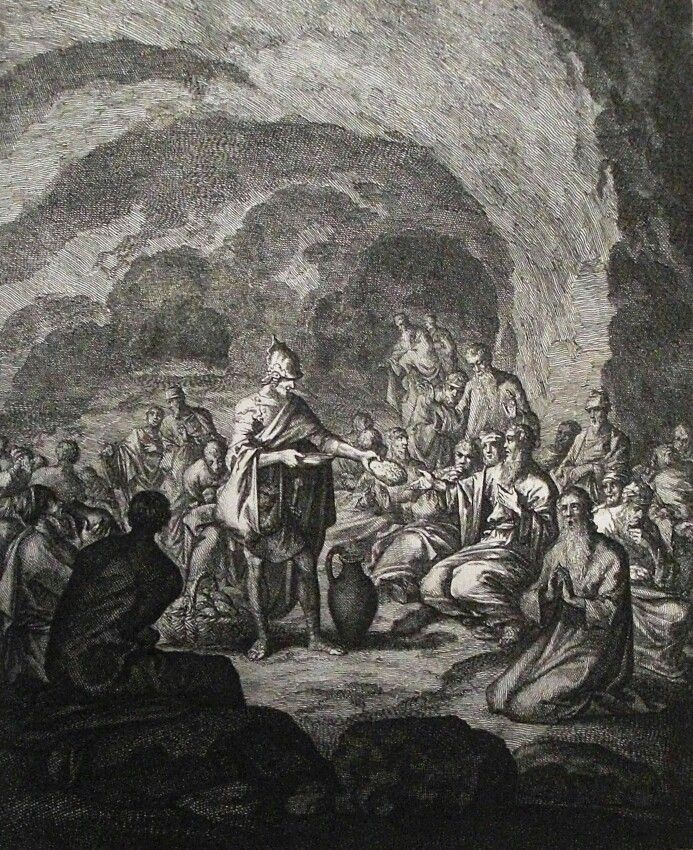
Obadiah Takes the Prophets to a Cave by Dutch engraver, Caspar Luyken (1672-1708)

For three years no rain fell in Samaria, and there was almost nothing to eat anywhere. The Lord said to Elijah, “Go and meet with King Ahab. I will soon make it rain.” So, Elijah went to see Ahab.

At that time Obadiah oversaw Ahab’s palace, but he faithfully worshiped the Lord. In fact, when Jezebel was trying to kill the Lord’s prophets, Obadiah hid one hundred of them in two caves and gave them food and water.

Ahab sent for Obadiah and said, “We have to find something for our horses and mules to eat. If we don’t, we will have to kill them. Let’s look around every creek and spring in the country for some grass. You go one way, and I’ll go the other.” Then they left in separate directions.

As Obadiah was walking along, he met Elijah. Obadiah recognized him, bowed down, and asked, “Elijah, is it really you?”

“Yes. Go tell Ahab I’m here.”

Obadiah replied: “King Ahab would kill me if I told him that. And I haven’t even done anything wrong. I swear to you in the name of the living Lord your God that the king has looked everywhere for you. He sent people to look in every country, and when they couldn’t find you, he made the leader of each country swear that you were not in that country. Do you really want me to tell him you’re here?

What if the Lord’s Spirit takes you away as soon as I leave? When Ahab comes to get you, he won’t find you. Then he will surely kill me.

I have worshiped the Lord since I was a boy. I even hid one hundred of the Lord’s prophets in caves when Jezebel was trying to kill them. I also gave them food and water. Do you really want me to tell Ahab you’re here? He will kill me!“

Elijah said, “I’m a servant of the living Lord All-Powerful, and I swear in his name that I will meet with Ahab today.”

Obadiah left and told Ahab where to find Elijah.

Ahab went to meet Elijah, and when he saw him, Ahab shouted, “There you are, the biggest troublemaker in Israel!”

Elijah answered: “You’re the troublemaker—not me! You and your family have disobeyed the Lord’s commands by worshiping Baal.” (CEV)

Obadiah was the overseer in charge of King Ahab’s palace in Samaria of ancient Israel. To put it mildly, Ahab was a rascal. Old Testament stories frequently and purposefully contrast characters so that we will easily discern ethical differences between good and evil. Here we have a clear contrast between the godly and faithful Obadiah and the downright wicked royal couple of Ahab and Jezebel.

Whereas Obadiah was trying to preserve life and went to great lengths to do so, Ahab and Jezebel were doing everything in their sinister power to destroy life. The entire drama plays out like an episode of House of Cards. Ahab and Jezebel were a real king and queen who were thoroughly selfish and evil in all their dealings. Ahab, enabled and emboldened by his pagan wife, did away with the true worship of God and established the worship of Baal in the land of Israel. 

This did not mean, however, that God was absent or inactive. Rather, the Lord was working behind the scenes to undermine the systemic evil in the kingdom through his servant, Obadiah, who was devoted to God. Obadiah was neither a prophet nor a priest. He was simply a man working in an ungodly kingdom, doing the best he could to serve the Lord. 

Elijah may have had the prophetic voice and power, but Obadiah was the backstage administrator, daily cobbling together a living for hundreds of people without any support from the royal pain-in-the-butts.

Our ordinary everyday vocations and jobs have been ordained by God to use us where we are. Instead of lamenting our limitations or wishing the situation were different, we all have an opportunity for God to work through us in our current positions and stations in life. 

Every one of us has the daily opportunity to integrate our faith and our work through connecting biblical ethics to concrete applications at our jobs; seeing our workplaces as mission fields; interpreting our work through a Christian worldview; discerning our vocation as a calling from God; and, knowing our work is a means for God to transform and sanctify us.

So, how do you view your job?  How might you connect your faith and your work?  How does what you do reflect the nature and character of God?  In what ways do you think God wants to use you in your workplace?

Sovereign God, you cause nations and institutions to rise and fall; you set up leaders to rule and put them down.  Take my life and my work and use it in redemptive ways that glorify the name of Jesus and exemplify the power of the Holy Spirit.  Amen.

Luke 2:8-12 – All I Want for Christmas Is Joy

Welcome, friends! Christians around the world celebrate good news of great joy because God became flesh and blood and moved into the neighborhood. Click the video below, and let us enjoy a time around God’s Word.

The video below is, of course, a classic…

The Christmas speech of Linus, quoted from Luke 2

The Christian’s unspeakable joy comes from the incarnation of Christ…

My Soul Magnifies the Lord by Chris Tomlin from the album Glory in the Highest

May Christ, the Sun of Righteousness, shine upon you, scatter the darkness from before your path, and make you ready to meet him when he comes in glory. Amen.

All I Want for Christmas Is Joy

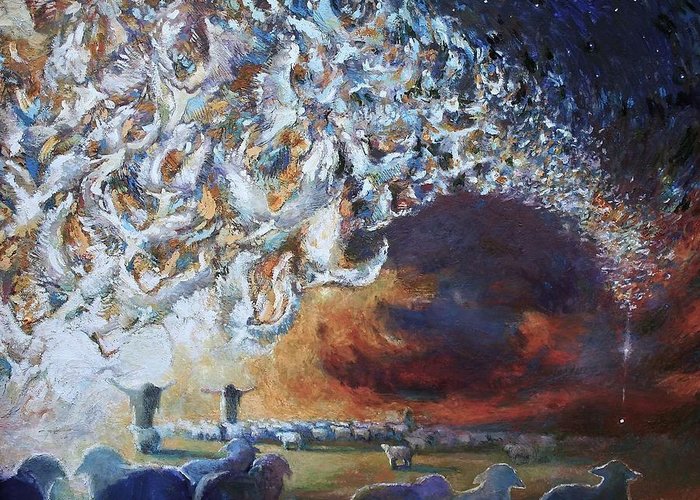
Seeing Shepherds by American painter Daniel Bonnell

There were shepherds living out in the fields nearby, keeping watch over their flocks at night. An angel of the Lord appeared to them, and the glory of the Lord shone around them, and they were terrified. But the angel said to them, “Do not be afraid. I bring you good news that will cause great joy for all the people. Today in the town of David a Savior has been born to you; he is the Messiah, the Lord. This will be a sign to you: You will find a baby wrapped in cloths and lying in a manger.” (Luke 2:8-12, NIV)

When I think of sheer unbounded joy, I think of dogs. My own dog, Max Power, waits every day for me to get home from work. And when I walk through the door, he acts as if he has not seen me in months, wagging his tail so hard that it looks like it will fly off his butt. This is one reason people like dogs so much – their joy brings us joy. It is not a joy that was ever learned in obedience school – it is just built into the relationship. 

Genuine joy does not come from getting all the presents we want for Christmas or having everything go our way.

Joy is not a product we can buy at the store. Authentic, real joy is the fruit of meaningful relationships. My dog cares nothing about how much money I have or even if he has the best dog food to eat and a trendy collar to wear; his joy comes from being with me.

The good news of a Savior coming to this earth means God is coming to be with us.  This is good news of great joy! We are loved because God is good, not because we are good.  And because God is good, and we are a mess of humanity, there is joy that the Lord is coming to save us!

The reason Christ’s birth was good news of great joy to the shepherds is that they were shepherds.  Shepherds in the ancient world were generally looked on with contempt. In fact, Egyptians refused to eat with Jews because they were mostly shepherds (Genesis 46:31-34). 

Shepherds spent most of their time living with their sheep outdoors, to protect the flock.  Shepherds were neither well-dressed nor culturally refined. They mostly smelled like sheep poop. Shepherds also had the notoriety of being drinkers. Because they slept with the sheep, many shepherds passed the time and dealt with the chilly air by taking a nip of alcohol.  We do not really know whether most shepherds were drunkards, or not; but we do know they had a bad reputation.

Becoming a shepherd was not a profession a young person aspired to. Nobody took out a student loan to major in shepherding at the University of Jerusalem. King David started out as a shepherd. He was the youngest in the family and got stuck with the job nobody else wanted.

Out of all the persons and people-groups the heavenly angels could have come to announce the birth of Christ, it was shepherds.

This is truly a gospel of grace. The angelic announcement to a bunch of stinky shepherds is profoundly significant.  It is important because grace is being shown to the lowliest of society. A lowly Savior, born to a lowly family, and placed in a lowly feeding trough, came to reach the lowly, common, ordinary person.

The Shepherds by Malaysian artist Hanna Varghese (1938-2009)

To have this kind of attention from God Almighty is like the master of a dog walking into the house. We, as the common, ordinary mutts of society, are beside ourselves with joy, feeling privileged to be in the same room as Jesus.

It is only the lowly and humble in heart who will see God and enjoy the Lord’s presence. That is because God opposes the proud but gives grace to the humble. It is why the angels came to the shepherds and not to the religious leaders. It is good news of great joy for all the people. 

The gospel is not limited to those who are the most educated, the wealthiest, or from the most prominent of families – it is for everyone.

Yet, even with this good news of grace, many people still live their lives in fear and worry instead of joy. The message seems to only linger on the surface, not getting firmly pressed into minds and hearts. 

Even though a Savior is born, we still experience the harshness of a world under the dominion of darkness.  We worry about constant disease, financial difficulties, and the daily stresses of life.  We fret about dealing with ornery people, hard circumstances, family members who go astray, and the little plastic things on our shoelaces coming off leaving the shoestrings frayed! 

Sometimes, we strain our eyes to try and see some joy.

Jesus is the son of David, born in the town of David – both were anointed as kings but had to go through a lot of hardship before realizing their kingships.  We live in the time between the two advents of Christ in which God’s kingdom is already here but not yet here. It is a topsy-turvy time characterized by a weird mix of sinner and saint, despair and joy, adversity, and comfort.

Real joy is not found in having every circumstance go our way and having everyone like us, all the time. Joy comes from the gospel of grace, from God coming down and being with us.  Being in the presence of the Master makes all the difference. If joy comes from being with God in Christ, then cultivating and practicing the presence of Jesus in our daily lives is important and necessary.

Had the angels come into Bethlehem, a town swelling in numbers of people because of the Roman census, I am not sure anybody would have heard them. The shepherds were away from the noise, out in the quiet solitude of the fields by themselves. So, they were able to hear the message of God when it came.

Noise comes in various forms, both around us and within us. Sometimes we even create noise on the outside so that the boisterous racing thoughts on the inside will get drowned. To be quiet is to be able to listen. To listen is to receive another’s voice.

Receiving the voice of the angels, their message, and their praise to God, is the pathway to joy and the way out of unhappy inner noise.

We need deliverance from our brokenness and unhealthy ways of coping. There is far too much unhappiness in this world. One in every two-hundred teenage American girls cut themselves on a regular basis. More than half of people in the United States with serious depression do not receive or will not get adequate help.  Anxiety disorders affect nearly sixty million adults in the United States. 

The coming of Jesus Christ into this world makes a difference. God has come to be with us to meet the deepest needs of our lives. The deliverance can be realized as we eagerly anticipate the Master, spend time with him, and allow the Lord’s loving presence and compassionate voice to transform our hearts and change us from the inside-out. 

Christianity is not a magic happy pill to swallow; it is a relationship with God which is cultivated and grows over time.

Joy is relational. That means no amount of positive thinking, buying new stuff, or good situations will create joy or sustain it. Christianity offers joy in Jesus – not a cheap sentimental happiness of having every prayer answered or each situation go our way – but the settled joy of God with us through the valleys as well as on the mountain tops.

Neither worry nor fret. Do not be afraid. I bring you good news of great joy that will be for all the people. In the town of David, a Savior is born. He is Christ the Lord.  What can I give him, poor as I am?  If I were a shepherd, I would bring a lamb. If I were a wealthy man, I would give him frankincense or gold. Yet, what can I give him?… 

I can give him my heart.