Psalm 110 – The Priest King

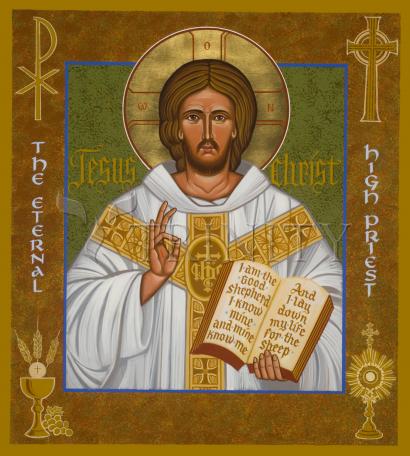
Jesus Christ – Eternal High Priest by American painter Joan Cole

The Lord says to my lord:

“Sit at my right hand
    until I make your enemies
    a footstool for your feet.”

The Lord will extend your mighty scepter from Zion, saying,
    “Rule in the midst of your enemies!”
Your troops will be willing
    on your day of battle.
Arrayed in holy splendor,
    your young men will come to you
    like dew from the morning’s womb.

The Lord has sworn
    and will not change his mind:
“You are a priest forever,
    in the order of Melchizedek.”

The Lord is at your right hand;
    he will crush kings on the day of his wrath.
He will judge the nations, heaping up the dead
    and crushing the rulers of the whole earth.
He will drink from a brook along the way,
    and so he will lift his head high. (NIV)

Today’s reading is the most quoted psalm in the New Testament (twenty-four times) and is mentioned in the Apostle’s Creed. The reason for this is, of course, because Christ’s apostles discerned Jesus as the messianic ruler of the psalm. The writer of Hebrews had the purpose of emphasizing the superiority of Jesus Christ over all others, and so, lifted this psalm, along with other psalms, and placed it in the beginning of his argument:

In the past God spoke to our ancestors through the prophets at many times and in various ways, but in these last days he has spoken to us by his Son, whom he appointed heir of all things, and through whom also he made the universe. The Son is the radiance of God’s glory and the exact representation of his being, sustaining all things by his powerful word. After he had provided purification for sins, he sat down at the right hand of the Majesty in heaven. So, he became as much superior to the angels as the name he has inherited is superior to theirs….

But about the Son he says,

“Your throne, O God, will last for ever and ever;
    a scepter of justice will be the scepter of your kingdom.
You have loved righteousness and hated wickedness;
    therefore God, your God, has set you above your companions
    by anointing you with the oil of joy.”

He also says,

“In the beginning, Lord, you laid the foundations of the earth,
    and the heavens are the work of your hands.
They will perish, but you remain;
    they will all wear out like a garment.
You will roll them up like a robe;
    like a garment they will be changed.
But you remain the same,
    and your years will never end.”

To which of the angels did God ever say,

“Sit at my right hand
    until I make your enemies
    a footstool for your feet”? (Hebrews 1:1-13, NIV)
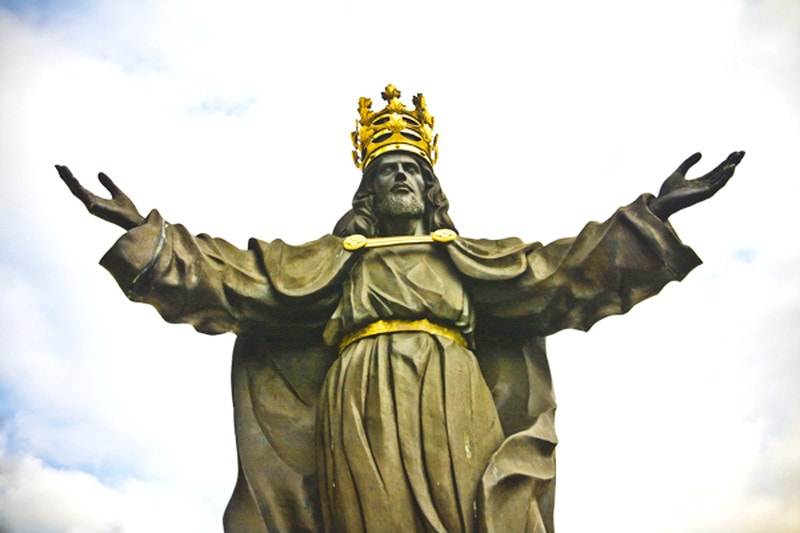
Jesus the King of the World in Czestochowa, Poland

In Christianity, Jesus is the ultimate Mediator between God and people. Neither angel nor any human can fill such a role. The author of Hebrews wanted to make it clear that Jesus is the rightful Ruler of all creation. Christ’s authority is far and above all others. So, Christians are never defenseless in this world. Believers have a sovereign Mediator and King to willingly submit to, knowing that Jesus has the power and authority to back up his words of love and assurance.

Jesus has the unique combination of being both King and Priest, the One who intercedes for us and leads us with compassionate leadership. Again, the author of Hebrews uses Psalm 110 to emphasize this:

Every high priest is selected from among the people and is appointed to represent the people in matters related to God, to offer gifts and sacrifices for sins. He can deal gently with those who are ignorant and are going astray, since he himself is subject to weakness. Therefore, he has to offer sacrifices for his own sins, as well as for the sins of the people. And no one takes this honor on himself, but he receives it when called by God, just as Aaron was.

In the same way, Christ did not take on himself the glory of becoming a high priest. But God said to him,

“You are my Son;
    today I have become your Father.”

And he says in another place,

“You are a priest forever,
    in the order of Melchizedek.”

During the days of Jesus’ life on earth, he offered up prayers and petitions with fervent cries and tears to the one who could save him from death, and he was heard because of his reverent submission. Son though he was, he learned obedience from what he suffered and once made perfect, he became the source of eternal salvation for all who obey him and was designated by God to be high priest in the order of Melchizedek. (Hebrews 5:1-10, NIV)

Jesus Christ demonstrated and proved he is qualified to be the rightful Priest and King through obedient suffering. That means he is perfectly suited and able to help us. Christ is no detached and aloof King and Priest. He knows exactly what it is like to be a human in this broken and fallen world. Such divine empathy translates into solid emotional and spiritual support because, as the Christian tradition holds, Jesus has taken care of the sin issue once for all through the Cross.

The Messiah’s enemies, whose final defeat is certain, are not Gentile kingdoms or human institutions. The ultimate foes are the hostile and evil principalities and powers of this dark world, including death itself. The universal reign of Jesus, the exalted Son of David, brings deliverance from guilt, shame, and injustice as the unique God-Man.

In this unabashed Christian view of Psalm 110, Jesus is our perfected high priest who is able for all time to save those who approach God, since he always lives to make intercession for us. (Hebrews 7:25)

The appropriate response to such a great King and Priest is submissive loyalty and eternal praise.

May it be so to the glory of God.

O Lord our God: Reign in power over us, through your Son, Jesus Christ – for he is exalted over all governments and authorities, all ideologies and creeds, and all human hearts and souls. King Jesus: Be enthroned in our lives, in all people everywhere, as our mediator and atoning sacrifice. Spirit of God: Reign in power over us through Jesus Christ and give us the victory over all the enemies of our souls, within and without, for the glory of your Name. Amen.

John 1:1-18 – God in the Flesh

Welcome, friends! The astounding love of God is seen most clearly in the face of Jesus Christ. Click the videos below and let us enjoy worshiping our incarnate Lord…

John 1:1-18
O Word of God Incarnate by Jeff Pardo
He Came Down by the Gaither Vocal Band, 1999

May your hearts be filled with grace through the incarnation of Christ.

May your minds be filled with truth through the knowledge of Jesus.

May your soul be filled with love through love incarnate, the Lord Jesus Christ our Savior. Amen.

God in the Flesh

The Word Became Flesh by Guatemalan painter Hyatt Moore

In the biggest cities of the world, like Mexico City, and Manilla, there are huge garbage dumps that cover several square miles. On top of these heaps of waste there live thousands of families who have made this their home. Each day they send their kids out to forage for scraps so they can have something to eat and survive.  Few others tread where these families are.  Yet, there are believers who make the journey and try to bring the gospel of grace and mercy to such a place.

As incredible and sad a situation that this is, it is incomparable to the journey from heaven to earth that Jesus made. Christ came to the sin-soaked dump of this world, to us who were living on a heap of garbage and entered our lives to save us from our wretched condition. Eugene Peterson’s paraphrase of the Bible, The Message, frames the Gospel of John 1:14 this way:

The Word became flesh and blood and moved into the neighborhood. We saw the glory with our own eyes, the one-of-a-kind glory, like Father, like Son, generous inside and out, true from start to finish.

Jesus did not merely appear to be human; he is human. The Christ of God, enjoying unhindered fellowship within the Godhead of Father, Son, and Spirit, became like us and lived with all the same things we face from day to day.  He “tabernacled” with us, using the imagery of God’s presence with the ancient Israelites (Exodus 25-31, 35-40). Jesus is our Immanuel, God with us.

We must remember that the Apostle John and the other gospel writers were evangelists; they wrote so that people might believe in Jesus and come to see what God has done through joining them in this broken world. Another John, John the Baptist, had a sole purpose in life to be a witness of Jesus to others, to testify to the truth that Christ came to rescue us from our terrible condition.

The Apostle John saw Jesus interact with families in the dump. He knew what was happening, that God was coming to save the people. The way to reach people, who are so concerned for scurrying about their business and trying to survive apart from God, is through the incarnation – in testifying to what God has done in Christ and being sent as little incarnations entering people’s lives. 

In this way, believers are like the moon, not producing light ourselves, but in the middle of darkness, reflecting the light of the sun so that the earth may know that Jesus is coming. The mystery of the incarnation is that Jesus became human and descended to live among us.

Any birth is an incredible miracle. I was present at the births of all three of my daughters, and one of my grandsons. There is nothing quite like it. Life coming into the world for the very first time is an unparalleled mystery with an unmatched sense of majesty. Although childbirth involves pain, agony, and mess, it is all quickly forgotten amidst the joy of this little baby becoming alive to all that is around them.

What a crazy contradiction of a virgin having a child gestate in her womb and then giving birth! That is something more than a miracle. It is Divine accommodation or condescension in which God does the unimaginable and unthinkable in not only coming to earth but entering as a vulnerable human baby. The great and mighty Sovereign of the universe got down on all fours and descended far beneath such loftiness. God got off the throne and sat on the garbage heap with us.

God is so far above and beyond us that to be revealed and communicate to us, the Holy Trinity conspired to enter the earth by means of a baby. God came to us. The sixteenth century Reformer, John Calvin, framed the incarnation of Christ in these terms:

“God lisps with us as nurses are wont to do with little children. Such modes of expression… accommodate the knowledge of the divine to our feebleness. In doing so, God must, of course, stoop far below his proper height… Because our weakness cannot reach his height, any description which we receive of God must be lowered to our capacity to be intelligible… God voluntarily lowers himself not as he really is but as we conceive of him.”

Indeed, God coos at us and babbles baby-talk not because that is his language but so that we can understand. What is more, God became flesh and blood for us, so we can climb up into his lap or lean into him, just as John did with Jesus. (John 13:23-25)

The incarnation of Christ means God loves us so deeply and completely that Jesus became one of us to bring that love with skin on, in ways that truly communicate empathy, compassion, kindness, and goodness to people. This is grace, that God first conformed to us before we are conformed to Christ. God went to the greatest lengths possible to reach us, save us, and bring us into the life of the Trinity.

Jesus climbed into our skin to assure us that God understands and cares. Jesus also gets into our hearts and invites us to know God. Even though Christ said a lot of things that can be difficult to understand, the love of coming alongside another person communicates well in any language and culture. Jesus, full of both grace and truth, bent over backwards to speak and act in ways that say, “I love you.”

God got down and dirty with us. The Lord jumped into the fray of broken humanity. God connected Jesus to an umbilical cord, covered him in the muck of fetal afterbirth, and caused him to cry alongside the sorrows of humanity. None of this was illusion or appearance. It was real, just like us. The author of the New Testament book of Hebrews said this:

Since the children are made of flesh and blood, it is logical that the Savior took on flesh and blood to rescue them by his death. By embracing death, taking it into himself, he destroyed the Devil’s hold on death and freed all who cower through life, scared to death of death.

It is obvious, of course, that he did not go to all this trouble for angels. It was for people like us, children of Abraham. That is why he had to enter every detail of human life. Then, when he came before God as high priest to get rid of the people’s sins, he would have already experienced it all himself—all the pain, all the testing—and would be able to help where help was needed. (Hebrews 2:14-18, MSG)

God’s grace stretches out on the wide horizontal beam of the Cross with compassionate arms for the world. God’s truth goes down deep with the vertical beam of the cross to give stability for the world. The truth of Jesus Christ, the One who reveals God, is strong enough to support the wide beam of grace which stretches round the earth to bring deliverance from the garbage dump of sin, death, and hell.

May we rejoice and be glad in this reality, and may it move us to be used of God to save those on the sin heap of this world.

Proverbs 1:1-7 – Right, Just, and Fair

“Passing Wisdom, Planting Seeds,” building art in Brooklyn, New York City by artists Danielle McDonald and Jazmine Hayes

These are the proverbs of Solomon, David’s son, king of Israel.

Their purpose is to teach people wisdom and discipline,
    to help them understand the insights of the wise.
Their purpose is to teach people to live disciplined and successful lives,
    to help them do what is right, just, and fair.
These proverbs will give insight to the simple,
    knowledge and discernment to the young.

Let the wise listen to these proverbs and become even wiser.
    Let those with understanding receive guidance
by exploring the meaning in these proverbs and parables,
    the words of the wise and their riddles.

Fear of the Lord is the foundation of true knowledge,
    but fools despise wisdom and discipline. (NLT)

The pursuit of wisdom is a noble aspiration for the New Year. One of the best places to go in that pursuit is the biblical book of Proverbs because it is all about living wisely and not foolishly.

To acquire and live by wisdom means learning to become right, just, and fair in all our interactions and dealings with others.

“Right” for the ancient King Solomon is a relational term – to be righteous, to have right relationships with God and other people. Righteousness involves experiencing peaceful, harmonious, and fruitful relations. For the Christian, right living is to know the wonderful freedom and joy of an unhindered relationship through Jesus Christ in dependence upon the Holy Spirit. 

When it comes to fellow human relations, a person characterized by righteousness does not, for example, let the sun go down on their anger. It is to know personal peace as well as to be a peacemaker so that relationships do not remain strained but enjoy harmony.

“Just” is closely related to “right.” We might tend toward primarily understanding justice as a punitive act – and that is certainly a part of the term. God punishes the wicked (not us!) with appropriate timing and wisdom; and deals with those who withhold righteousness and love through their uncaring, inattentive, or evil acts. 

Solomon understood justice as mostly concerned with providing a person with the necessities of life. So, for example, if someone is hungry and needs food, or does not have clean water to drink, it is a “just” act for us to provide those critical needs. God is deeply concerned for justice and expects people to act in this same manner.

“Fair” is to be egalitarian. Fairness and equity binds righteousness and peace together by avoiding prejudice toward others and their needs. It means to not show favoritism because there is an unshakable belief in the equality of all people, no matter where they are from, what they do, or who they are.

Therefore, if we exercise righteousness and justice exclusively with individuals and groups we like, but ignore others in need, there is no fairness. To give our love and service to all persons without strings attached, or without being concerned to get paid back, is the practice of being fair in all our affairs.

To live in the way of being right, just, and fair in all things is to be wise. Conversely, the classic fool is one who judges others, creates discord, and ranks persons according to their own personal standard of who deserves help, and who does not. Trying to have a useful and gracious conversation with a fool is like trying to reason with a toddler – you will get nowhere. 

A good place to start in pursuing the wise and biblical virtues of righteousness, justice, and fairness is to ask God to open our eyes to those within our sphere of influence who need both physical and relational needs met. Then, follow through with loving those persons for whom God brings into our lives.

Almighty God, the essence and source of wisdom, you are always right, just, and fair in all things, I praise you for your infinite and abundant wisdom. Whereas you abound in wisdom, I am lacking. Please help me to grow in wisdom as I increase in my knowledge and respect of your divine presence. By means of your Spirit, please increase my depth of insight as I study your Holy Word. Hold me back from leaning on my own understanding and enable me to wholeheartedly embrace the wisdom from above. Righteous God help me to grow in wisdom continually and consistently. Teach me your ways. Since you are a just God who shows no favoritism, lead me into being like you in my dealings with others through the example of Jesus Christ, in the strength of the Holy Spirit. Amen.