Psalm 86 – Theology Proper

Psalm 86 by Ann Williams

Incline your ear, O Lord, and answer me,
    for I am poor and needy.
Preserve my life, for I am devoted to you;
    save your servant who trusts in you.
You are my God; be gracious to me, O Lord,
    for to you do I cry all day long.
Gladden the soul of your servant,
    for to you, O Lord, I lift up my soul.
For you, O Lord, are good and forgiving,
    abounding in steadfast love to all who call on you.
Give ear, O Lord, to my prayer;
    listen to my cry of supplication.
In the day of my trouble I call on you,
    for you will answer me.

There is none like you among the gods, O Lord,
    nor are there any works like yours.
All the nations you have made shall come
    and bow down before you, O Lord,
    and shall glorify your name.
For you are great and do wondrous things;
    you alone are God.
Teach me your way, O Lord,
    that I may walk in your truth;
    give me an undivided heart to revere your name.
I give thanks to you, O Lord my God, with my whole heart,
    and I will glorify your name forever.
For great is your steadfast love toward me;
    you have delivered my soul from the depths of Sheol.

O God, the insolent rise up against me;
    a band of ruffians seeks my life,
    and they do not set you before them.
But you, O Lord, are a God merciful and gracious,
    slow to anger and abounding in steadfast love and faithfulness.
Turn to me and be gracious to me;
    give your strength to your servant;
    save the child of your serving girl.
Show me a sign of your favor,
    so that those who hate me may see it and be put to shame,
    because you, Lord, have helped me and comforted me. (NRSV)

Today’s psalm is a prayer of David, asking God for help against enemies. David was a guy who knew what it was like to have evil men hate him and pursue taking his life through no fault of his own. I am not sure about your experiences with such people. Although I have never faced adversity to such a degree as David, I do know something about people who, to put it bluntly, just flat-out hate my guts. It feels awful, and it can be terribly draining emotionally and spiritually. Having disrespectful and rude people talk behind your back (and sometimes even to your face) is in direct contrast to who God is.

God is described by David as merciful and gracious, slow to anger, abounding in steadfast love, and faithful. Whereas insolent people objectify others and seek their own selfish agendas, God always acts in accord with a basic character of love and grace. Based upon the nature of God, we can choose to cry out, just like David did, to show us a sign of God’s favor. We can pray for God to provide us with some tangible communication of divine love in ways we can understand so that we can be helped and receive the kind of comfort we need through our adversity.
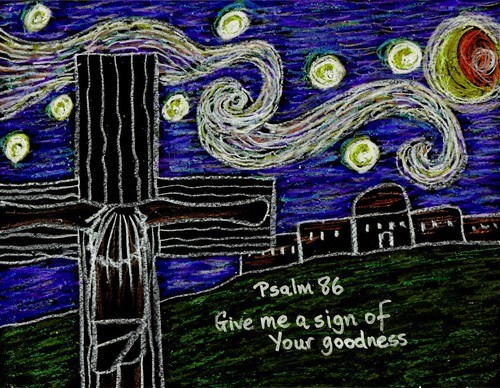
Psalm 86, chalk art by Scottish pastor and artist John Stuart, 2009

Be assured that with such a God, our pleas, cries, and tears will be noticed, affirmed, and answered. We can trust the sovereign Lord of all creation to address the insolence and injustice that exists around us and toward us.

All of this gets down to our view of God, our theological understanding of the basic Divine nature and purpose.  For some people, God is up there, somewhere, like some white-bearded old guy who is aloof to what is going on down here – there is neither anything personal nor personable about him, at all. For others, God is a force which binds all things together. In this theology, God exists, but you are never quite sure how to connect – it is like a crapshoot trying to get in touch with him.  For yet others, God is perpetually perturbed about something; he has a bee in his bonnet, and it is apparently our job to figure out what he is so sullen and upset about all the time so that we can appease him in some way.

However, the psalmist, David, sees God in wholly other ways than this. For David, God is personal, knowable, and reachable. David thought about God in ways which transcend either gendered or personality-type categories. Note the descriptions David provided: a willingness to forgive; an abiding, consistent, and steadfast presence of divine love; always having the time and desire to listen; possessing the power and ability to provide help and protection; being kind and merciful; not being easily angered; and extending needed comfort and consolation.

Now this is a God you can sink your teeth into – attentive, engaged, and anything but upset all the time. This is the reason why David has confidence to ask for deliverance, direction, and delight. Such a God is like a caring grandmother who seeks to always love and serve, and not a crotchety old curmudgeon who always seems bothered by everyone and everything.

If your theology, your view of God, cannot support and bear the weight of life’s hardest circumstances, then you need a different view of God! I invite you to see the God of David. Theology proper discerns the being, attributes, and works of God as fundamentally faithful and loving. This God has both the ability and the will to meet and satisfy your life’s greatest needs.

Great God of David, you are above all things and beside all things and with all things. You are uniquely positioned and powerful to walk with me through all the situations of my life. Thank you for sending the Son of David to make real your promises to me.  Amen.

1 Corinthians 6:12-20 – An Embodied Spirituality

Welcome, friends! The body is important. Our physical bodies are the vehicle to accomplishing the will of God in the church and the world. Click the videos below and let us discover the connection between the spirit and the body…

1 Corinthians 6:12-20
This Body Is Your Temple by Matt and Joanna Black

Go forth into the world in peace;
be of good courage;
hold fast that which is good;
render to no one evil for evil;
strengthen the fainthearted;
support the weak;
help the afflicted;
honor everyone;
love and serve the Lord in body, mind, and spirit,
rejoicing in the power of the Holy Spirit;
and the blessing of God almighty,
the Father, the Son, and the Holy Spirit,
be among you and remain with you always. Amen.

An Embodied Spirituality

By Unknown artist

It is normal to feel guilty at this time of year about our bodies. Some of the more common goals for a new year are to lose weight, stop smoking, get in shape, have better sleep hygiene, and generally learn better self-care.  I am not going to add to the burden of guilt but emphasize something important: Our bodies are the vehicle given to us to glorify God. Our spirituality is quite embodied. (1 Corinthians 6:19-20)

One of the reasons we fail our bodies is that we do not always make the biblical connection of seeing our material selves with the same importance as the immaterial.  The Apostle Paul brought up a discussion about the body to the Corinthian Church because Corinth was a Greek city thoroughly imbibed with a Platonic philosophy of life.  At the core of Plato’s view of humanity was that the immaterial and the spiritual were of higher value than the body.  For Plato, the body is a necessary evil.  He referred to our souls as being imprisoned within the flesh.  When we die the soul is released and is freed from its bodily prison.

Western civilization has been significantly influenced, even today, by Plato’s view of humanity. Yet, that is not a biblical view of the body.  Instead of being a prison, the body is a temple, a sacred place which is no better and no worse than the soul.  When we die, we will not be disembodied souls, but will experience a bodily resurrection at the end of the age.  Eternity will be spent existing in a real glorified body free from sin. (1 Corinthians 15)

Since the body is sacred, and we glorify God with our bodies, then we must steward them just like we would steward any other physical material possession we own.  We have bought into Platonic philosophy when we treat our cars better than we treat our bodies.  If a warning light comes on in our cars, we get it checked by the mechanic.  He fixes the issue and tells us what we need to do to prevent it from happening again, and we listen to him. 

Far too often, when warning lights go off in our bodies, we ignore them until our bodies literally break down and we must go to the doctor.  And even then, the doctor tells us to do something, and we do not do it.  We never avoid the advice of our mechanic, and yet we do it with our doctor.  We need to adopt the biblical wisdom of glorifying God on this earth through our bodies. 

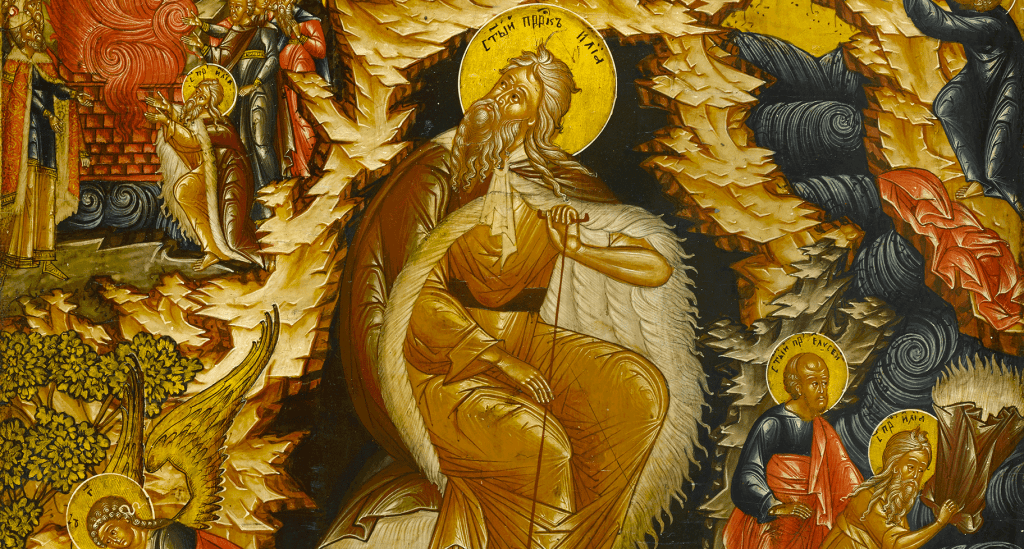
God’s care for our bodies can be found, for example, in the Old Testament prophet, Elijah. After Elijah experienced a great spiritual victory, he became the target of evil Queen Jezebel.  Elijah ran for his life and was severely burned-out from intense spiritual struggles with the queen’s prophets of Baal (1 Kings 19:1-3).  At that point, God did not come to Elijah and give him a sermon or exhortations about getting over it.  No, God restored Elijah’s body. And the Lord wants to restore our bodies, as well.

19th century Russian Orthodox icon of the prophet Elijah in the wilderness

First, Elijah needed sleep (1 Kings 19:5-6).  Millions of Americans are sleep deprived and live with a significant sleep debt (thus being continually cranky and out of sorts).  Insurance companies know this is a major issue because improper sleep habits have caused various auto accidents and fatalities. I once kept a crazy schedule with not many hours for sleep.  One day, during rush hour, I drove through a downtown expressway in bumper-to-bumper traffic and fell asleep.  I woke up about two minutes later and was still alive driving down the highway.  I sincerely believe God graciously drove the car for me.  That was my “wake up” call to change the way I was treating my body.

Second, Elijah needed to eat well (1 Kings 19:6-8).  For us, that means eating healthy.  One source of being overweight is failing to make the connection that eating is a spiritual activity.  Food is important to the kingdom of God.  It was eating that got us into trouble to start with and resulted in the fall of humanity.  Eventually, we will come full circle with eating being the activity we engage in at the end of the age – a redeemed view of food and eating together with Jesus at the marriage supper of the Lamb (Revelation 19:1-10).  God cares about food – what we eat and how much of it we consume.  He cares because we do not own our bodies – we steward them for God.

Third, Elijah needed some vigorous exercise (1 Kings 19:8-9).  He walked all the way to Mount Horeb, which was over a month’s travel.  But that exercise was essential to his well-being, both physically and spiritually.  It was only after he slept, ate well, and walked that Elijah was ready to meet with God in a powerful experience.

Our physical fitness is a spiritual issue, and so, needs prioritization.  I am under no illusions or delusions about the difficulty of this. I prefer brownies to broccoli and rather like sleeping instead of exercise. Yet, I work at being physically fit and caring for my body.  I am personally motivated toward health because I love God and want to please the Lord with my body. After all, my body was important enough to be redeemed through the Cross of Christ.

This is not about willpower – it is about Christian stewardship. I look at my body the same way I look at borrowing something from another person: I return it in the best condition I can. When the Lord takes me someday, I do not want it to be because I hastened my own death through disregard of my God-given body.

If I were God, donuts would be health food, sitting back in the recliner would build muscle, and two hours of sleep at night would be sufficient. But I am not God, so I submit to doing what it takes to have an embodied spirituality. We are to enjoy life through making the connection between the spiritual and the physical because that is the way God created us.

It is never too late to be a proper steward of the body.  Our physical anatomy is an amazing work of God and incredibly receptive to healthy choices. Here are a few of the choices we can make…

Remember the positives

Remember that care of the body is worth it.  Being fit feels great and equips us for the will of God.  Keep the long view in mind.  Sacrificing a temporary pleasure is worth the eventual gain.

Start small

I will not be doing any triathlons anytime soon, or ever. We need to be realistic and set appropriate goals without comparison to others. Start small and build up over time with slow incremental change. The place to begin is by rearranging our schedules so that our bodies become a priority.  Maybe it is time to make that doctor’s appointment you have been putting off.

Join others

Accountability and fun can and ought to go together. For example, preparing meals together is a chance to connect with a friend or family member. Discover and maintain a consistent rhythm of health that works for you and is enjoyable.

Reframe it

People often give up their best laid plans because they are disconnected from the rest of their lives. Reframing our view of the body as a spiritual activity helps connect and align our mind, body, and spirit in the wholeness God designed for us.

Start today

It takes time for something to become a habit. All good things are a process of realization. Consider and plan today, asking for God’s direction. Get the Lord in on it from the beginning and let it be an offering to him.

May you find the joy, contentment, and satisfaction of living with a body properly cared for and ready for use to the glory of God.

1 Samuel 2:21-26 – Sin and Sinners

God was most especially kind to Hannah. She had three more sons and two daughters! The boy Samuel stayed at the sanctuary and grew up with God.

By this time Eli was very old. He kept getting reports on how his sons were ripping off the people and sleeping with the women who helped-out at the sanctuary. Eli took them to task: “What’s going on here? Why are you doing these things? I hear story after story of your corrupt and evil carrying on. Oh, my sons, this is not right! These are terrible reports I’m getting, stories spreading right and left among God’s people! If you sin against another person, there’s help—God’s help. But if you sin against God, who is around to help?”

But they were far gone in disobedience and refused to listen to a thing their father said. So, God, who was fed up with them, decreed their death. But the boy Samuel was very much alive, growing up, blessed by God and popular with the people. (MSG)

God is not okay with sin. And that is a good thing. In a world full of systemic violence, oppression, injustice, as well as personal cruelty and callousness toward others, we depend upon the Lord’s inherent character of justice and righteousness.

“Sin” is quickly becoming an antiquated word in our culture. That is likely because far too many persons and groups have created extrabiblical lists of sins to avoid – and so many understandably do not want anything to do with it. Biblically, sin is described as wrong and unjust actions (1 John 3:4), as well as failing to do right and just actions (James 4:17). 

Sin is both the breaking of God’s commands, and the lack of conforming to the teachings of Jesus. Christians throughout the ages have generally understood that the Ten Commandments (Exodus 20:1-17) and Christ’s law of love (Luke 10:27) constitute a summary of God’s holy and moral instruction for humanity. This is all based in the character of God, as a holy and loving Being. Sin, then, may be defined as anything in a person which does not express, or is contrary to, the basic character of God.

All sin, whether through overt actions of injustice or a failure to get involved in righteous causes, is rooted in attitudes and activities of self-centeredness. Such sinful attitudes bring about an obsession with lust (1 John 8:34; Galatians 5:16); a broken relationship with God (Romans 3:23; Galatians 5:17); bondage to Satan (1 Timothy 3:6-7; 2 Timothy 2:26); death (Romans 6:23; 8:6); hardening of the heart (Hebrews 3:13); and deception (1 Corinthians 3:18; James 1:22, 26) just to a name a few. There is no upside to sin.

What all this means is that we are guilty of transgressing basic morality as well as failing to live up to being ethically virtuous people on any on-going consistent basis. “Well,” you might say, “that sounds like a total Debbie-Downer.” No, it is total depravity. Being depraved does not mean we are never capable of doing good; it just means that sin has profoundly touched everything in our lives, without exception.

The ironic paradox is that experiencing true joy and comfort comes through knowing how great our sin is. We can only live above sin if we are set free from it by the grace of God in Jesus Christ. If a person is to be redeemed from sin, then a provision must be made. In Christianity, sin has been dealt with once for all through the person and work of Jesus. Christ is our representative, taking our place with the punishment we deserved (Galatians 4:4-5; Ephesians 2:5-6; Colossians 2:9-15; Hebrews 2:17-18; 1 John 2:1).

Jesus Christ is our ultimate substitute (Romans 5:8); which resulted in our redemption (Galatians 5:13); which resulted in his sacrifice for sin satisfying all justice (Romans 3:25); which resulted in our reconciliation to God (Romans 5:10). So, the person who believes in Jesus is forgiven of sin because Christ’s sacrifice is sufficient to deal with all the effects of sin. The Christian is complete in Christ (Colossians 2:10).

The sin issue has been dealt with decisively and definitively in Christ. Thus, gratitude is the order of the day.  Christians ought to be the last people on earth who walk around looking like a bunch of sourpusses who were baptized in pickle juice. Instead, Christians ought to be the most thankful and gracious people around because they are forgiven people. A lack of joy and celebration betrays a lack of Christianity (Luke 15:25-32).

Sin certainly is awful. It destroys everything it touches and can leave terrible consequences in its wake. Sin, however, does not have the last word. Christ’s crucifixion and resurrection are the decisive blows to sin’s power. The skinny on sin is that it is terribly bad. But Jesus is extremely good and overcomes the worst that sin can dish out.

If only Eli’s sons would have listened to their father and embraced grace, yet their sin was so egregiously intolerant to the point that God had had enough of their shenanigans. The contrast between the Eli’s biological sons and his spiritual son, Samuel, were quite pronounced. Old Eli blessed Samuel and his parents but had to rebuke his own sons. Indeed, unchecked sin led to death, but the gift of favor is given to the penitent.

“Work hard for sin your whole life and your pension is death. But God’s gift is real life, eternal life, delivered by Jesus, our Master.”

romans 6:23, msg

Just as Samuel grew in stature and in favor with God and others, so a thousand-years later Luke the Evangelist uses this language to describe the growth of Jesus (Luke 2:40). We, too, can enjoy the grace of God whenever we forsake the heinous nature of sin and live into the way, the truth, and the life that the Lord has waiting for us.

Almighty God, Sovereign Lord of the universe, and Creator of humanity, we, your unfaithful children, are terribly sorry for our sins and the lives we have lived apart from your grace. We sincerely believe that only through the precious blood of our Lord Jesus Christ can we obtain your forgiveness. We confess we have committed serious offences against you in thought, word, and deed against our neighbors. In laziness, despair, and lust for power, we have provoked hatred, division and hurt within our communities. In greed, deceit, and indifference, we have caused serious damage and unnecessary conflict to our brothers and sisters. In selfishness, insensitivity, and bias we have encouraged and emboldened those who inflict hurt, pain, and sorrow
on our loved ones and families. In the name of religion, doctrine, and even of Christ himself we have wounded fellow believers. In stubbornness, pride, and arrogance, we have caused division and strife within your church.

Mercifully send your Holy Spirit and cleanse us from all unrighteousness, restore in us true faith in Christ, and help us to live in peace with our ourselves and our fellow humanity, through our Lord Jesus Christ, to the glory of your holy name. Amen.