Believing Hearts vs. Poisoned Minds (Acts 14:1-7)

A Roman bridge between Iconium and Pisidian Antioch

The same thing occurred in Iconium, where Paul and Barnabas went into the Jewish synagogue and spoke in such a way that a great number of both Jews and Greeks became believers. But the unbelieving Jews stirred up the gentiles and poisoned their minds against the brothers. So they remained for a long time speaking boldly for the Lord, who testified to the word of his grace by granting signs and wonders to be done through them. 

But the residents of the city were divided: some sided with the Jews, and some with the apostles. And when an attempt was made by both gentiles and Jews, with their rulers, to mistreat them and to stone them, the apostles learned of it and fled to Lystra and Derbe, cities of Lycaonia, and to the surrounding region, and there they continued proclaiming the good news. (New Revised Standard Version)

The typical approach of the Apostles Paul and Barnabas was to enter a city and find the local Jewish synagogue. But their missionary efforts went well beyond attempting to reach fellow Jews; they also had the mind and heart to include non-Jewish persons, Gentiles, in the fledgling Church.

As a result of this apostolic ministry, a number of both Jews and Gentiles believed the message of God’s grace and became followers of Jesus. Thus, two ancient enemies came together to form one new society. Old animosities and prejudices came down. Jew and Gentile began worshiping together and embracing the words and ways of Jesus.

Yet, at the same time, there were also many Jews who refused to believe. Just as the new believers united together in faith, so the unbelievers banded together for a different purpose: to stir up the Gentiles by infecting their minds against this new union of people, centered around a common confession of Christ.

The unbelievers started a slander campaign against Paul and Barnabas, sowing mistrust and suspicion amongst the people in the street. But the sinful propaganda didn’t deter the apostles from spending considerable time in the city of Iconium and speaking confidently about the good news of Jesus.

What’s more, the message was confirmed by a demonstration of spiritual power. Paul and Barnabas were enabled by God to do many miraculous wonders in the city. This helped the gospel and the authority of the apostles to be established with the people.

The dynamic of belief and unbelief, cut right down the middle of the city. The people became divided and polarized. Some sided with the Apostles Paul and Barnabas, persuaded by their arguments and convinced by their actions; and others sided with the unbelieving Jews, having listened to their slanderous accusations and looking at the apostles as a threat to their existing society.

The climate in the city of Iconium became ripe for violence. Relations between believers and unbelievers deteriorated into planning harm against the new Christians. Even the city officials were becoming sympathizers with the planners to rid the city of the apostles once and for all. In other words, for Paul and Barnabas to remain in the city meant that they would likely get stoned and left for dead.

So, the apostles got out of Dodge and went to the cities of Lystra and Derbe. At least they could keep proclaiming the good news of grace to other people and avoid getting killed.

This story gets at a practical reality for many people of faith: How do people maintain their religious convictions and commitments in an environment that views them as harmful to society?

To be sure, not every person of faith faces this. But others around the world face it every day. And then there are perhaps the majority of the faithful, who sometimes find themselves in places and positions in which slander is rife and verbal violence abounds. What is a person of faith to do?

Not every situation is the same, so each circumstance will take some wisdom in handling it. Nevertheless, the following are some aspects to consider in dealing with the unbelief of others and the harmful effects it can bring:

  1. Persevere in your spiritual confidence. Paul and Barnabas did not cower in fear, but kept up their missionary efforts. The words of gossip and attitudes of hostility around them didn’t slow them down one bit. In fact, in other situations, the apostles who actually experienced harm, chose to view it as a privilege to suffer in the same sort of way Jesus did.
  2. Know when to walk away. Boldness doesn’t necessarily mean that one throws caution to the wind and simply keeps going, no matter the consequences. Paul and Barnabas knew when to leave the city and go somewhere else. They realized the shelf life of their ministry in Iconium was at an end. Neither one of them bemoaned the situation, but instead, looked ahead to the opportunity of gospel proclamation in other cities.
  3. Trust God in all things. Whenever we are slandered, or others actually make plans of harm against us, our initial desire may be to get them before they get us; or to fight back using the same tools of violence that were done against us. Paul and Barnabas did no such thing. Believers have spiritual tools of use that unbelievers don’t possess. So, use them. Pray for those who mistreat you. And let God handle the judgment end of things.

If Christians keep focusing on the words and ways of Jesus, they will consistently practice humility, not pride; confession of faith, not calling out in anger; meekness, not aggressiveness; righteousness, not wrongdoing; mercy, not judgment; purity, not dirty politics; and peacemaking, not war-mongering.

May it be so, to the glory of God. Amen.

The Everlasting God (Isaiah 40:21-31)

Don’t you know? Haven’t you heard?
    Wasn’t it announced to you from the beginning?
    Haven’t you understood since the earth was founded?
God inhabits the earth’s horizon—
    its inhabitants are like locusts—
    stretches out the skies like a curtain
    and spreads it out like a tent for dwelling.
    God makes dignitaries useless
    and the earth’s judges into nothing.
Scarcely are they planted, scarcely sown,
    scarcely is their shoot rooted in the earth
    when God breathes on them, and they dry up;
    the windstorm carries them off like straw.
So to whom will you compare me,
    and who is my equal? says the holy one.

Look up at the sky and consider:
    Who created these?
    The one who brings out their attendants one by one,
    summoning each of them by name.
Because of God’s great strength
    and mighty power, not one is missing.
Why do you say, Jacob,
    and declare, Israel,
    “My way is hidden from the Lord,
    my God ignores my predicament”?
Don’t you know? Haven’t you heard?
    The Lord is the everlasting God,
    the creator of the ends of the earth.
    He doesn’t grow tired or weary.
His understanding is beyond human reach,
    giving power to the tired
    and reviving the exhausted.
Youths will become tired and weary,
    young men will certainly stumble;
    but those who hope in the Lord
    will renew their strength;
    they will fly up on wings like eagles;
    they will run and not be tired;
    they will walk and not be weary. (Common English Bible)

Strength, endurance, and perseverance are vital resources which come from the reservoir of spiritual resources.  One does not simply will it into reality, and, poof! It is there! No, these resources must be drawn from a source that is reliable and continual.

Whenever you and I are persuaded to use an unreliable and/or limited resource, like our own, or some slick marketed one, we are not revived or restored to keep going and persevere through a given situation. In such times, we may naively think that God is absent, and cry, “God ignores my predicament.”

But God isn’t sleeping. The Lord hasn’t gone out to lunch or taken a bathroom break. God is not the problem. 

We actually thought we could handle our own junk, independently, without any help, saying, “I’ve got this!”  Maybe, for a while, you did. But then the strength ran out; weariness overwhelmed you. All of sudden, it seems, you have overestimated yourself, and underestimated God. 

With no steady and reliable resource to draw from, your brain’s thinking became distorted, and your heart’s confidence sunk. That’s because the sovereign and majestic God is the One who gives power and life, and there was trust in other things beside the Lord.

Yet, placing our hope in the God who is there, is to plunge into an inexhaustible and gracious pool of strength.  God enables us to fly and soar above our human predicaments and our daily problems. With the power God provides, we can carry-on and follow-through with the demands, duties, and desires of life on this earth which God created for us.

To draw from the deep well of God, it is thus extremely necessary to meet with this God on a regular and consistent basis. If food and drink for the body requires multiple daily attention and time, then filling the soul is just as, and even more, important.

This need for daily spiritual food and drink is why I choose to engage in the Divine Hours, also known as the Daily Office, or Fixed Hour Prayer. At certain set times in the day I break away from what I’m doing to give attention to the soul by drawing from the merciful resources of God. 

Perhaps this might be for you, as well, a fresh way to address your parched and needy soul.

Here is a link to the Divine Hours, based on the book of prayers compiled by Phyllis Tickle:

explorefaith.org/prayer/fixed/hours.php

Yet, no matter the particulars of how we address meeting with God, consistently drawing from the well of grace is vital to our spiritual and emotional health.

Set me free, O God, from the bondage of my sins, and give me the liberty of that abundant life which you have made known to me in your Son our Savior Jesus Christ; who lives and reigns with you and the Holy Spirit, one God, now and forever. Amen

Have a Healthy Spiritual Heart (Matthew 12:9-14)

Going on from that place, he went into their synagogue, and a man with a shriveled hand was there. Looking for a reason to bring charges against Jesus, they asked him, “Is it lawful to heal on the Sabbath?”

He said to them, “If any of you has a sheep and it falls into a pit on the Sabbath, will you not take hold of it and lift it out? How much more valuable is a person than a sheep! Therefore it is lawful to do good on the Sabbath.”

Then he said to the man, “Stretch out your hand.” So he stretched it out and it was completely restored, just as sound as the other. But the Pharisees went out and plotted how they might kill Jesus. (New International Version)

The juxtaposition of this story is pronounced: A man with a shriveled hand stretched it out and is healed by Jesus in full view of everyone in the synagogue; and the synagogue leaders with shriveled hearts withhold their hearts from Jesus, and are not healed of their paralyzed beliefs.

Asking questions out of a desire to make a point, instead of asking out of sincere curiosity, is a telltale sign of the small and shriveled heart. And the surefire signal that the heart is wadded-up like a crumpled piece of paper, is the concern for policy and procedure over people.

There was, of course, an allowance for life-threatening medical situations to be attended to on the Sabbath. The man’s shriveled hand, however, didn’t fall into this category. Jesus could have handled the question of healing by stating that he would do it the next day. That certainly would have protected him and quelled any concerns of his orthodoxy.

But Jesus didn’t go there.

Jesus heals the man with a withered hand, from a 17th century Arabic copy of the Gospels

Instead, he deliberately made a stink in front of everyone. Why? Because the whole situation already stunk to high heaven. The ensconced handling of the law by the religious authorities was calloused to real human need. In other words, such a view of the law was ungodly.

Somewhere along the line, the command of a Sabbath day’s rest had turned from a devoted time for community renewal to an opportunity for showing off one’s religiosity and personal piety.

And the height of offense for Jesus was that God was used as the justification for the peacocking to happen. It is to place the supreme spirituality of a holy person above the hard reality of human need and pain. Jesus wanted nothing to do with such a charade of law.

The divine purpose of the Sabbath command was the health of the entire community – even including animals. It’s meant to be a day of mercy, and not a day of restrictions to the point of perpetuating or even causing ill health.

In truth, to not heal on the Sabbath is a travesty of God’s law.

This isn’t only an ancient problem, but also a contemporary issue, as well. One reason so many modern people today believe that Christianity (and, in some cases, all religion) is nothing but a bunch of goofiness, is that there are far too many Christians and churches who espouse a reading of Scripture that is unhealthy instead of healthy.

Whenever Holy Scripture is used a weapon to keep women in check, existing power structures in place, and people different from one’s religious tradition out of congregational life, then such a practice will eventually be challenged by Jesus. And, ironically, all the nice religious folk will turn on Christ and plot how to be rid of him altogether.

And who, pray tell, wants to be a part of that sort of goofiness?

The bottom line, for many people, is their wealth, money, property, and resources. And if someone happens to get in the way of those economic resources, well then, we’ll simply reinterpret existing biblical commands to protect and maintain our stuff.

For Jesus, the whole point of the banter in the synagogue was to actually help the man right in front of him – to do the right thing on the Sabbath day, and not the hard-hearted thing of nothing.

Sabbath is intended to give everyone, without exception, an opportunity to “be” instead of “do.” The Sabbath is designed for the interests and betterment of all creation, all humanity, and not the other way around. The very fact that the upstanding religious folk even have to be told this, signals that they have drifted very far from the actual commands of God.

“If Jesus had been more diplomatic, he may have reformed Judaism, but he would not have won the world. He would not have give us a gospel that serves the depth intention of the law by freeing us from a slavish service to its surfaces.”

Frederick Dale Bruner

In short, Jesus healed the man’s shriveled hand. But the pious religious persons were not healed of their shriveled hearts. Instead, they were mad as hell. They held an after-church meeting in the parking lot about how to do away Jesus, once and for all.

They did this because the entire movement of maintaining religious power and authority was being threatened to the core.

There are those who hate the one who upholds justice in court and detest the one who tells the truth. (Amos 5:10, NIV)

Therefore, I strongly urge every believer in Jesus Christ to be completely devoted to the Scriptures of the Old and New Testaments, by actually reading them every day; instead of relying upon slick preachers who tell you what you like to hear.

Be discerning and wise in the reading, hearing, and study of God’s Holy Word. It’s a matter of health and illness, hope and despair, life and death. Don’t have a shriveled heart; have a healthy heart, my friend.

Almighty God, to you all hearts are open, all desires known, and from you no secrets are hid: Cleanse the thoughts of our hearts by the inspiration of your Holy Spirit, that we may perfectly love you, and worthily magnify your holy Name; through Christ our Lord. Amen.

A View of Suffering (Job 36:1-23)

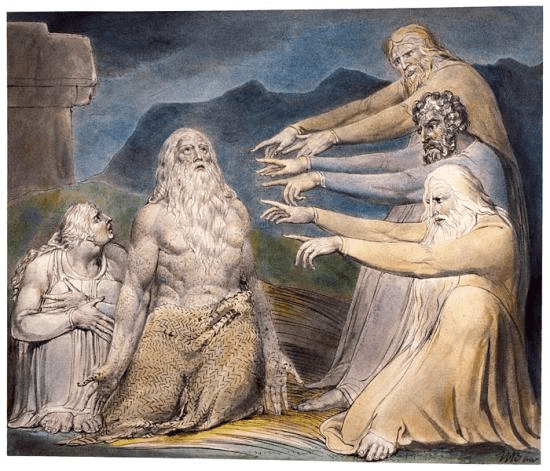
The Wrath of Elihu,” by William Blake (1757-1827)

Elihu continued:

“Bear with me a little longer and I will show you
    that there is more to be said in God’s behalf.
I get my knowledge from afar;
    I will ascribe justice to my Maker.
Be assured that my words are not false;
    one who has perfect knowledge is with you.

“God is mighty, but despises no one;
    he is mighty, and firm in his purpose.
He does not keep the wicked alive
    but gives the afflicted their rights.
He does not take his eyes off the righteous;
    he enthrones them with kings
    and exalts them forever.
But if people are bound in chains,
    held fast by cords of affliction,
he tells them what they have done—
    that they have sinned arrogantly.
He makes them listen to correction
    and commands them to repent of their evil.
If they obey and serve him,
    they will spend the rest of their days in prosperity
    and their years in contentment.
But if they do not listen,
    they will perish by the sword

    and die without knowledge.

“The godless in heart harbor resentment;
    even when he fetters them, they do not cry for help.
They die in their youth,
    among male prostitutes of the shrines.
But those who suffer he delivers in their suffering;
    he speaks to them in their affliction.

“He is wooing you from the jaws of distress
    to a spacious place free from restriction,
    to the comfort of your table laden with choice food.
But now you are laden with the judgment due the wicked;
    judgment and justice have taken hold of you.
Be careful that no one entices you by riches;
    do not let a large bribe turn you aside.
Would your wealth or even all your mighty efforts
    sustain you so you would not be in distress?
Do not long for the night,
    to drag people away from their homes.
Beware of turning to evil,
    which you seem to prefer to affliction.

“God is exalted in his power.
    Who is a teacher like him?
Who has prescribed his ways for him,
    or said to him, ‘You have done wrong’? (New International Version)

Job’s “friends” scorn him, painting by William Blake

I’m just going to go ahead and say it: Elihu was a jerk. His worldview wasn’t big enough to accommodate for Job’s awful suffering as anything but a chastisement from God.

Elihu embodied the proud person, full of himself, believing that he knows how the world works. But, in reality, he knows jack squat. The best thing Elihu did in the book of Job was to keep his mouth shut. The silence was actually helpful.

After Job lost everything and everyone dear to him (except his wife) he was understandably in tremendous grief. His lament needed to be heard – not responded to with the rebuttal of an ignoramus. Unfortunately, Elihu didn’t keep his mouth closed. He seems like a mere windbag, speaking a lot of words and saying nothing.

To be fair, Elihu gets a lot of information right; it’s just that his reasoning is narrow and misguided. He rightly affirms that God has incomparable power, and is the One who is able to punish the wicked and grant justice to the oppressed.

Yet, Elihu assumes – in his apparent black-and-white world – that anyone afflicted with such terrible events as Job is under the correction of God. The Lord is disciplining the person and teaching them a lesson about the error of their ways, he reasons.

That sort of logic betrays a very contractual sort of relationship with God – as if the Lord is only the high and transcendent plantation boss who singularly serves to maintain discipline and fealty amongst the ranks of inferiors. Elihu ignored the immanence of God in coming close to the brokenhearted and providing release for those in captivity.

In such a bifurcated world of a high God and low humanity, there are really only two choices whenever someone is in a situation like Job: either turn from your erroneous ways and serve God; or don’t, and die under the punishment of God.

But the book of Job challenges us on that kind of thinking and belief. The hard circumstances of people cannot neatly be categorized into the need for repentance – nor can a life of ease and wealth be considered a mark of divine favor.

Elihu was leaning toward viewing Job as a rebellious man who needed to admit his sin and submit to God. Yet, Job (and God!) knew better than this. And that is perhaps one of the most difficult aspects of horrible human suffering – that the sufferer must contend with persons who look at them askance as if they have done some egregious sin which offended God.

We know, as readers of the biblical book, that there was no wickedness or sin involved in Job’s suffering. Instead, there were unseen forces behind the scenes causing that suffering. In fact, just the opposite was at work: Job was suffering because of his incredible righteousness, and not by any wrongdoing on his part.

Most situations are complex and defy simple explanations or solutions. It is foolish to make assumptions based upon circumstantial evidence. Wanting quick and easy answers to the problems we face as humans is the path of simpletons.

In contrast to nice and neat mental categories, there are loving believers who are devoted to faith and patience, knowing that there can be more going on than what it seems on the surface. Listening and understanding is the path to wisdom, whereas entrenched opinions – offered as certainty of belief – is a way of dying in ignorance.

“Life’s but a walking shadow; a poor player, that struts and frets his hour upon the stage, and then is heard no more: it is a tale told by an idiot, full of sound and fury, signifying nothing.”

William Shakespeare, Macbeth

If we keep a focus on being helpful to the other, then we are less likely to offer unhelpful, even harmful, words. Knowing that life is much bigger than we can realize, is one good step toward that end.

O Lord our heavenly Father, whose blessed Son came not to be served, but to serve: We ask you to bless all who, following in his steps, give themselves to the service of others; endue them with wisdom, patience, and courage, that they may strengthen the weak and raise up those who fall, and, being inspired by your love, may worthily minister to the suffering, the friendless, and the needy, for the sake of him who laid down his life for us, your Son our Savior Jesus Christ. Amen.