Psalm 119:9-16 – How Can a Young Person Live a Pure Life?

How can a young person live a pure life?
    By obeying your word.
I try with all my heart to serve you.
    Help me obey your commands.
I study your teachings very carefully
    so that I will not sin against you.
Lord, you are worthy of praise!
    Teach me your laws.
I will repeat the laws we have heard from you.
I enjoy following your rules
    as much as others enjoy great riches.
I will study your instructions.
    I will give thought to your way of life.
I enjoy your laws.
    I will not forget your word. (ERV)

Pornography is a multi-billion-dollar a year industry and is steadily growing. The younger generation is particularly susceptible in this internet age of easy access and multiple porn websites.

  • 35% of all internet downloads worldwide are related to pornography.
  • Teen-aged boys are the largest consumers of pornographic internet sites. 

The following percentages of children report having seen pornography in some way:

  • 50% of 11-13-year-olds
  • 65% of 14-15-year-olds
  • 78% of 16-17-year-olds
  • 75% of parents believe their children have not seen pornography online.
  • 53% of the children said that they had seen pornography online.

Into this terrible muck of impurity an impropriety enters the biblical psalmist with his ancient, yet truly relevant question for us today: How can a young person live a pure life? 

The answer the psalmist gives is this: By guarding the heart through obedience to God’s Holy Word. The psalmist himself stored up the commands and teachings of Scripture in his heart so that he might not sin against God.

A solid tried-and-true activity parents can do for themselves (the statistics for adult use of porn are staggering) and for their kids in this area of purity is for the entire family to do some old school Bible memorization. Yes, I mean getting down to rote memory work. 

This is to be neither a legalistic practice nor some fetish that will keep evil away. Instead, memorizing verses and large sections of the Bible provides a solid foundation from which to construct of base of operations for the work of meditation. When temptation occurs, there will be something to stand upon in the heat of the moment.

Today’s lesson from Psalm 119 is a great place to begin. Expand to memorize the entire psalm, all 176 verses of it. When faced with the decision of viewing pornography or not, it would be wise to dedicate the time to memorizing Scripture so that there will be a delight in God’s statutes rather than a depressed guilt over another fall into impure thoughts and/or actions.

Now, I can feel the pushback from some folks. You might not have memorized anything your entire life, or so you think. One of the reasons many people can freely quote lines from movies is that they have watched their favorites repeatedly. Ah, so we are on to something, right!?

I have been reading the Holy Bible for over forty years, every day. I have large chunks of Scripture memorized – mostly because of all that reading. So far in my life I’ve read the entire Old Testament around 100 times and the New Testament about 300 times – not because I ever had the goal of doing all that reading but because I need God’s Word.

What’s more, I take the further step of spending some time in reflection and ongoing meditation on Scripture, especially at night before retiring. This might seem over the top to some. However, the reading and reflection of Scripture is about a 30-minute venture for me on most days. The goal is engrafting the message of the Bible into the heart and life. Memorization is simply the means of helping that to happen.

There are some memorization tips I use and have picked up along the way to aid in pressing Scripture firmly into my soul:

  • Sleep on it. Studies show that our brains process and store information while we sleep. Try to review some Scripture just before you go to sleep—even if it’s only for a few minutes—and see if it helps embed the information in your memory.
  • Repeat it. There is no substitute for consistent and repetitive reading or listening to Scripture being read to you. This one practice alone has been key to my own ability to memorize. 
  • Write it out. Writing helps deeply encode biblical truth we’re trying to learn because there is a direct connection between our hand and our brain. To increase recall, speak the Scripture out loud and visualize the concepts as well.
  • Sing it. Singing is what got my middle daughter through school. Songs or jingles use your brain’s right hemisphere, helping us to remember. There are already plenty of songs out there for all kinds of biblical passages. And, of course, you can always try making your own music.
  • Sense it. Use as many of the five senses as possible. Our senses enable us to use more parts of our brains and retain information better. For example, when I read Scripture, I use a physical Bible to hold and often use a pointer when reading (touch); have a cross in front of me (sight); read out loud, sometimes with worship music in the background (hearing); light a candle (smell); and, I always have a cup of coffee to sip while reading! (taste)

The biblical psalms are meant to be prayed. So, using them for that purpose has the effect of shaping our prayers and desires in a good direction, as well as helping us to live into the commands of God to “repeat the laws I have heard from you.” In a world of spiritual impurity, emotional assault, and mental adultery, we need the purifying work of God’s Word to wash our souls clean.

May it be so, to the glory of God.

Merciful God, thank you for providing your Word to me so that I might read it, use it, memorize it, meditate upon it, and engraft it into my soul.  Fortify my spirit against the demons of impurity by the power of your Holy Spirit, to the glory of Jesus Christ.  Amen.

Acts 2:14-24 – From Flaky to Faithful

Preaching of the Apostles (crayon on paper) by Peter Gorban, 1990

Peter stood up with the Eleven, raised his voice and addressed the crowd: “Fellow Jews and all of you who live in Jerusalem, let me explain this to you; listen carefully to what I say. These people are not drunk, as you suppose. It’s only nine in the morning! No, this is what was spoken by the prophet Joel:

“‘In the last days, God says,
    I will pour out my Spirit on all people.
Your sons and daughters will prophesy,
    your young men will see visions,
    your old men will dream dreams.
Even on my servants, both men and women,
    I will pour out my Spirit in those days,
    and they will prophesy.
I will show wonders in the heavens above
    and signs on the earth below,
    blood and fire and billows of smoke.
The sun will be turned to darkness
    and the moon to blood
    before the coming of the great and glorious day of the Lord.
And everyone who calls
    on the name of the Lord will be saved.’

“Fellow Israelites listen to this: Jesus of Nazareth was a man accredited by God to you by miracles, wonders and signs, which God did among you through him, as you yourselves know. This man was handed over to you by God’s deliberate plan and foreknowledge; and you, with the help of wicked men, put him to death by nailing him to the cross. But God raised him from the dead, freeing him from the agony of death, because it was impossible for death to keep its hold on him. (NIV)

In the New Testament Gospels of the Holy Bible, the Apostle Peter was a flake. He sometimes got it, and sometimes didn’t. Peter could discern Jesus was Messiah, but then would turn around and refuse that Christ had to die on a cross. He would get bold and walk on water, then, end up falling short and needing help from drowning. Peter stood tall for Jesus, and then denied him three times.

However, following the Gospels in the Acts of the Apostles, Peter is a completely changed man. He now gets it. He is brave. He confesses Christ with confidence and boldness. And, while the reader might be waiting for the other shoe to drop yet again, all the while Peter does not falter, flinch, or back down. Alright, Peter, way to go!

So, what is the difference between the Gospels and Acts with Peter? Why is there such a turnaround from flaky to faithful? The Scriptures make it plain: The Holy Spirit comes upon Peter. And he is never the same again. Everything falls into place for Peter. He proclaimed the life and death of Jesus in such a way that thousands changed their way of thinking, as well as their way of life, and placed their faith and hope in Christ as Savior and Lord. Not a bad day’s work for a former fisherman.

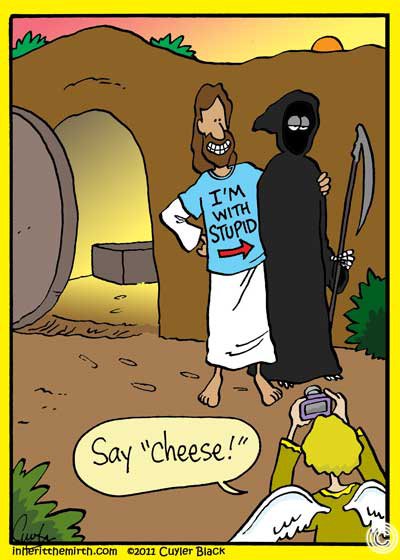
Peter’s message was pointed and straightforward: God raised Jesus up, forever changing the nature of death. Peter was dogmatic about stating that it wasn’t even possible for death to get a grip on Jesus. Oh, death thought it had him, the Grim Reaper believed he had Christ nailed to death for certain. Not so. The grave could not contain the immense and incredible power of divine love for humanity.

Inherit the Mirth

If it was impossible for death to keep its grip on Jesus, then there is absolutely nothing that can deter Jesus or hold him back from accomplishing what he wants to accomplish. Flaky believers are not going to frustrate Jesus or upset his plans; he’ll just send the Holy Spirit. 

We too often imprison ourselves in self-made spiritual jail cells, flaking-out in the Christian life, sometimes getting it right and once-in-a-while hitting upon some right combination we can’t explain, like a golfer who hits an amazing shot but can’t reproduce it no matter how hard he tries. The truth is: Jesus has conquered sin, death, and hell. By faith, we have forgiveness of sins in Christ and have the way opened to a new life in the Spirit. It isn’t a secret; it is a new reality.

The season of Lent is a time of remembering those things which hinder us in our walk with Jesus and repenting of our sins so that we can live anew. As we quickly approach Holy Week, the golf clubs of vulnerability, confession and prayer will keep us in God’s fairway and allow us to shoot par.

Gracious God, who raised Jesus from the dead, may the same power reside in me so that I can do your will in every situation through the power and presence of your Holy Spirit.  Amen.

Isaiah 43:8-13 – God Is Sovereign and I Am Not

Photo by Rachel Claire on Pexels.com

Bring my people together.
They have eyes and ears,
    but they can’t see or hear.
Tell everyone of every nation
    to gather around.
None of them can honestly say,
    “We told you so!”
If someone heard them say this,
    then tell us about it now.

My people, you are my witnesses
    and my chosen servant.
I want you to know me,
to trust me,
and understand
    that I alone am God.
I have always been God;
    there can be no others.

I alone am the Lord;
    only I can rescue you.
I promised to save you,
    and I kept my promise.
You are my witnesses
that no other god did this.
    I, the Lord, have spoken.
I am God now and forever.
No one can snatch you from me
    or stand in my way. (CEV)

I confess that I am an unabashed Calvinist – a Protestant theologian, pastor, and chaplain in the Reformed tradition. What that means to me is that I believe in God’s unconditional election of persons to salvation and new life. Maybe that means nothing to you, and to others it means everything. For many folks, it is just some churchy mumbo-jumbo which is rather irrelevant to the real stuff of the Christian life. 

I do not agree. It seems to me to be quite important. The heart of Reformation faith is a focus on God’s sovereignty, majesty, power, and grace. It is God who justifies, and not any human. That means there are no conditions to which God is beholden to act.

God works in the world according to divine free will and is not dependent upon anyone or anything to accomplish good purposes and fulfill good promises.

Today’s Old Testament lesson is a soaring view of God’s grace and powerful control. Yes, indeed, throughout all eternity God is God. There is none who can thwart the Lord’s plans. God acts freely and mercifully and nothing can cancel out those actions. Nothing can separate us from the love of God. 

We might jump from finger to finger in our puny attempts at autonomy, but we are not getting out of God’s hand! 

This really ought to be a comfort to every believer. God’s decrees will be fulfilled, and there is not one thing any wicked person can do to subvert divine initiatives. Furthermore, there is absolutely no way we can screw-up God’s purposes. We simply do not have such power. Our great task as believers is to rest secure in God’s will and place our trust in the One who knows exactly what he is doing in the world.

So, take a few minutes, draw a few deep breaths, and think on the wonderful truth that God is sovereign. To help you, here is the great opening to the Reformed confession, The Heidelberg Catechism, giving us a glimpse into the majesty of God:

Q: What is your only comfort in life and in death?

A: That I am not my own,

but belong with body and soul,

both in life and in death,

to my faithful Savior Jesus Christ.

He has fully paid for all my sins

with his precious blood,

and has set me free

from all the power of the devil.

He also preserves me in such a way

that without the will of my heavenly Father

not a hair can fall from my head;

indeed, all things must work together

for my salvation.

Therefore, by his Holy Spirit

he also assures me

of eternal life

and makes me wholeheartedly willing and ready

from now on to live for him. Amen.

John 12:20-33 – Life By Death

Welcome, friends! Jesus let us in on how the world can be changed. For that to happen, there are some things we will need to die to. Click the videos below, and let’s find out….

John 12:20-33, Pastor Tim Ehrhardt
From the album by the Oslo Gospel Choir, “We Lift our Hands, Part 2” 2006

May the peace of God which surpasses all understanding, keep our hearts and minds in the knowledge and love of God, and of his son Jesus Christ our Lord; and the blessing of God almighty, the Father, the Son, and the Holy Spirit be amongst us and remain with us forever. Amen.