Acts 15:36-41 – Intense Argument

Some time later, Paul said to Barnabas, “Let’s go back and visit all the brothers and sisters in every city where we preached the Lord’s word. Let’s see how they are doing.” Barnabas wanted to take John Mark with them.  Paul insisted that they shouldn’t take him along, since he had deserted them in Pamphylia and hadn’t continued with them in their work. Their argument became so intense that they went their separate ways. Barnabas took Mark and sailed to Cyprus. Paul chose Silas and left, entrusted by the brothers and sisters to the Lord’s grace. He traveled through Syria and Cilicia, strengthening the churches. (Common English Bible)
 
            Having continual consensus, complete harmony, and perpetual peaceful relationships are ideals, not reality.  Oh, it’s not that we ought not to strive for such things – it’s just that they aren’t going to be fully realized this side of heaven.
            Imagine if Paul and Barnabas, along with their entire coterie of people who traveled with them, decided that they wouldn’t go anywhere until there was 100% consensus on every decision to be made. It could be that they would never get anything done at all.  It’s sad when people can’t come together and be of one mind, but it happens now and will happen in the future.  Sometimes you just need to go do what you think is the best and right thing to do and step out and do it, whether others agree with you or not.
            I’m a bit adverse to taking sides on most things, but I admit to having a bent toward going with Barnabas.  His name means “Son of Encouragement.” He understands taking someone under his wing and giving them a second chance when they screw up.  Barnabas had a soft spot for John Mark.  Barnabas seems like the kind of guy who knows about grace.  This is a guy I could hang out with.
            Paul, on the other hand, has much more of a Type A personality.  He doesn’t have time for whiners or cry-babies.  There are things to do, goals to reach, areas to conquer.  Paul didn’t need someone in the group slowing them down with fear or lack of courage.  For all that I appreciate about Paul in the New Testament, sometimes he strikes me as being too driven and difficult to work with.
            Yet, in the end, taking sides isn’t really the issue.  It’s about God working his sovereign and good will through stubborn and stupid people like me, and maybe like you, who sometimes get lost in winning an argument.  Nothing is going to thwart God’s providential plans and purposes in this world.  So, rather than taking sides, I think I’ll rely solely on God’s grace and mercy in my life to work through me, despite my too often short-sightedness.


Holy God, you work your good purposes in and through your people, no matter what.  I want my life and work to be a joy to you and with others, and not a burden.  Create in me a clean heart.  See if there is any offensive way in me and lead me in the way everlasting; through Jesus Christ, my Lord, in the power of the Holy Spirit.  Amen.

Putting Political (and Church) Parties in Their Place


            In speaking of political parties in either government or church, I’m not talking about weekend benders, Washington D.C. cocktail gatherings, nor fellowship hall potlucks after church.  The word “party” in the New Testament of the Bible means what we would understand as either a special interest group who lobbies to get their agenda accomplished on the backs of others, or a group of like-minded people who stand opposed to another group with a different set of ideals through belligerent, manipulative, and/or bullying tactics.  The consistent ideal of the Scripture is that a “party spirit” belongs to the sinful nature, part of the old person, and has no part with the redeemed person in the kingdom of God.
            The word is, in Greek, ἐριθεία (English transliteration, eritheia). It appears as a vice which the Apostle Paul condemns as being contrary to the fruit of the Spirit.  It is translated in various ways throughout the different versions of the Bible as “rivalry,” “selfish ambition,” “strife,” “faction,” and “dispute,” just to mention a few.  It is to have a contentious spirit that continually strives and cajoles to get its way.  It’s just the opposite of scanning the horizon of human need and seeking to implement what is in the best interest of the common good of all people.
“Now the works of the flesh are evident: sexual immorality, impurity, sensuality, idolatry, sorcery, enmity, strife, jealousy, fits of anger, rivalries, dissensions, divisions, envy, drunkenness, orgies, and things like these. I warn you, as I warned you before, that those who do such things will not inherit the kingdom of God.” (Galatians 2:19-21, ESV)
 
“Do nothing out of selfish ambition or vain conceit. Rather, in humility value others above yourselves.” (Philippians 2:3, NIV)
 
“For where envying and strife is, there is confusion and every evil work.” (James 3:16, KJV)
 
Whenever churches, ministries, organizations, and even governments devolve into opposing groups or parties which are constantly at odds with one another, this is a situation that is not to be lauded but condemned.
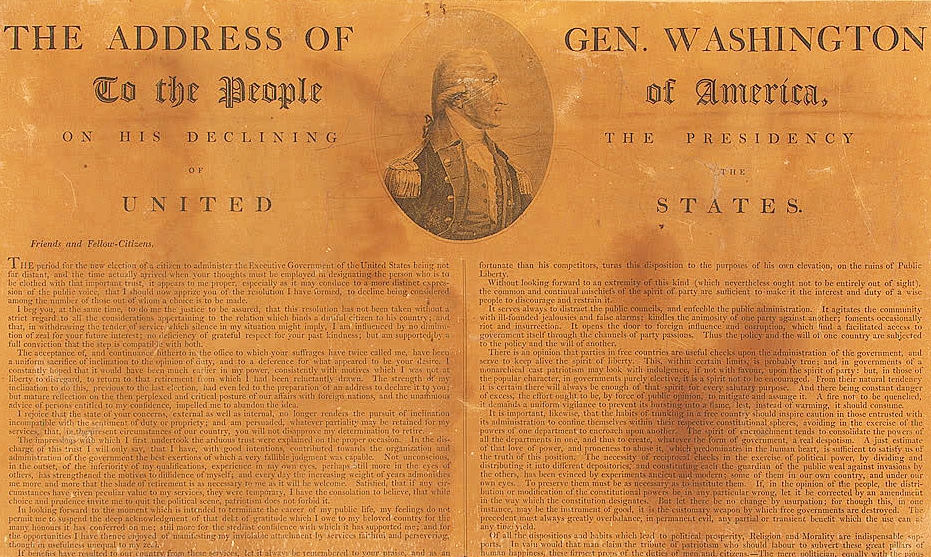
            Seemingly lost to many are the comments from George Washington concerning the understanding of a party-spirit which, for him, was this biblical idea of contentious rivalries which did not have in view the interests of all people.  In George Washington’s 1796 Farewell Address when leaving the presidential office, he sagaciously and prophetically said that political parties:
“are likely, in the course of time and things, to become potent engines, by which cunning, ambitious, and unprincipled men will be enabled to subvert the power of the people and to usurp for themselves the reins of government, destroying afterwards the very engines which have lifted them to unjust dominion….  The alternate domination of one faction over another, sharpened by the spirit of revenge, natural to party dissension, which in different ages and countries has perpetrated the most horrid enormities, is itself a frightful despotism. But this leads at length to a more formal and permanent despotism. The disorders and miseries which result gradually incline the minds of men to seek security and repose in the absolute power of an individual; and sooner or later the chief of some prevailing faction, more able or more fortunate than his competitors, turns this disposition to the purposes of his own elevation, on the ruins of public liberty.”
 
 
Washington went on to say:
“In contemplating the causes which may disturb our Union, it occurs as matter of serious concern that any ground should have been furnished for characterizing parties by geographical discriminations, Northern and Southern, Atlantic and Western; whence designing men may endeavor to excite a belief that there is a real difference of local interests and views. One of the expedients of party to acquire influence within particular districts is to misrepresent the opinions and aims of other districts. You cannot shield yourselves too much against the jealousies and heartburnings which spring from these misrepresentations; they tend to render alien to each other those who ought to be bound together by fraternal affection.”
 
            I’m grinding on this current party-spirit reality because we have gotten to a place in both our political discourse and our church rhetoric where we take opposing parties for granted – as if it’s okay.  It’s not okay, and we need to resist it.  Furthermore, I am in no way advocating for everyone to think and believe the same way.  Monolithic groupthink is only a form of the party-spirit which seeks to conquer all opposing views and corral them under a certain group’s views.
            Its possible to celebrate individual thought, identify yourself with organizations which labor to change a situation, and engage in lively debate with one another without having a party spirit.  What’s not okay is a spirit of rivalry which aims to colonize other people’s minds and strip them of critical thinking skills that either advance a selfish group agenda or push power politics to maintain the powerful at any cost.  God will not contend with this situation forever.
            If one person dominates and determines how a church ministry operates; if one group of families holds power and refuses to listen to others; if two or more groups can be clearly identified as engaging in the power politics of fear; if the aisle down the middle of the church building is symbolic of division; or, if individuals exhibit anger and jealousy when they are not properly recognized in the church; then, there is a party spirit within that church, ministry, or organization which needs to be addressed before the spirit of rivalry destroys the Body.
Working against a party spirit, and establishing a spirit for the common good requires:
·         Leaders naming the factious spirit
·         Calling-out individuals with bad behavior
·         Valuing the voices of others not in power
·         Great courage through trust in God
·         A calming presence from leadership
·         Humility and wisdom
·         Being filled with the Holy Spirit
·         Bearing one another’s (everyone’s) burdens
·         Sharing wealth, stature, recognition, and privilege
·         Not hiding from or ignoring marginal people
The best antidote to a party spirit is to have the heart of servant.  Recovering politics as public service, and reestablishing church ministry as sacred service puts the focus away from bad spirits of sectionalism and sensationalism, placing it squarely on those people who need the services which you have to offer.
“For even the Son of Man [Jesus] did not come to be served, but to serve, and to give his life as a ransom for many.” (Mark 10:45)
 
Groups are not inherently evil.  But if they only look inward as to how they can benefit themselves – and do not look outward to include, help, serve, and uphold others very different from themselves – then there is a “party spirit” which is contrary to Holy Scripture.
            Prayer is always the best place to begin facing down a party spirit.  Only solid spiritual resources can effectively combat bad negative spirits.  Party spirits won’t go away on their own – they must be faced down with the fruit of the Spirit.


            Everyone and every organization must confront party spirits at various times in their existence because its just the nature of living in this fallen world.  What we do when we see them is the critical step….

Psalm 102.12-28

“God will turn to the prayer of the impoverished;
he won’t despise their prayers.”
 
            When you are destitute and hurting, it’s easy to feel alone as if no one really understands.  The healthy, the wealthy, and the powerful do not often take notice of the needy.  Whether you are in chronic pain, constantly deal with sickness, feel like you’re drowning in bills, or labor long hours in obscurity with little pay, or all of them at the same time, there is good news for you: God specializes in situations like yours.
            Contrary to popular characterizations of the Old Testament, God is merciful, gracious, and kind.  The dominant motif is not a God of wrath, but a God of steadfast love – a God who makes and keeps promises to his people.  His wrath is reserved for those who have the power and privilege to care for others, but, instead, fleeces them of what little they possess.
            This was the situation for the psalmist.  He didn’t have a clue why he was the victim – he just knew he needed God.  So, he turns to him – trusting that God is good for his promises – knowing that God will be attentive to his need.
            It’s interesting that we don’t get a wonderful or miraculous answer to the psalmist’s plea to God.  There is only pain, petition, trust, and hope.
            Sometimes, maybe for you oftentimes, all you have is faith, hope, and love.  Yet, and I’m just throwing out a notion for you to consider, if you have these virtues you are the one who is healthy, rich, and strong.
            God is attentive to your prayer.  God hears you when you adopt this psalm for yourself and pray it with some fervor and some flavor.  That he doesn’t immediately respond does not mean he isn’t planning something spectacular for you.
            To pray in a time of trouble is to dwell in the presence of God; to be in the presence of God is to find an answer to prayer that you might not have been looking for to begin with.


O God Almighty, sovereign of all and the One in whom is my hope: Help!  I pray to you alone.  I know you bend your ear to pay attention, so hear my prayer for mercy in the middle of my hardship.  You are always the same, even though everything and everyone else changes.  Be my rock in a time of trouble; in Jesus, through the Spirit.  Amen.

Isaiah 40:21-31 – Resourcing Our Lives

Why do you say, Jacob,
and declare, Israel,
“My way is hidden from the Lord
my God ignores my predicament”?
Don’t you know? Haven’t you heard?
The Lord is the everlasting God,
the creator of the ends of the earth.
He doesn’t grow tired or weary.
His understanding is beyond human reach,
     giving power to the tired
and reviving the exhausted.
 Youths will become tired and weary,
young men will certainly stumble;
     but those who hope in the Lord
will renew their strength;
they will fly up on wings like eagles;
they will run and not be tired;
they will walk and not be weary. (Common English Bible)
 
            Strength, endurance, and perseverance are vital resources which come from a reservoir.  One doesn’t simply will it into reality, and, poof! It is there.  No, these resources must be drawn from a source that is reliable and continual.
            Whenever you and I are persuaded to use an unreliable and/or limited resource, like our own, or some slick marketed one, we are not revived or restored to keep going.  It is in such a time we naively think God is absent.  “God ignores my predicament,” is the cry.
            God isn’t sleeping.  He isn’t out to lunch.  Heis not the problem.  It’s just that we thought we could handle our own junk.  We’ve got this.  Maybe for a while.  But then the strength runs out and weariness overwhelms us.  With no steady reliable resource to draw from, our thinking becomes distorted.
            The sovereign and majestic God is the One who gives power and life.   Placing our hope in Him is to plunge into an inexhaustible and gracious pool of strength.  God enables us to fly and soar above our human predicaments and our daily problems.  With the power God provides we can carry-on and follow-through with the demands, duties, and desires of life on this earth which God created for us.
            To draw from the deep well of God, it is extremely necessary to meet with Him on a regular and consistent basis.  If food and drink for the body requires multiple daily attention and time, then filling the soul is just as, even more, important.
            This need for spiritual food and drink is why I choose to engage in the Divine Hours, also known as the Daily Office, or Fixed Hour Prayer.  At certain set times in the day I break away from what I’m doing to give attention to the soul by drawing from the merciful resources of God.  This may be for you a fresh way to address your parched and needy soul.
Here is a link to the Divine Hours, based on the book of prayers compiled by Phyllis Tickle:


Set me free, O God, from the bondage of my sins, and give me the liberty of that abundant life which you have made known to me in your Son our Savior Jesus Christ; who lives and reigns with you and the Holy Spirit, one God, now and forever. Amen