1 Samuel 15:10-31

“Does the LORD really want sacrifices and offerings? No! He doesn’t want your sacrifices.  He wants you to obey him” (verse 22), so said Samuel to King Saul.
God had given Saul explicit instructions on how to handle a group of people called the Amalekites.  Saul obeyed… some of the instructions, but not all of them.  He rationalized his behavior as worship.  But God would have none of it.  The Lord rejected Saul as king; He wanted no monkey business when it comes to obedience.
            I’d like to think I’m not like Saul.  But I sat a bit with this verse, and realized I sometimes do the same thing:
·         Whenever I say I’ll do something and then get busy and not do it, I sometimes rationalize my lack of follow through by explaining what good things I was doing with my time instead.
·         I sometimes justify a purchase of something I don’t really need but want with the excuse to God that I put a lot of money in the offering plate for Him.
·         Occasionally slandering another person, even though it is forbidden by God, with the knucklehead notion that I’m protecting and helping others from that person’s evil ways.
·         I sometimes keep quiet in the face of a bad situation when I should be speaking up, and dismiss the lack of engagement and involvement with the fact that I need to save my energy for people who want it….
I got too convicted to keep thinking about it anymore, but I could have kept going. *Sigh*
            Before we get too uppity about saying we are not like Saul and would never be like him, perhaps we ought to sit with this story and this verse of Holy Scripture for awhile and allow a mindfulness of any unacknowledged disobedience.
            Rationalization is the way of sinners.  Repentance is the path of saints.  Which road will you choose today?


Holy God, you expect obedience to clear instructions.  I’m sorry for all those times I’ve found creative ways to circumvent your teaching.  Help me not to avoid your good commands, but to own them with vigor and vitality through Jesus Christ my Lord in the power of your Holy Spirit.  Amen.

Psalm 86

            What is your view of God?  For some, God is up there, somewhere, like some white-bearded old guy who is aloof to what is going on down here – there is neither anything personal nor personable about him, at all.  For others, God is a force which binds all things together; he’s there, but you’re never quite sure how to get in touch with him – it’s like a crap shoot trying to connect with him.  For yet others, God is perpetually perturbed about something; he’s got a bee in his bonnet and its our job to figure out what he’s sullen and upset about all the time so that we might appease him in some way.
            But the psalmist, David, sees God in wholly other ways than this.  For David, God is personal, knowable, and very reachable.  Reading this psalm tells us a great deal of how David thought about God.  Notice what we learn about God from the way David describes him: “You willingly forgive,” “your love is always there,” “you listen,” “you perform great wonders,” “you protect me,” “you are kind and merciful,” you don’t easily get angry,” and “you help and comfort me.”
            Now this is a God you can sink your teeth into.  He’s attentive, engaged, and anything but upset all the time.  This is the reason why David has no problem asking God to: “please listen and answer my prayer,” “save me,” “make my heart glad,” and “teach me to follow you.”  With this God, David willingly states without being coerced: “I will serve you.”
            If your view of God cannot support and bear the weight of your life’s hardest circumstances, then you need a different view of God! I invite you to see the God of David.  This God has the ability within himself to satisfy your life’s greatest needs.


Great God of David, you are above all things and beside all things and with all things.  You are uniquely positioned and powerful to walk with me through all the situations of my life.  Thank you for sending the Son of David to make real your promises to me.  Amen.

MLK & CJ

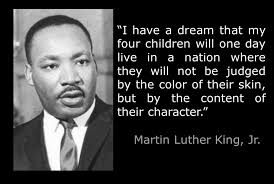
MLK

Yes, it’s once again Martin Luther King Day.  It also happens to be my middle daughter Charissa’s birthday.  I often call her “CJ.”  Today I’ve been thinking about the two of them.  From the outside looking in there doesn’t seem to be much similarity.  But the two of them are interconnected in ways that I believe honor the hope and vision of each.

CJ is a lily-white girl (okay, she’s 28 years old today and a woman, but, hey, I’m her Dad) who gets a sunburn from just thinking about sunshine.  She’s clearly got my Northern European stock.  CJ is also a teacher, and a darned good one.  I admit my chest swells a bit thinking about the kind of impact she has in her school.  She’s not famous in the world.  But, she’s famous to me.  I’m a big fan.

Dr. King was an African-American preacher who left his indelible print on our nation.  His courage and agitation for a better world is encapsulated in his picking up the vision of the Old Testament prophet Amos – to see justice roll down for all people.  His “I Have a Dream” speech resonates deeply with me and for many people not only in this nation but around the world.

Only from the outside looking in do these two people look so dissimilar.  Yet, a closer inspection reveals a connection worth noting.  You see, CJ teaches in an inner-city school.  Only the outsider would look at this as a white teacher in a black school.  But in the school, CJ is just a teacher and the students just students.  This is exactly where CJ wants to be – her dream job is not in the suburbs – it’s right where she is.

I can’t help but think today about the fact that this is just what Dr. King envisioned: White and black together, not distinguished by their color but viewing one another by the content of their character.  CJ is not shaping and forming African-American children near as much as she is teaching and building into the lives of precious people created in the image and likeness of God, just like her.  These students love her, not because they aspire to be white or see her that way, but because she loves them and is faithful to do whatever she can to further their education.

So, today is a celebration.  For me, it’s a celebration of seeing two people, from very different backgrounds, from different generations, and from different cultures meet in a similar vision that is being realized each day in a non-descript school in Midwest America.  And it is this kind of current reality that transcends politics and religion and is the real hope for a new day for all Americans.

The Way to Harmony


“When we bless the cup at the Lord’s Table, aren’t we sharing in the blood of Christ? And when we break the bread, aren’t we sharing in the body of Christ?  And though we are many, we all eat from one loaf of bread, showing that we are one body.” –1 Corinthians 10:16-17
 
            Imagine waking up in the morning eager to go to work.  The harmony between you and your co-workers makes for a happy work environment.  The challenges of accomplishing tasks are easy because you have a supportive boss.  The sales team communicates with you and your colleagues so that production happens with a seamless co-operation.  Lunch-time talk is discussing one another’s families and your hopes for the upcoming evening with them.
            Imagine going home and enjoying conversation around the dinner table with your loved ones.  Laughter, inside-jokes, hilarious stories about the day’s antics are shared with great food and great fun.  Everyone lingers at the table, enjoying the time and staying in their chairs to put a puzzle together.
            Imagine getting out of bed on Sunday morning with joyful anticipation in your heart of worshiping God with people of like mind.  You know the interaction with fellow believers in Jesus will be open, honest, sweet, and full of grace.  The wonderful relationships between God and people will be celebrated at the Lord’s Table….
            It could be that somewhere in those descriptions you pursed your lips with a “ppfffff” – like that’s gonna happen!”  That’s because you feel drained from the lunch-time gossip gab session at work; you couldn’t wait to finish supper at home because of the bickering between your kids at the table; and, you drag yourself out of bed on Sunday out of duty, knowing that the Lord’s Table will be just another ritual to do with people who don’t talk to each other across the divided aisle.
            There is someone who understood this reality first-hand, and knew that it really could be different – it could be a new reality that fulfills, even exceeds your imagination of harmony and unity.
The Apostle Paul wrote a letter to the 1st-century Corinthian church to emphasize that the work of Jesus on the cross effected what we call “reconciliation” between God and people, and between each other as people.  This means that God, in Christ, has restored relations between us and God, and between one another.  The relations between the Corinthian believers had broken down into special interest groups, and there was no interaction or fellowship or participation between those various factions.  People basically just hung out with others who thought just like them, and did not care about what other people in the church thought; each group wanted their own way, and they had not yet learned how to work together and have true unity and fellowship with each other.
Participation in Christ, and participation with each other is the result of the reconciliation that has been applied to us because of the cross; and, it is this reconciliation that brings unity or one-ness to your church, to your workplace, and to your family, allowing you to work together and play well with others.  So, when we come to the Lord’s Table, it is this truth that we celebrate, enjoy, and re-create together.
            Jesus is not just someone we remember, but someone we participate in through the Lord’s Table.  Sharing the Table together brings healing and forgiveness, and builds up our faith so that we might joyfully live in the reconciliation that Christ has brought us.
            Therefore, we must live up to what we possess – our participation in Christ results in participation and fellowship and unity with each other.  Since we are forgiven, we work at being harmonious at church, at work, and at home.  This is symbolized by partaking of the same loaf of bread, and drinking from a common cup.


            Peace, harmony, unity, and fellowship begins with Jesus Christ.  Workplace enjoyment will happen with an intentional development of encouraging language on your part, based in your participation with Jesus.  Family harmony will come when you seek to live into the reconciliation bought for you with Christ’s body and blood.  Church unity will exist when you make things right between you and God, and you and others with the cross always at the forefront of your mind and heart.