Psalm 62:5-12

            The Old Testament book of Psalms is the church’s prayer book.  Each psalm has been carefully crafted and designed for repeated prayers by the faithful.  Today’s psalm needs no comment.  Read it slowly and deliberately as many times as you need, allowing the words to wash over you and fill you with the grace and peace which can only come from God alone:
Only God gives inward peace,
and I depend on him.
God alone is the mighty rock
that keeps me safe,
and he is the fortress
where I feel secure.
God saves me and honors me.
He is that mighty rock
where I find safety.
Trust God, my friends,
and always tell him
each one of your concerns.
God is our place of safety.
We humans are only a breath;
none of us are truly great.
All of us together weigh less
than a puff of air.
Don’t trust in violence
or depend on dishonesty
or rely on great wealth.
I heard God say two things:
“I am powerful,
     and I am very kind.”
The Lord rewards each of us
according to what we do.
(Contemporary English Version)


Amen, and amen.

On the Need for Humility

Univeristy College Student Lifestyle

One of the reasons I like being around millennials and college students is that they have a very well attuned BS barometer.  Unlike children, and unlike more mature adults, this group of people live in a nexus between an emerging awareness of the world without having yet been crusted over with bitterness or disillusionment.  They can spot a disingenuous person across the room like an eagle eyes the difference between a fish and a rock at 5,000 feet in the air.

You know the experience.  You might not be able to explain why, but you’ve had the encounter with the person who seems off, just a bit contrived and manipulative in his speech or behavior.  He/she might talk a good line, but your instincts tell you different.

One of the things that is difficult for many people is that life isn’t about learning a certain skill set, as if life is like a trade school.  The skills approach simply thinks that you learn to say certain things, do certain things, and press certain buttons in others and you will get a solid expected outcome.  That kind of approach is where the BS meter goes off in others.  They sense that this person talking to them is not bringing anything of themselves to the discussion; they’re just talking without listening; they just go on without a sense of dialogue in which they learn from you or reveal anything of themselves to you.

I truly believe that the virtue of humility is so very important and necessary.  Without humility, there is no sense of the majesty and dignity of the other person.  Without humility, there is only competition – I conquer, and you are the conquered.  Without humility, life is a trade school in learning to get what I want on the backs of others.

But with humility, who I am as a person matters.  I bring my feelings, my thoughts, my beliefs, my experiences, and my questions into the conversation or situation and seek to, in turn, discover what you think and feel.  Then, together, we come to a third way of seeing that honors our collective sharing.  That isn’t a skill set; its just being a good human being.

The trade school approach wants to know how one becomes humble.  However, humility is a posture, not a skill.  It is taking a position of learning, growth and development.  It is to sit with uncertainty and mystery so that genuine relationship has a real go at happening.  Humility is much more sitting on the floor at Jesus’ feet and discovering something about yourself, God, and the interaction between each.
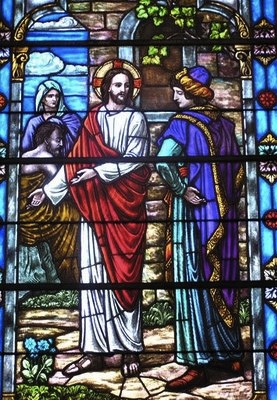
rich young ruler

The rich young ruler wanted a clear, concise, and certain answer to his question: “Good teacher, what can I do to have eternal life?” In-other-words: “What skill set do I need that I don’t already have to get eternal life?” Wrong question.  Jesus didn’t even begin to touch it because he had the most attuned BS meter ever in history.

Jesus asked his own question: “Why do you call me good?”  That question was way off from what the rich young ruler wanted or expected.  But the question was meant by Jesus to evoke a sense of humility that would lead to discovery and trust of God.  Jesus finally got around to telling the man what he needed to do: “Go sell everything you own. Give the money to the poor… Then come and follow me.” (Mark 10:17-27)

The humble emptying of oneself is necessary in awakening to a new awareness that God is with you.  It may not mean that you give everything you own away, but it will mean coming face to face with yourself.  It will mean exploring God.  It will mean living in the awkward in-between of assurance and uncertainty, being loved but not knowing where that love will take you, and following Jesus without a pre-negotiated plan.

You can’t BS your way through the Christian life.  You need the posture of humility.  Jesus will be your Teacher, but you will need to bring yourself to the mix because Christianity is not dispassionately taking notes and then forensically regurgitating it all on an exam.  Instead, Christianity is a dynamic spiritual encounter between you and God through the person of Jesus.  It begins with humility.

Genesis 16

            I’m blind as a bat without my glasses.  They’re the first thing I put on when waking in the morning, and the last thing I take off before retiring at night.  Without them I can’t distinguish anything well.  I can’t see others unless they are inches from my face.
            As bad as it would be if I didn’t have my glasses, it would be even worse if you were not seen by anyone.  I believe that one of the great tragedies of modern Western civilization is that we can live among so many other people, yet not be seen by so many of them.  The loneliness of not being seen is a terrible situation.
            The ancient woman, Hagar, certainly felt that way.  She felt an even worse circumstance: Hagar neither believed that anyone saw her and cared, nor that God saw her at all.  It was as if God lost his glasses somewhere.
            In a convoluted series of decisions, mostly outside of her control, Hagar became pregnant with Abraham’s son.  Then, Sarah, Abraham’s “real” wife got pregnant with another son.  It got complicated.  Dysfunction was all around, leaving Hagar and her young son out in the wilderness all by themselves with no one to help.  Hagar simply expected the two of them to die.
            You can feel Hagar’s despair and desperation.  She saw no hope, and nobody saw her… but there was someone watching: God.  He saw everything that happened to her – all the craziness, and all the mistreatment – and he stepped-in and acted on behalf of Hagar and her son.
            As a result, Hagar began to call God, “The God Who Sees Me.” She never again had to wonder or doubt whether she was seen.
            You might feel today that God doesn’t see your pain, is aloof and distant from your hurt, and is blind to your deep wounds.  But he sees.  He sees it all, everything.  God may not be working on the same timetable as you and me, but nevertheless he sees you.  You never have to wonder about it.


God of Hagar, just as you saw her in the desert and the desperate position she was in, so I ask that would see me and act according to your great mercy; through Jesus Christ, my Savior, with the Holy Spirit.  Amen.

Do One Thing Well


            I was watching the BBC series Planet Earth II last night.  There’s nothing quite like the soothing British tone of David Attenborough talking to you about the wonders of our planet.  In the first episode, the sloth… was on… and he… moved… really… slow.  That’s what sloths do.  They move slow.  But that’s okay.  They just move up and down mango trees… at a really sloooow pace… and eat mango leaves.  Turns out they put their giddy-up on a bit when its mating time, but, other than that, they just focus on their mango tree existence.
 
            What struck me about watching Slow Poke Sloth was the fact that he didn’t care he was slow (he did want to get to that lady sloth quicker, but, hey, there’s joy in the anticipation).  He wasn’t wishing he were a jaguar racing across the savannah.  He did one thing.  He did that one thing really well.
 
            It sometimes amazes me how we humans, in contrast to the sloth, keep trying to be all things to all people.  We hurry and scurry and fret and worry and strive and connive and go as fast as we can to get where we’re going, sometimes not even knowing where it is we’re headed.
 
            When it comes to church ministry, even our own individual Christian lives, it also amazes me how much we try to do everything under the sun – as if we were meant to be every creature on the planet.  I have often heard small churches lament that they’re not bigger.  The implication is that if they had more people in the pews, then they could really do a lot of things, offer more ministries.  Yet, even the megachurch doesn’t do everything well.  Truth be told, the trend for big churches is finding ways to be smaller – which is why the multi-site movement is prevalent today.  The big guy has found that doing pastoral and spiritual care is difficult with such size.
 
            I think we need to take a lesson from Mr. Sloth.  He moves slow, but with single-minded purpose.  If you look at Jesus in the Gospels, he was never in a hurry to get anything done.  He moved at his own pace, not deterred or influenced by others trying to get him to go faster or do something he didn’t want or need to do.  When our Lord looked at the state of people concerned about what was going to happen, he told them to do… one… thing… well. 
 
“Don’t worry and ask yourselves, ‘Will we have anything to drink?  Will we have anything to drink?  Will we have any clothes to wear?’ Only people who don’t know God are always worrying about such things.  Your Father in heaven knows that you need all of these….  
 
“But more than anything else, put God’s work first and do what he wants.  Then the other things will be yours as well.” (Matthew 6:31-33)
 
            The singular question for each Christian, every church, and all denominations and ministry groups is: “What does God want?”  The question is not: “What is that other church doing?” “What will make this group of people happy?” “What is everyone else doing?”  Nope.  What… does… God… want?  What does it mean to put God and his work first?  Now we’re talking – that’s the kind of discussion to have in an elders’ meeting.  It’s the kind of inner dialogue that needs to happen in your heart.


            Mango leaves are not you’re thing.  But going hard after the kingdom of God and his righteousness is to be your one passionate pursuit.  If you will do this one thing, then all the other stuff will fall into place.  That’s not David Attenborough talking – its Jesus.
